

Small Clinics
Operational and Clinical Guide to Hemodialysis Blood Tubing Sets
A detailed clinical and operational guide for procurement managers on evaluating vital hemodialysis blood tubing sets, covering components, safety, and compatibility.


In any high-performing dialysis unit, the focus is often on the dialyzer and the dialysis machine itself. However, the integrity of the entire extracorporeal circuit hinges on a component that is just as critical: the hemodialysis blood tubing set. This is not merely a passive conduit for blood; it is an active, vital interface between the patient and the machine, directly impacting treatment efficacy, patient safety, and operational efficiency. Understanding the nuances of a vital hemodialysis blood tubing set is essential for any procurement head or senior clinician responsible for unit outcomes.
This guide moves beyond surface-level specifications to provide a peer-to-peer breakdown of what truly matters in the selection and daily use of these essential disposables. We will cover component anatomy, critical evaluation criteria, and operational best practices from a clinical standpoint.
Anatomy of a Hemodialysis Blood Tubing Set
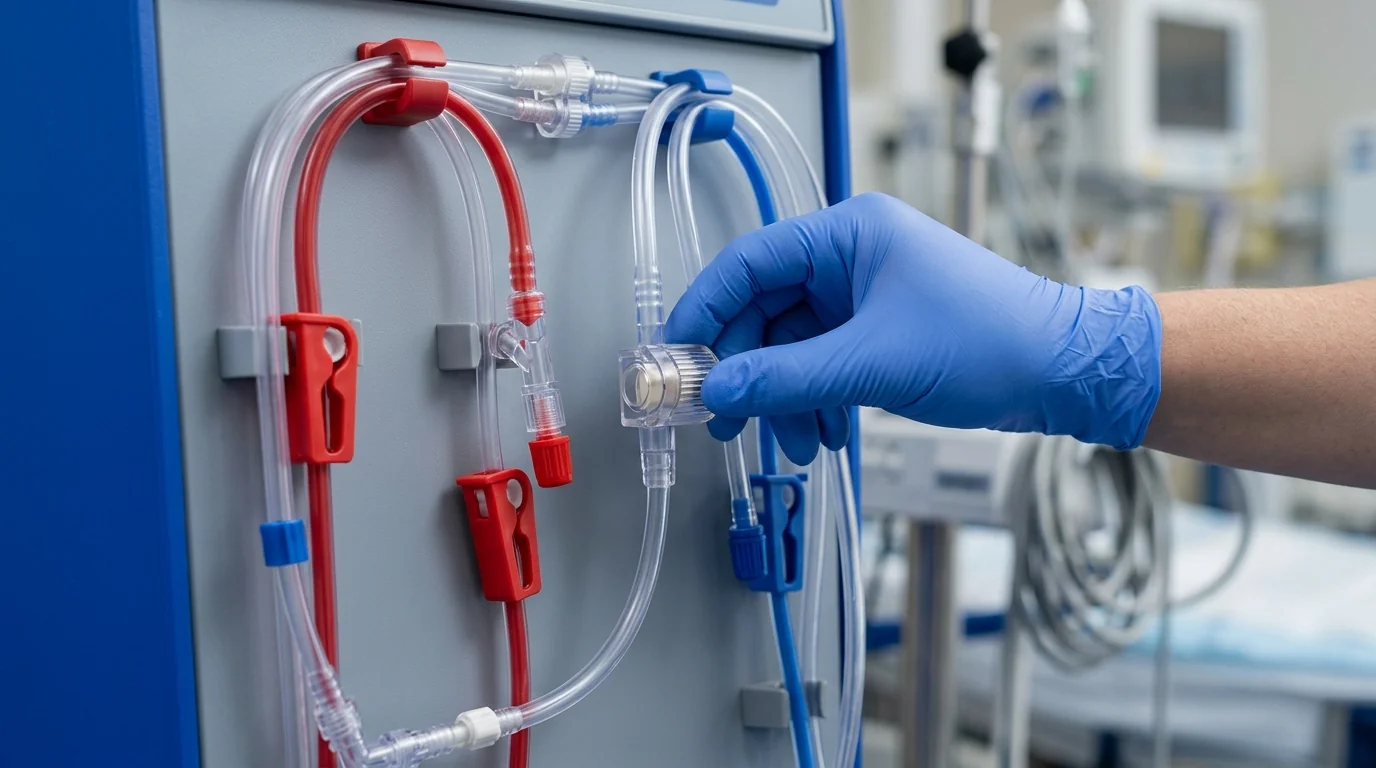 A standard hemodialysis blood tubing set is comprised of two primary lines—arterial and venous—each with specific components engineered for a distinct function within the extracorporeal circuit.
-
Arterial Line: This is the segment that draws blood from the patient's vascular access to the dialyzer.
- Patient Connector: Securely connects to the arterial access needle or catheter.
- Pre-Pump Segment: A clear, non-kinking tube that allows for visual inspection of blood flow.
- Pump Segment: A highly durable, flexible, and resilient section designed to withstand the repeated compression of the machine's peristaltic blood pump. Its diameter and durometry (hardness) are critical for accurate blood flow rates.
- Heparin Infusion Line: A small-bore line for the continuous administration of anticoagulant to prevent clotting in the circuit.
- Pressure Monitoring Port: Allows the machine to monitor pre-pump arterial pressure, an indicator of access flow.
-
Venous Line: This segment returns the dialyzed blood from the dialyzer back to the patient.
- Venous Drip Chamber: A crucial safety feature designed to trap any air that may have entered the system, preventing air embolism. It also serves as a site for monitoring venous pressure.
- Venous Pressure Monitoring Port: Connects to the machine to monitor the pressure required to return blood to the patient, which can indicate issues with the venous access.
- Patient Connector: Connects to the venous access needle or catheter to complete the circuit.
-
Ancillary Components:
- Transducer Protectors: Hydrophobic filters fitted to the pressure monitoring lines. They prevent blood or saline from contaminating the internal pressure transducers of the dialysis machine, a critical infection control measure.
- Clamps: Slide or roller clamps are positioned at various points for flow control during setup, priming, and discontinuation of treatment.
- Priming Recirculator: A connector that links the arterial and venous patient ends, allowing for a closed-loop recirculation of saline during the priming process.
Key Evaluation Criteria for Procurement and Clinical Use
Selecting the right tubing set goes far beyond a simple line-item comparison. It requires a detailed assessment of compatibility, material science, and regulatory adherence.
1. Machine Compatibility This is the non-negotiable first step. Tubing sets are not universally interchangeable. The pump segment diameter, cassette design (if any), and connector types are specifically designed for certain dialysis machine models (e.g., from manufacturers like Fresenius, B. Braun, Nipro). Using an incompatible set can lead to inaccurate blood flow, alarm fatigue, and potential damage to the blood pump. When evaluating options like a vital hemodialysis blood tubing set, compatibility with your existing machines is the first checkpoint.
2. Material Biocompatibility and Safety The material that is in direct contact with the patient's blood for hours must be inert and safe.
- Medical-Grade PVC: The industry standard due to its flexibility, clarity, and kink resistance.
- DEHP-Free Options: Di(2-ethylhexyl) phthalate (DEHP) is a plasticizer used to make PVC flexible. Concerns about its potential for leaching have led to the development of DEHP-free alternatives (often using TOTM or DEHT as plasticizers). These are particularly important for vulnerable populations such as paediatric patients and women of child-bearing age.
- Latex-Free: All patient-contact components, especially injection ports, should be latex-free to prevent severe allergic reactions in sensitized patients and staff.
- Biocompatibility Standards: Look for compliance with ISO 10993 standards, which confirms the material has been tested for cytotoxicity, sensitization, and other adverse biological responses.
3. Sterilisation Method The method used to sterilize the tubing set can impact its material integrity and safety.
- Ethylene Oxide (EtO): A common method, but requires rigorous post-sterilisation aeration to remove residual gas, which can be toxic.
- Gamma Irradiation: Effective but can cause some plastics to become brittle or discoloured over time.
- Electron Beam (E-beam): A form of ionizing radiation that offers rapid sterilization with less material degradation compared to gamma.
4. Manufacturing and Regulatory Compliance A reliable indicator of quality is the manufacturer's adherence to established standards. Sourcing from suppliers who provide products manufactured in an ISO 13485 certified facility is a baseline requirement. A CE mark indicates conformity with European health and safety standards and is a strong quality signal.
Operational Best Practices for Tubing Set Handling
The quality of a tubing set is only realised through meticulous handling by the clinical team.
Pre-Procedure Inspection: Before use, every set must be inspected.
- Check for damage to the sterile packaging.
- Verify the expiry date.
- Visually inspect the set through the clear packaging for any defects, kinks, or foreign particles.
Aseptic Priming Protocol: This is one of the most critical steps for patient safety. The goal is to completely flush the circuit with sterile saline to remove all air and any residual sterilant particles. Standard protocol involves a thorough rinse and recirculation process as per your unit's standard operating procedures (SOPs), ensuring every part of the circuit, including transducer lines, is properly primed. Ensuring your team has a reliable supply of appropriate blood tubing sets and other consumables is the foundation of a safe unit.
Secure Connections: All Luer-lock connections must be firmly secured with a "push and twist" motion to prevent accidental disconnection and blood loss. A final check of all connections before initiating treatment is mandatory.
Post-Procedure Disposal: Used blood tubing sets are considered infectious biomedical waste. They must be disposed of carefully in designated, leak-proof, colour-coded bags (typically yellow in India) according to the facility's infection control policy and national Bio-Medical Waste Management Rules.
The Tubing Set's Role in Patient Safety and Efficacy
Every feature of a well-designed tubing set contributes directly to better patient outcomes. The clarity of the tubing allows for early detection of clots. The integrity of the pump segment ensures the prescribed blood flow is delivered accurately, maximizing urea clearance. The drip chamber is the primary defence against air embolism. The performance of these tubing sets is a key component in the broader field of Nephrology care, directly influencing both patient safety and the long-term success of renal replacement therapy.
A failure in any of these components does not just cause an alarm; it represents a direct risk to the patient and a disruption to the unit's workflow. Therefore, treating the procurement of these disposables with the same rigour as capital equipment is not just good practice—it's essential.
Equip Your Facility Today
Ensuring your dialysis unit is equipped with high-quality, compatible, and safe disposables is fundamental to delivering superior patient care. A methodical approach to evaluating and sourcing your hemodialysis blood tubing sets protects your patients, supports your clinical team, and enhances the operational reliability of your entire department. For a comprehensive range of nephrology supplies tailored for clinical facilities, explore the options available on MedikaBazaar.
FAQs

