

Hospitals
Malaria Rapid Test Guide: How to Use, Read & Interpret Test Results
Learn how to read a malaria test kit, how to use a malaria test kit, understand malaria test tube color, and interpret rapid diagnostic test results.


Malaria is a mosquito-borne disease caused by parasites of the Plasmodium species. Early testing can help healthcare professionals identify malaria infection and make appropriate clinical decisions.
A rapid diagnostic test for malaria (RDT) is a convenient diagnostic tool that detects specific malaria parasite antigens in a blood sample. These tests can provide results quickly and are particularly useful where laboratory microscopy is unavailable or limited.
Different malaria test kits can detect different malaria species and use different test-line labels. Therefore, the exact procedure and result interpretation should always be based on the manufacturer's instructions for the specific kit.
What Is a Rapid Diagnostic Test for Malaria?
A rapid diagnostic test for malaria is a blood-based test used to detect antigens produced by malaria parasites.
Most malaria RDTs use lateral-flow immunoassay technology. When a blood sample is added to the test device along with the required buffer, the sample moves through a test strip. If the relevant malaria antigen is present, it reacts with specific antibodies and produces a visible test line.
A separate control line (C) indicates that the test has worked correctly.
Depending on the product, an RDT may detect:
- Plasmodium falciparum
- Plasmodium vivax
- Other Plasmodium species
- More than one malaria antigen or species
For this reason, users should always check the result guide supplied with the particular malaria test kit.
For a range of malaria testing products, you can explore Malaria Rapid Test Kits.
What Is Included in a Malaria Test Kit?
A typical malaria test kit may contain some or all of the following:
- Test cassette or test card
- Sterile lancet for blood collection
- Capillary tube, loop, dropper or pipette
- Assay buffer
- Alcohol swab
- Desiccant
- Instructions for use
The exact components can vary between manufacturers and products.
Before using a kit, check the packaging, expiry date, storage conditions and manufacturer's instructions.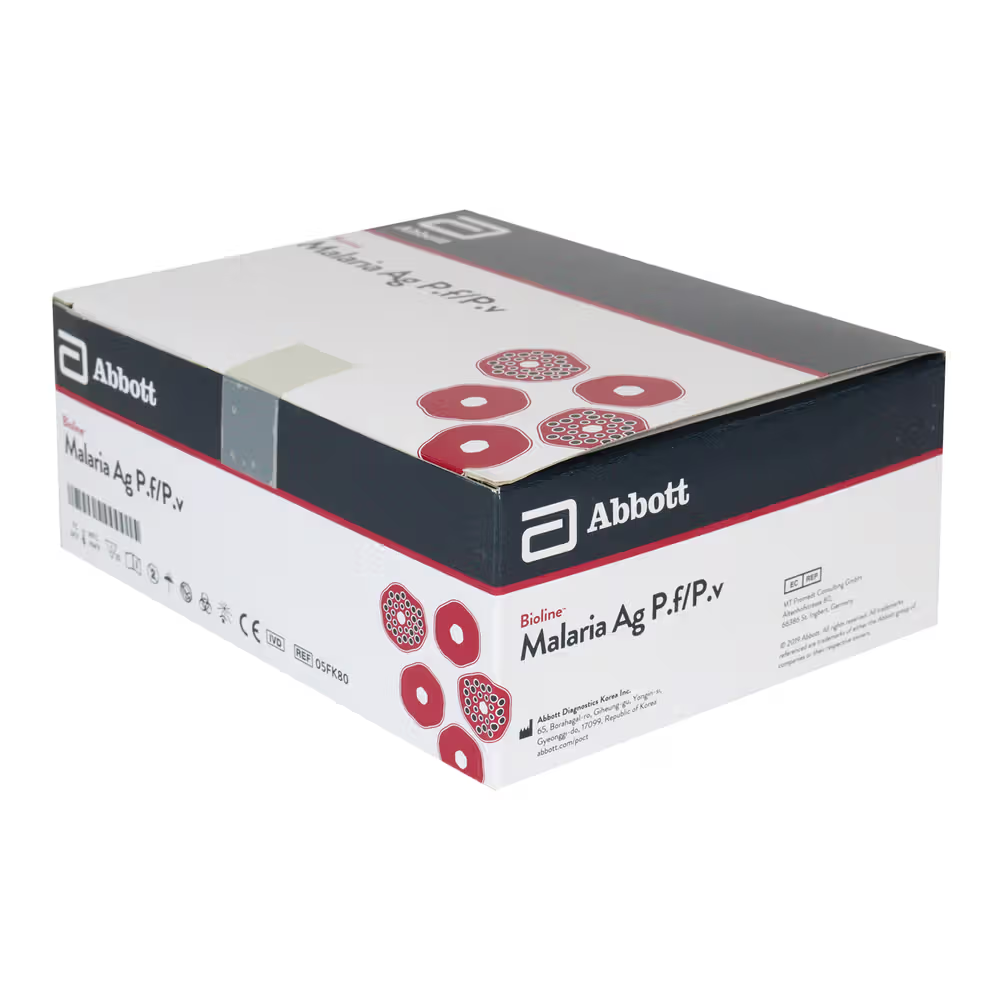
How to Use a Malaria Test Kit
If you are looking for how to use a malaria test kit, it is important to understand that the procedure can vary between products. Always follow the instructions supplied with the specific kit.
The general process for a malaria rapid test includes the following steps.
1. Check the Test Kit Before Use
Before starting:
- Check the expiry date.
- Make sure the package is intact.
- Check that the test has been stored according to the manufacturer's recommendations.
- Bring the test components and sample to the required temperature, if specified.
- Read the instructions supplied with the kit.
Do not use a test cassette or card if the packaging is damaged or the manufacturer states that the device should not be used.
2. Prepare the Blood Sample
Malaria RDTs generally use a blood sample. Depending on the product, this may be obtained through a finger prick or collected as venous whole blood.
For finger-prick testing, use appropriate hand hygiene, gloves and a sterile lancet.
Allow an adequate blood drop to form without excessively squeezing the finger, as excessive squeezing can affect sample collection.
3. Add the Blood Sample
Transfer the required amount of blood to the sample well or area indicated on the test device.
The required sample volume can differ between malaria test kits. Use the supplied capillary tube, dropper, pipette or other collection device specified by the manufacturer.
Avoid introducing air bubbles or using an incorrect sample volume.
4. Add the Test Buffer
Add the required amount of assay buffer to the appropriate buffer well or sample area.
The number of drops and application method can vary between products, so do not assume that the same number of drops applies to every malaria test kit.
5. Wait for the Specified Time
Allow the test to develop for the time specified in the manufacturer's instructions.
Do not interpret the test too early or substantially later than the recommended reading time. Reading a test outside the specified time window can result in incorrect interpretation.
How to Read a Malaria Test Kit
One of the most common questions about malaria RDTs is how to read a malaria test kit.
The first step is to check the control line (C). If the control line does not appear, the test is generally considered invalid and should not be interpreted as positive or negative. If the control line is visible, check the test area for the specific test lines indicated in the manufacturer's instructions.
Common Malaria Test Results
The exact result pattern depends on the test. A typical malaria RDT may show the following:
| Lines visible | General interpretation |
| C only | No target malaria antigen detected by the test |
| C + Pf | P. falciparum target detected |
| C + Pv | P. vivax target detected |
| C + Pf + Pv | Possible mixed detection, depending on the test |
| No C line | Invalid test |
Important: This table is an example of a Pf/Pv test format. It should not be applied to every malaria RDT because different manufacturers use different test-line labels and may detect different antigens or species.
Always compare the result with the interpretation guide supplied with the specific malaria test kit.
Negative or Non-Reactive Result
If the control line is visible but the relevant test line is absent, the result may be reported as negative or non-reactive for the malaria target detected by that particular test.
A non-reactive result should be interpreted in the context of the patient's symptoms and clinical assessment. If malaria is still suspected, healthcare professionals may recommend further testing according to applicable clinical guidelines.
Positive or Reactive Result
If the control line and one or more relevant test lines appear, the result may be positive or reactive for the malaria antigen targeted by the test.
The specific line pattern should be checked against the manufacturer's result guide.
A reactive RDT result should be managed according to appropriate clinical and laboratory guidance.
Invalid Malaria Test Result
If the control line (C) does not appear, the test is generally considered invalid.
An invalid result should not be interpreted as positive or negative.
Repeat the test using a new test device and follow the manufacturer's instructions.
What Does a Faint Line on a Malaria Test Mean?
A faint test line can sometimes be difficult to interpret.
A faint line should not automatically be considered negative. The correct interpretation depends on the specific test kit and its manufacturer's instructions.
If a faint or unclear line appears, follow the manufacturer's guidance. Depending on the product and clinical situation, repeat testing or confirmation through an appropriate laboratory method may be required.
Malaria Test Tube Color: Which Tube Is Used?
Malaria test tube color is a common search query, but there is no single universal tube color for every malaria test.
The appropriate blood collection tube depends on:
- The type of blood sample required
- The test manufacturer's instructions
- The anticoagulant or additive used
- The laboratory's blood collection system
For example, some malaria RDTs can use whole blood collected with specific anticoagulants such as EDTA, citrate or heparin. However, the tube should be selected based on the requirements of the particular test rather than relying only on its color.
Tube colors can vary between manufacturers and laboratory systems. Therefore, healthcare professionals should check the tube label, additive and applicable laboratory procedures.
Sample Collection Techniques for Malaria RDT
Proper sample collection is important for reliable malaria RDT results.
Healthcare professionals or trained users should:
- Perform appropriate hand hygiene.
- Wear suitable protective equipment.
- Use a sterile lancet for finger-prick collection.
- Allow a suitable blood drop to form.
- Avoid excessive squeezing of the finger.
- Collect the required volume of blood.
- Use the collection device supplied or recommended by the manufacturer.
- Avoid air bubbles where applicable.
- Dispose of used lancets and other sharps in an appropriate sharps container.
The exact sample volume and collection method vary between malaria test kits.
Quality Control When Using a Malaria Test Kit
Before and during testing, healthcare professionals should check:
- The test kit expiry date
- Package and test-card integrity
- Recommended storage conditions
- Required sample type
- Required sample volume
- Correct buffer and number of drops
- Recommended reading time
- Presence of the control line
- Correct result interpretation
Any invalid, unclear or inconsistent result should be handled according to the manufacturer's instructions and applicable clinical procedures.
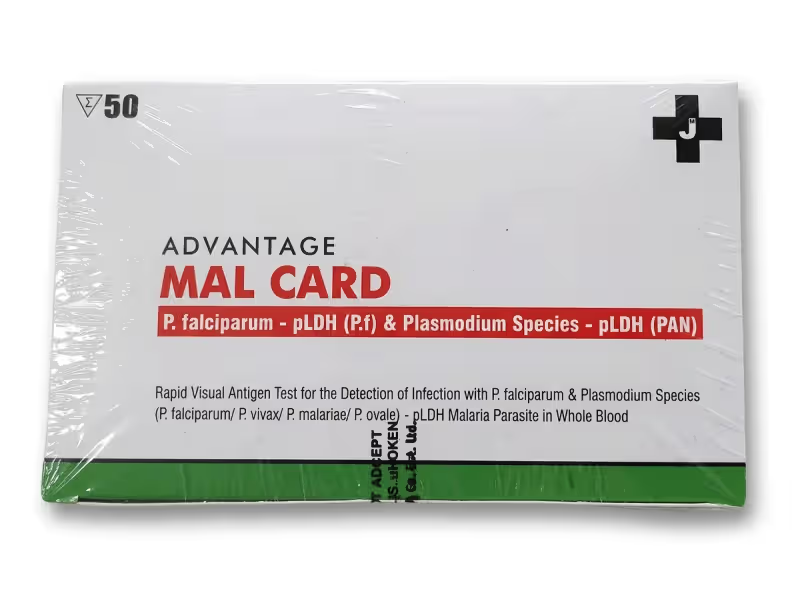
J Mitra Advantage Mal Card Test Kit
The J Mitra Advantage Mal Card is a rapid malaria antigen test designed for qualitative detection of malaria antigens in human whole blood.
According to the manufacturer's instructions, the test is intended for professional use by a competent person.
For this specific product, the manufacturer's instructions specify:
- Human whole blood as the sample
- 4 µL of blood
- 3 drops of assay buffer
- Result reading at 20 minutes
The product uses test lines associated with P. falciparum and Pan-Plasmodium detection. Because the exact interpretation is product-specific, users should follow the J Mitra instructions supplied with the kit.
Why Choose Malaria Rapid Diagnostic Tests?
Malaria RDTs can be useful when a quick parasite-based test is required.
Some key advantages include:
- Quick visual results
- Simple test format
- Minimal equipment requirements
- Useful where microscopy facilities are limited
- Can support timely clinical decision-making
- Available in different formats for different malaria targets
However, performance and detection capability vary between products. A malaria RDT should therefore be selected and used according to the intended application, manufacturer's instructions and applicable clinical guidelines.
Bulk Procurement of Malaria Test Kits
Healthcare facilities, hospitals, diagnostic laboratories and clinics may require malaria test kits in larger quantities.
Bulk procurement can help organizations:
- Maintain adequate inventory
- Reduce the frequency of individual orders
- Simplify stock management
- Support uninterrupted testing workflows
- Plan medical-supply budgets more effectively
When purchasing malaria RDTs in bulk, organizations should consider the product's intended use, test type, pack size, expiry period, storage requirements and manufacturer instructions.
Final Takeaway
Knowing how to use a malaria test kit and how to read a malaria test kit correctly is important for obtaining and interpreting a reliable result.
Malaria rapid diagnostic tests provide a convenient way to detect specific malaria parasite antigens in blood. However, the testing procedure, sample volume, detectable malaria species, test-line labels and interpretation can vary between products.
Disclaimer: This article is intended for general educational purposes. It does not replace the manufacturer's instructions for use, professional medical advice, laboratory procedures or applicable clinical guidelines. Always use and interpret a malaria test kit according to the instructions supplied with the specific product.
FAQs

