

Dentist
GIC vs Composite Fillings: A Dentist's Guide to Choosing the Right Restorative
GIC or composite? Compare glass ionomer and composite fillings on bonding, fluoride, strength, moisture tolerance and longevity, with a case-by-case guide.


composite is usually the better choice for permanent restorations in adult teeth when the tooth can be kept dry, because it is stronger, more wear-resistant and more aesthetic. Glass ionomer cement (GIC) is often the better choice for primary teeth, cervical and root caries, patients at high caries risk, and situations where isolation is difficult, because it bonds chemically, releases fluoride and tolerates moisture. Resin-modified GIC and the sandwich technique sit between the two.
This guide compares the two materials property by property and case by case, so you can choose the right restorative for each patient.
GIC or Composite: Quick Guide by Case
| Clinical situation | Usual first choice | Why |
| Class I and II restorations in permanent posterior teeth | Composite | Higher strength and wear resistance under chewing load |
| Anterior Class III and IV, aesthetic zone | Composite | Better shade matching, polish and long-term aesthetics |
| Restorations in primary molars | GIC (often high-viscosity) or composite | GIC tolerates moisture and releases fluoride; composite where isolation is good |
| Class V and root caries, especially in older adults | GIC or resin-modified GIC | Chemical bond to dentine and fluoride release at the gum line |
| High caries risk patients | GIC | Fluoride release and recharge |
| Poor isolation, special-needs patients, ART | GIC | Less sensitive to moisture and technique |
| Interim restorations and stepwise caries management | GIC | Quick placement and fluoride release |
| Deep cavities under a composite restoration | GIC or RMGIC base, composite on top | Sandwich technique combines the benefits of both |
How GIC and Composite Fillings Differ
| Property | Glass ionomer cement (GIC) | Resin composite |
| Composition | Fluoroaluminosilicate glass and polyacrylic acid | Resin matrix with inorganic filler |
| Bonding to tooth | Chemical bond to enamel and dentine | Micromechanical bond through etching and an adhesive system |
| Fluoride release | Yes, ongoing and rechargeable | Minimal in most products |
| Moisture tolerance | Tolerates a moist field, but is sensitive to water and drying while it sets | Needs strict isolation for a reliable bond |
| Strength and wear | Lower; wears faster under load | Higher; suited to stress-bearing areas |
| Aesthetics | Good; more opaque and less polishable | Excellent; wide shade range, high polish |
| Shrinkage | Minimal; expansion close to tooth structure | Polymerisation shrinkage that must be managed |
| Placement | Fewer steps; no separate adhesive | More steps: etch, bond, layer and cure |
| Cost per restoration | Generally lower material cost | Generally higher, with adhesive and curing |
Which Type of GIC Competes with Composite?
Not all glass ionomers behave the same way, so the comparison depends on which GIC you mean:
- Conventional GIC is the weakest and is best kept for low-stress sites, primary teeth and interim restorations.
- High-viscosity GIC is stronger and packable. It is the GIC most often used in primary molars and the atraumatic restorative treatment (ART) technique.
- Resin-modified GIC (RMGIC) sets on light curing, has better early strength and aesthetics, and is widely used for Class V lesions and as a base under composite. GC Gold Label 2 LC (Fuji II LC) is a common example.
- Glass hybrid restoratives are newer formulations designed to narrow the strength gap with composite in selected cases; follow the manufacturer's indications.
For a fuller explanation of GIC types and mixing, see our guide to types of glass ionomer cement and their clinical use.
The Sandwich Technique: Using Both
In the sandwich technique, a layer of GIC or RMGIC replaces lost dentine and a composite layer restores the enamel and the occlusal or proximal surface. The GIC adds a chemical bond to dentine, fluoride release and reduced polymerisation stress, while the composite provides strength and aesthetics. In a closed sandwich the GIC is fully covered by composite; in an open sandwich the GIC is exposed at the cervical margin of a Class II box, where fluoride release helps protect the margin.
Placement Differences That Affect Results
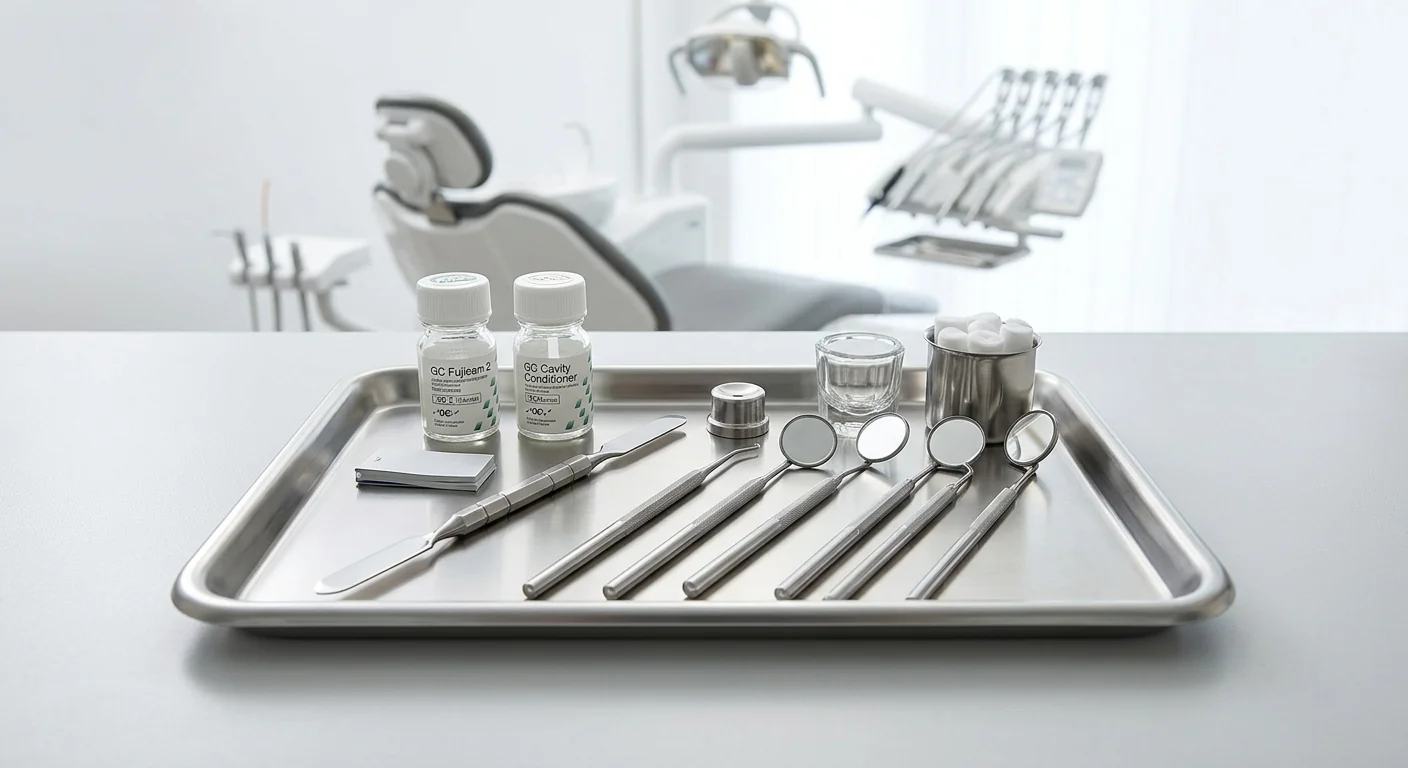 GIC: condition the dentine where the product recommends it, place the material without contaminating it with saliva or letting it dry out, and protect the surface with a varnish or coating while it matures.
- Composite: isolate well, ideally with a rubber dam, follow the adhesive system's etch and bond steps, and place in increments (or as bulk-fill where indicated) with adequate curing.
Many GIC failures come from early moisture contamination or dehydration, and many composite failures come from poor isolation or bonding. The better material on paper will not perform if the technique does not suit the situation.
How Long Do GIC and Composite Fillings Last?
Longevity depends on the cavity, the patient's caries risk and the technique as much as the material. In stress-bearing restorations in permanent posterior teeth, composite generally outlasts conventional GIC, which is why GIC is often regarded as interim there. In primary teeth, cervical lesions and root caries, GIC and RMGIC can perform well long-term, and their fluoride release is an advantage in high-risk patients.
What to Keep in Stock
A general dental practice usually needs both families of material. A practical stock list is:
- A conventional or high-viscosity restorative GIC for children, ART and interim work
- A resin-modified GIC for Class V lesions, liners and bases
- A universal composite system, with its adhesive, in the shades you use most
You can compare options in Medikabazaar's restorative GIC range and universal composite resins.
FAQs

