

Hospitals
A Clinician's Guide to Vein Finder Technology: Selection and Best Practices
An essential guide for clinicians on vein finder technology. Understand NIR, projection vs. handheld types, and key criteria for paediatrics, oncology, and phlebotomy.


Difficult Venous Access (DVA) is a persistent operational challenge across nearly every clinical department, from the phlebotomy lab to the neonatal ICU. Multiple failed cannulation attempts not only cause significant patient discomfort and anxiety but also consume valuable clinician time and increase the risk of complications like haematomas and thrombophlebitis. A modern vein finder is a non-invasive tool designed to mitigate these challenges by providing real-time visualisation of subcutaneous vasculature.
This guide moves beyond a basic product overview to provide a practical framework for evaluating, selecting, and implementing vein finder technology within an Indian clinical setting. We will focus on the underlying technology, distinct device formats, and the operational criteria that matter most in day-to-day practice.
Understanding the Core Technology: Near-Infrared (NIR) Illumination
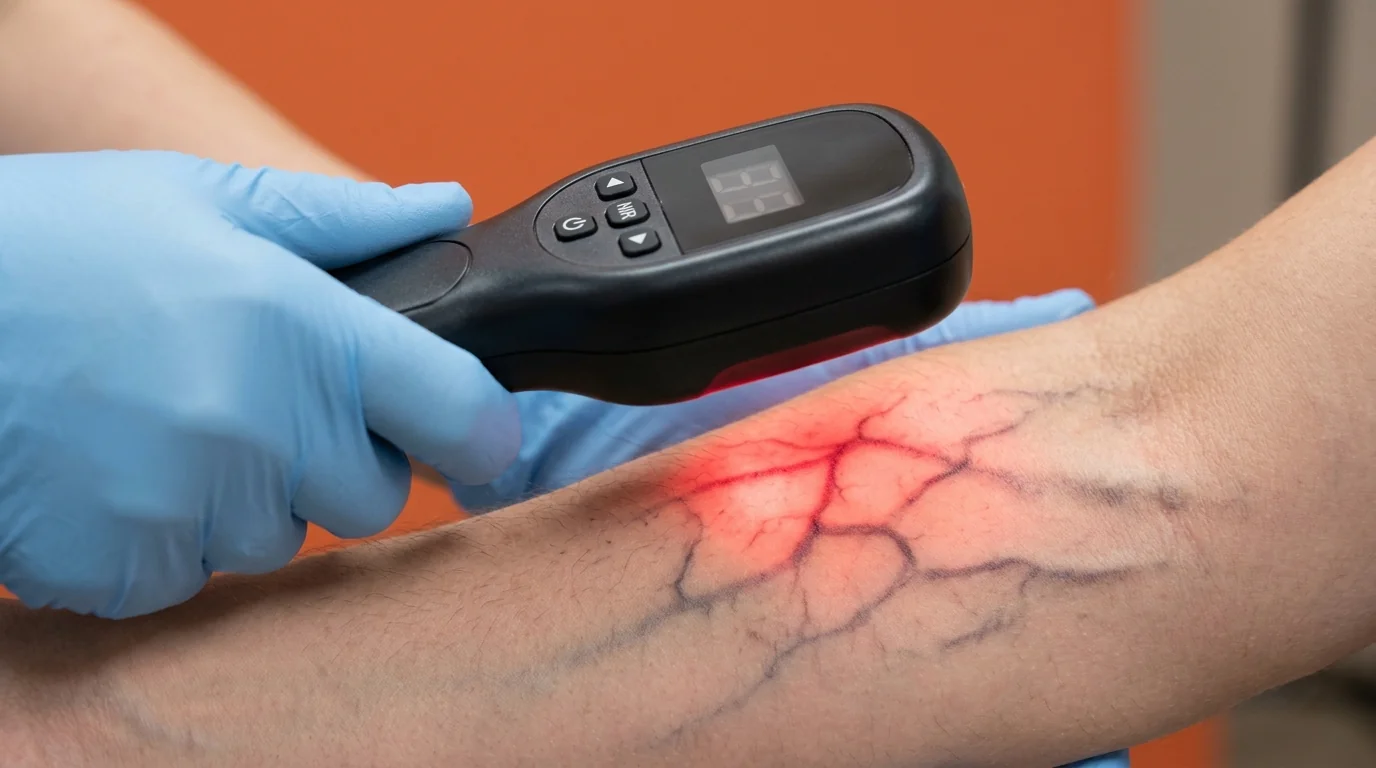 The majority of advanced vein finders operate using near-infrared (NIR) light technology. The principle is straightforward and based on haemoglobin's light-absorption properties.
- The device emits harmless NIR light onto the skin's surface.
- The deoxygenated haemoglobin in venous blood absorbs this light, while the surrounding tissues reflect it.
- A sensor in the device captures the reflected light, processes the contrast difference, and projects a real-time digital map of the veins back onto the skin or displays it on a screen.
This method is entirely non-invasive, involves no radiation, and provides an immediate, accurate representation of venous patterns that may be invisible or difficult to palpate.
Types of Vein Finders: Projection vs. Handheld
The primary differentiation in the market is the device's form factor, which directly impacts workflow and usability. The two main categories are projection-based and handheld units.
Projection-Based Vein Viewers
These devices project the digital vein map directly onto the patient's skin at the potential venipuncture site.
- Operational Advantage: The primary benefit is hands-free operation once the device is positioned. This allows the phlebotomist or nurse to use both hands to stabilise the patient's limb and perform the cannulation, all while viewing the "vein roadmap" directly on the site.
- Clinical Setting: Best suited for high-volume, controlled environments like pre-operative holding areas, chemotherapy infusion centres, and dedicated phlebotomy stations. The Promptcare Vein Viewer, often used with a mobile stand, is a representative example of this category, facilitating stable, clear projections.
- Limitations: Can be larger and less portable. Image quality may be affected by high ambient lighting or significant patient movement.
Handheld Vein Finders
These are portable, self-contained units that are held over the skin. The vein map is either displayed on an integrated screen or visualised through an eyepiece. A simpler variant is the transilluminator, which uses high-intensity LEDs to light up subcutaneous structures.
- Operational Advantage: Their portability is unmatched. They are ideal for use at the bedside, in emergency or trauma situations, and for routine rounds across different wards. The clinician can quickly assess multiple sites.
- Clinical Setting: Indispensable in ICUs, emergency departments, and for paediatric rounds. Models like the Doctroid 3-in-1 Vein Finder offer the flexibility of a handheld device with features like adjustable colour displays to enhance contrast for the practitioner. For highly specific applications like neonatology, a dedicated transilluminator like the MCP Pediatric LED O-Shape Vein Finder can be more effective due to its focused light and design tailored for tiny limbs.
- Limitations: Requires one hand to operate the device, leaving only one hand free for the procedure itself. The clinician must also shift their gaze from the screen to the puncture site.
Key Clinical Applications and Use Cases
The utility of a vein finder is most pronounced in patient populations known for DVA.
- Paediatrics and Neonates: Veins are not only small and shallow but also easily obscured by subcutaneous fat. A vein finder minimises distress from multiple attempts in a frightened child and is often considered a standard of care in NICUs.
- Geriatric Patients: Veins can be fragile, tortuous, and prone to rolling. Visualisation helps in selecting the straightest, most viable segment and reduces the risk of blowing the vein.
- Oncology Patients: Repeated chemotherapy cycles can lead to sclerosis and collapse of peripheral veins. Vein finders are essential for identifying remaining viable access points and preserving vessel health.
- Obese Patients: Subcutaneous adipose tissue can make palpation nearly impossible. NIR technology effectively penetrates this layer to reveal underlying vasculature.
- Dark-Skinned Patients: While palpation remains the gold standard, visual cues can be less apparent. NIR technology functions independently of skin melanin, providing a clear map for all skin tones.
- Emergency and Critical Care: In trauma or hypovolemic shock cases, peripheral veins may collapse, making rapid access difficult. A vein finder can save critical minutes.
A Practical Evaluation Checklist for Procurement
When evaluating vein finders for your facility, move beyond the spec sheet and consider these operational factors:
- Image Quality and Depth: How clear and sharp is the projected or displayed image? Critically, what is the maximum depth of penetration? Most NIR devices are effective up to 8-10 mm, which covers the majority of peripheral veins.
- Portability and Form Factor: Analyse your workflow. Does the device need to move between the ER, ICU, and general wards? If so, a lightweight handheld unit is preferable. If it will serve a single high-volume phlebotomy station, a more stable projection model on a stand may be more efficient.
- Ease of Use: How intuitive is the device for nursing staff and technicians with minimal training? A device with a steep learning curve can hinder adoption and negate its benefits. Assess boot-up time, calibration needs, and control simplicity.
- Durability and Infection Control: The device will be used on multiple patients. Is the casing made of medical-grade plastic that can withstand frequent cleaning with hospital disinfectants? Are there minimal crevices where pathogens can accumulate?
- Power Source: What is the battery life on a full charge, and what is the recharge time? The device must be able to last through a demanding shift without being tethered to a power outlet.
- Regulatory Compliance: This is non-negotiable. Ensure the device has the necessary certifications, such as CE marking or ISO 13485 compliance, which indicate adherence to quality management standards for medical devices. Verifying regulatory compliance is a mandatory step in sourcing any new equipment, and you can explore a wide range of certified options in our Medicalequipments catalogue.
Operational Best Practices and Limitations
To maximise the clinical utility of a vein finder, staff must be trained on its proper use and its inherent limitations.
Best Practices:
- Augment, Don't Replace: A vein finder is a tool to assist, not replace, fundamental clinical skills. Palpation is still required to assess a vein's turgor, diameter, and viability (e.g., to check for sclerosis or valves).
- Optimise the Environment: For projection models, dimming ambient light can significantly enhance the contrast and clarity of the vein map on the skin.
- Prepare the Site: Ensure the skin is clean and dry. Excessive hair may need to be trimmed, as it can interfere with light reflection.
- Anchor the Vein: Use proper technique to anchor the vein before puncture, even when it is clearly visualised. The device shows the location, but it does not prevent rolling.
Understanding Limitations:
- Depth: NIR technology cannot visualise very deep veins, such as the femoral or subclavian. It is intended for peripheral vasculature.
- No Arterial Differentiation: The device visualises haemoglobin; it cannot distinguish between venous and arterial blood. Clinicians must rely on anatomical knowledge and pulse checks to prevent inadvertent arterial puncture.
- Not a Gauge of Health: The device shows that a vessel exists, but it provides no information about its patency or the presence of valves that could impede catheter advancement.
Equip Your Facility Today
Integrating the right vein finder technology can significantly improve first-attempt success rates, enhance patient comfort, and support clinical efficiency. For facilities looking to elevate their standard of care in venous access, exploring the available options is a crucial next step.
FAQs

