

Hospitals
A Clinician's Guide to Selecting the Right Finger Tip Pulse Oximeter
An authoritative guide for procurement managers and clinicians on evaluating and selecting a finger tip pulse oximeter for institutional use in India.


As a non-invasive tool for monitoring a patient's oxygen saturation (SpO2) and pulse rate, the finger tip pulse oximeter has become indispensable across virtually every clinical department—from the outpatient department (OPD) and general wards to casualty and post-operative recovery units. While seemingly simple, selecting the right device for high-volume institutional use involves looking beyond the basic display. For procurement heads and senior clinicians, the evaluation process must prioritise accuracy, durability, and features that support a demanding clinical workflow.
This guide moves beyond surface-level specifications to detail the operational and clinical criteria that truly matter when equipping your facility. We will examine the underlying technology, key evaluation metrics for professional-grade devices, and best practices for deployment and maintenance.
Understanding the Core Technology: How Pulse Oximetry Works
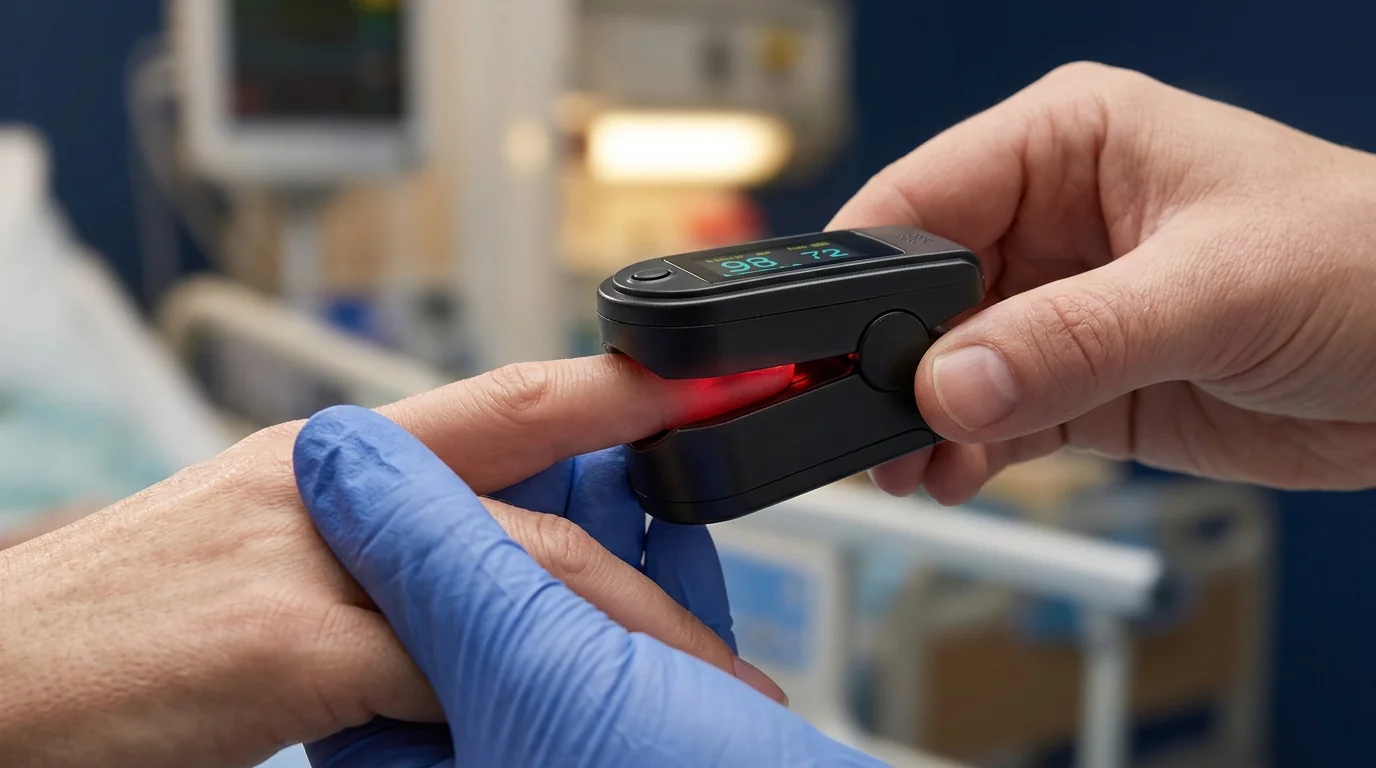 At its core, pulse oximetry operates on the principle of spectrophotometry. The device clamp houses two light-emitting diodes (LEDs)—one emitting red light (at a wavelength of approximately 660 nm) and the other infrared light (around 940 nm). These beams pass through the fingertip to a photodetector on the opposite side.
The science rests on the differential absorption of these light wavelengths by two forms of hemoglobin:
- Oxyhemoglobin (HbO2): Oxygenated hemoglobin, which preferentially absorbs infrared light.
- Deoxyhemoglobin (Hb): Deoxygenated hemoglobin, which preferentially absorbs red light.
The device measures the constant light absorption from static tissues (skin, bone, venous blood) and isolates the variable, pulsatile absorption caused by arterial blood flow. By analysing the ratio of red to infrared light absorption during each pulse, the oximeter's microprocessor calculates the percentage of hemoglobin saturated with oxygen—the SpO2 value.
Key Evaluation Criteria for Institutional Procurement
When assessing a finger tip pulse oximeter for hospital or clinic-wide deployment, the focus shifts from consumer-grade features to professional standards of reliability and performance.
Accuracy and Clinical Validation The fundamental requirement is clinical accuracy. Look for devices that specify an accuracy of ±2% for SpO2 in the critical 70-100% range and ±2 bpm (or ±2%) for pulse rate. This level of precision is essential for making sound clinical judgements. Compliance with international standards, such as ISO 80601-2-61, provides a strong indicator of validated performance.
Display Clarity and Functionality In a busy clinical environment, data must be instantly legible.
- Display Type: OLED (Organic Light-Emitting Diode) displays are generally superior to standard LED screens, offering higher contrast, wider viewing angles, and better readability in various lighting conditions.
- Data Presented: A professional-grade display should show more than just the numbers. The inclusion of a plethysmograph (waveform) is critical. This visual representation of the arterial pulse allows the clinician to qualitatively assess the quality and strength of the signal, helping to identify motion artifacts or poor perfusion that could compromise the reading.
- Orientation: A multi-directional display that automatically rotates is not a luxury; it is a practical necessity, allowing staff to read the output from any angle without physically moving the device or the patient's hand.
Durability and Construction A device used dozens of times a day must be built to last.
- Casing: High-quality ABS plastic provides a good balance of strength and light weight. Assess the device for drop-resistance specifications.
- Hinge Mechanism: The spring and hinge are the most common points of failure. A robust, well-engineered hinge is non-negotiable for institutional use.
- Ingress Protection (IP) Rating: An IP rating (e.g., IP22) indicates the device's resistance to ingress from solids (like dust) and liquids (like drips or splashes), a vital feature for infection control and device longevity.
Advanced Clinical Features Beyond the basics, certain features distinguish a clinical tool from a consumer gadget.
- Perfusion Index (PI): The PI is the ratio of the pulsatile blood flow to the non-pulsatile static blood flow. It provides a numerical value (typically 0.02% to 20%) that indicates the strength of the pulse signal. A low PI can alert the user to poor peripheral perfusion, suggesting the reading may be less reliable or that an alternative monitoring site should be considered.
- Configurable Alarms: The ability to set audible and visual alarms for user-defined high and low SpO2 and pulse rate limits is essential for continuous spot-monitoring, especially in recovery or step-down settings. Models such as the BPL Medical Technologies Smart Oxy Finger Tip Pulse Oximeter - Black effectively integrate these core clinical features, making them suitable for reliable, routine checks across departments.
Operational Best Practices for Accurate Readings
Acquiring a quality device is only half the battle. Ensuring its correct use is paramount for patient safety and diagnostic accuracy.
Patient-Related Factors Staff must be trained to recognise conditions that can interfere with oximeter readings:
- Poor Perfusion: Hypothermia, hypotension, severe anemia, or the use of vasoconstrictor drugs can weaken the arterial pulse, leading to failed or inaccurate readings.
- Motion Artifacts: Shivering, tremors, or any patient movement can disrupt the signal and produce erroneous data.
- External Interferences: Dark or metallic nail polish, artificial nails, and even bright ambient light can interfere with the light transmission and detection.
- Dyshemoglobinemias: Standard pulse oximeters cannot differentiate between oxyhemoglobin and other forms, such as carboxyhemoglobin (from carbon monoxide poisoning) or methemoglobin. This can lead to a falsely high SpO2 reading.
Proper Usage Technique
- Ensure the patient is calm and has been resting for a few minutes.
- Select a suitable finger, typically the index or middle finger of the non-dominant hand.
- Check that the finger is clean, dry, and fits comfortably but securely within the device.
- Instruct the patient to keep their hand still and relaxed.
- Allow at least 10-15 seconds for the device to acquire a strong signal and provide a stable reading. Always assess the plethysmograph waveform for consistency before documenting the values.
Infection Control Protocol Between each patient use, the oximeter must be cleaned and disinfected according to your facility's infection control policy and the manufacturer's instructions for use (IFU). Typically, this involves wiping the device, especially the silicone finger sleeve, with a 70% isopropyl alcohol wipe and allowing it to air dry completely.
Sourcing Professional-Grade Oximeters
When sourcing for a healthcare facility, it's crucial to differentiate between devices intended for personal wellness and those built for clinical application. Professional-grade oximeters are characterized by their regulatory approvals (such as CE marking or FDA clearance), robust construction, and inclusion of clinically relevant features like the perfusion index and plethysmograph. When evaluating options, the entire range of professional-grade Fingertip Pulse Oximeter models available for institutional sourcing should be considered to find the best fit for specific departmental needs and budgets. A trusted bpl pulse oximeter, for instance, is often selected for its proven reliability in the demanding Indian healthcare ecosystem.
Well-known brands like BPL Medical Technologies have a long-standing presence in the Indian market. A bpl medical technologies oximeter is generally designed with the realities of high-volume Indian clinics and hospitals in mind, focusing on durability, ease of use for diverse staff, and consistent performance. This focus on operational reality is a key consideration during the procurement process.
Equip Your Facility with Reliable Monitoring Tools
Ensuring every clinical station is equipped with an accurate and durable pulse oximeter is fundamental to patient safety and efficient workflow. For facilities looking to standardize or upgrade their monitoring equipment, exploring a curated selection from trusted manufacturers is the critical next step in the procurement process. Making an informed choice based on clinical need and operational durability will yield benefits in both patient outcomes and long-term equipment performance.
FAQs

