

Small Clinics
A Clinician's Guide to Choosing Leg Stockings for Swelling and Oedema Management
Authoritative guide for clinicians on selecting medical leg stockings for swelling. Covers compression classes, indications, and practical guidance for oedema management.


As clinical and operational leads, we are constantly evaluating the tools and supplies that deliver good patient outcomes. When it comes to managing peripheral oedema, venous insufficiency, and related conditions, medical-grade leg stockings for swelling are a fundamental therapeutic modality. This is not about simple support hosiery; it's about a prescribed medical device that requires precise specification. This guide provides a clinical and operational framework for selecting and deploying compression stockings effectively within your facility.
The core principle is graduated compression therapy. Unlike uniform hosiery, medical compression stockings apply a controlled amount of pressure that is strongest at the ankle and gradually decreases up the leg. This mechanical gradient assists the calf muscle pump, improves venous return, reduces venous stasis and pressure, and supports lymphatic drainage. The direct result is a reduction in swelling and an improvement in overall leg health.
Understanding the Mechanism: Graduated Compression Therapy
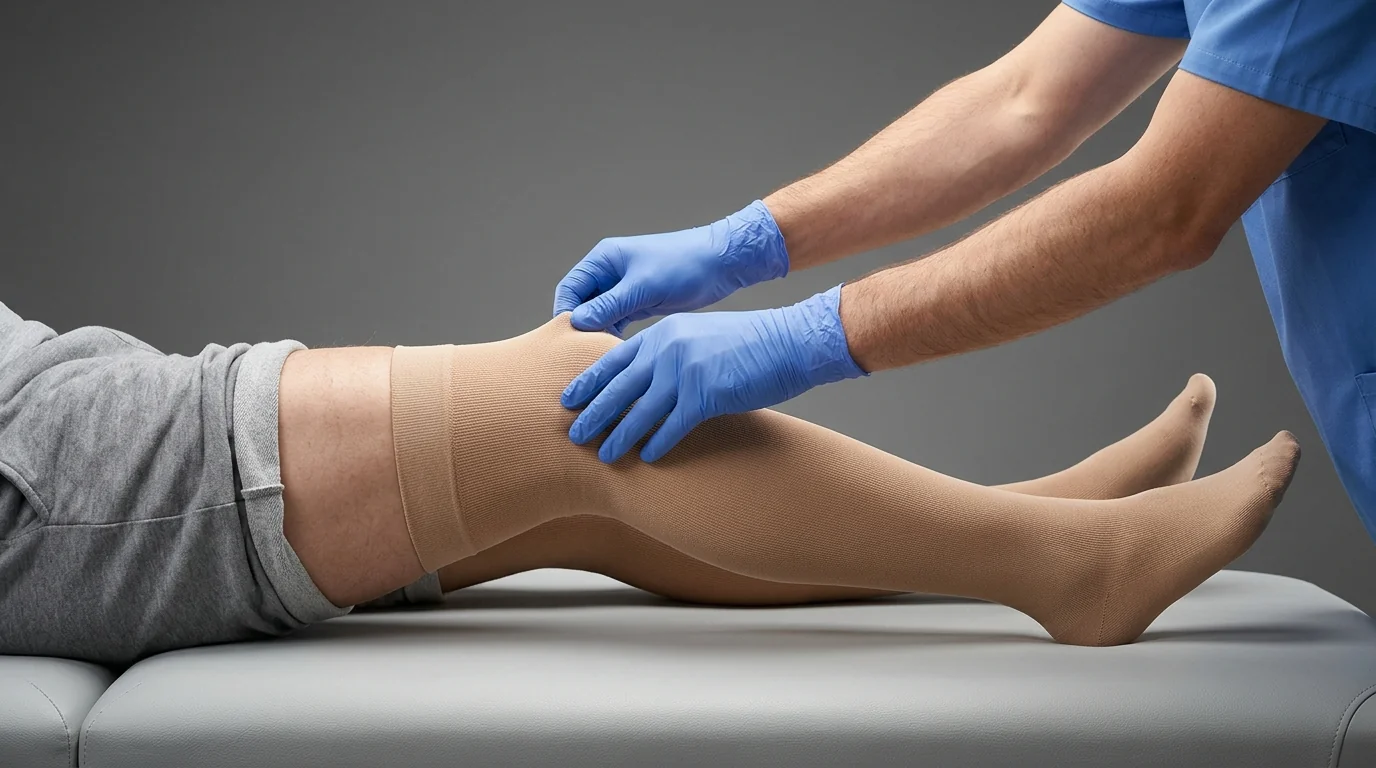 The efficacy of compression therapy hinges on its physiological mechanism. By applying a precise external pressure gradient, these stockings functionally improve haemodynamics in the lower limbs.
This intervention is crucial for providing effective stockings for blood circulation. The external pressure helps narrow the diameter of distended veins, which in turn increases the velocity and volume of blood flow back towards the heart. This enhanced circulation in the legs helps prevent the pooling of blood, reduces ambulatory venous hypertension, and improves the tissue's microcirculation and oxygenation.
It is critical to distinguish these therapeutic devices from standard "support" or "flight" socks. Medical compression stockings are manufactured to exacting standards to ensure the pressure gradient is accurate and maintained over the lifespan of the garment.
Key Clinical Indications for Leg Stockings
Prescribing or stocking compression hosiery requires a clear understanding of the appropriate clinical indications. The selection of compression class, style, and length is directly tied to the patient's underlying diagnosis.
Common indications include:
- Chronic Venous Insufficiency (CVI): A primary indication, used to manage symptoms like pain, oedema, skin changes, and to aid in the healing of venous ulcers.
- Varicose Veins: To control swelling and discomfort associated with varicosities, and often used post-sclerotherapy or other procedures.
- Deep Vein Thrombosis (DVT) Prophylaxis: While lower-pressure anti-embolism stockings are used for non-ambulatory patients, graduated compression stockings are vital for ambulatory patients at risk.
- Post-Thrombotic Syndrome (PTS): To manage the chronic symptoms of pain, swelling, and skin changes that can occur after a DVT.
- Lymphoedema: As a core component of decongestive therapy to maintain limb volume reduction after initial treatment.
- Orthostatic Hypotension: To reduce venous pooling in the lower extremities upon standing, thereby improving venous return and stabilising blood pressure.
- Generalised Oedema: For managing dependent oedema and stockings for ankle swelling related to prolonged sitting or standing, particularly in professions that require it.
Demystifying Compression Classes and Pressure Gradients
The single most important specification for a medical compression stocking is its pressure class, measured in millimetres of mercury (mmHg) at the ankle. Prescribing an incorrect class can render the therapy ineffective or, in some cases, cause harm. Indian and European standards are generally aligned.
Below is a reference table for common compression classes and their applications:
| Compression Class | Pressure at Ankle (mmHg) | Typical Clinical Indications |
| Class 1 | 18-21 mmHg | Mild oedema, tired/achy legs, minor varicose veins, DVT prophylaxis in low-risk patients. |
| Class 2 | 23-32 mmHg | Moderate oedema, significant varicose veins, post-DVT management, venous ulcer management. |
| Class 3 | 34-46 mmHg | Severe oedema, lymphoedema, chronic venous insufficiency with skin changes or ulceration. |
Operational Note: Your facility's formulary should ideally include options across at least Class 1 and Class 2, as these cover the majority of clinical presentations in both inpatient and outpatient settings. Class 3 is a more specialist requirement.
Sourcing and Specification: Key Operational Criteria
From a procurement and clinical governance standpoint, several factors beyond compression class are critical for successful implementation.
- Material and Weave: Materials like nylon and elastane provide the core compression, while microfibers and cotton blends enhance breathability and comfort. The type of weave (circular-knit or flat-knit) also matters. Circular-knit stockings are seamless and more cosmetic, suitable for mild-to-moderate conditions. Flat-knit stockings are seamed, less elastic, and provide higher containment, making them essential for managing advanced lymphoedema.
- Accurate Sizing: This cannot be overstated. Incorrect fit is the primary reason for non-compliance and therapeutic failure. A standard operating procedure for measurement must be implemented. Staff must be trained to take precise circumference measurements at the ankle (narrowest point) and calf (widest point), and length measurements from the floor to the popliteal fossa (for below-knee) or gluteal fold (for thigh-high). Always use the sizing chart specific to the manufacturer being sourced.
- Style and Length:
- Below-Knee (AD): The most frequently used style, appropriate when swelling is confined to the ankle and calf.
- Thigh-High (AG): Indicated when CVI or oedema extends above the knee. Silicone bands are often used to hold them in place.
- Pantyhose (AT): For conditions affecting the entire leg or for patient preference.
- Toe Style: Open-toe designs are useful for patients with longer feet, ingrown toenails, or when frequent inspection of the toes is necessary. Closed-toe styles offer a more traditional sock-like feel.
When evaluating suppliers, it is essential to ensure their products conform to recognised manufacturing standards that guarantee the stated compression gradient. Sourcing a variety of sizes and styles is key to meeting diverse patient needs. For thigh-high requirements, one option is the Dyna Pryda Medical Compression Stockings Class 2 AG Up to Groin - Unisex Beige Medium (2303). You can Browse Stockings to evaluate the range of options available for your facility.
Practical Guidance for Application, Patient Education, and Maintenance
Effective compression therapy extends beyond proper specification. Implementation on the ward and patient education are equally vital.
- Application Technique: Stockings should be applied first thing in the morning, before the patient gets out of bed and oedema has had a chance to accumulate. For higher compression classes, donning aids (applicators) can significantly improve ease of application and are a worthwhile ancillary item to stock. Ensure the stocking is free of wrinkles, and the heel is correctly positioned.
- Patient Education: This is the cornerstone of compliance. A patient who understands the "why" and "how" is more likely to adhere to the therapy. Key education points include the purpose of the stockings, the correct application/removal technique, signs of a problem (numbness, tingling, skin discolouration), and a clear wear schedule (typically on all day, off at night).
- Care and Replacement: The elastic fibres that provide compression degrade with washing and wear. To maintain therapeutic efficacy, stockings should be replaced every 3-6 months. Instruct patients to hand wash them with mild soap and lukewarm water and to air dry them away from direct heat. Stocking two pairs allows for rotation while one is being washed.
Equip Your Facility
Ensuring your clinicians have access to a full range of high-quality medical compression stockings is essential for effective oedema management and superior patient care. Explore the curated selection of therapeutic stockings for circulation in legs on MedikaBazaar to meet the needs of your various departments, from post-operative wards to outpatient physiotherapy and vascular clinics.
FAQs