

Small Clinics
A Clinician's Reference for Scalp Vein Set Selection and Use
A detailed clinical and procurement guide to the scalp vein set (butterfly needle), covering gauge sizes, uses in paediatrics, and comparison with IV cannulas.


As procurement heads and senior clinicians, we make dozens of small decisions every day that have a direct impact on patient outcomes and operational efficiency. The selection of a seemingly simple disposable, like a scalp vein set, is one of them. While often overshadowed by more complex equipment, choosing the right set for the right patient and procedure is critical for minimising patient discomfort, ensuring procedural success, and preventing complications.
This guide moves beyond the basics to provide a practical, peer-to-peer reference for evaluating, selecting, and correctly using scalp vein sets in a demanding clinical environment. It’s the information you need, grounded in daily practice.
Anatomy of a Scalp Vein Set
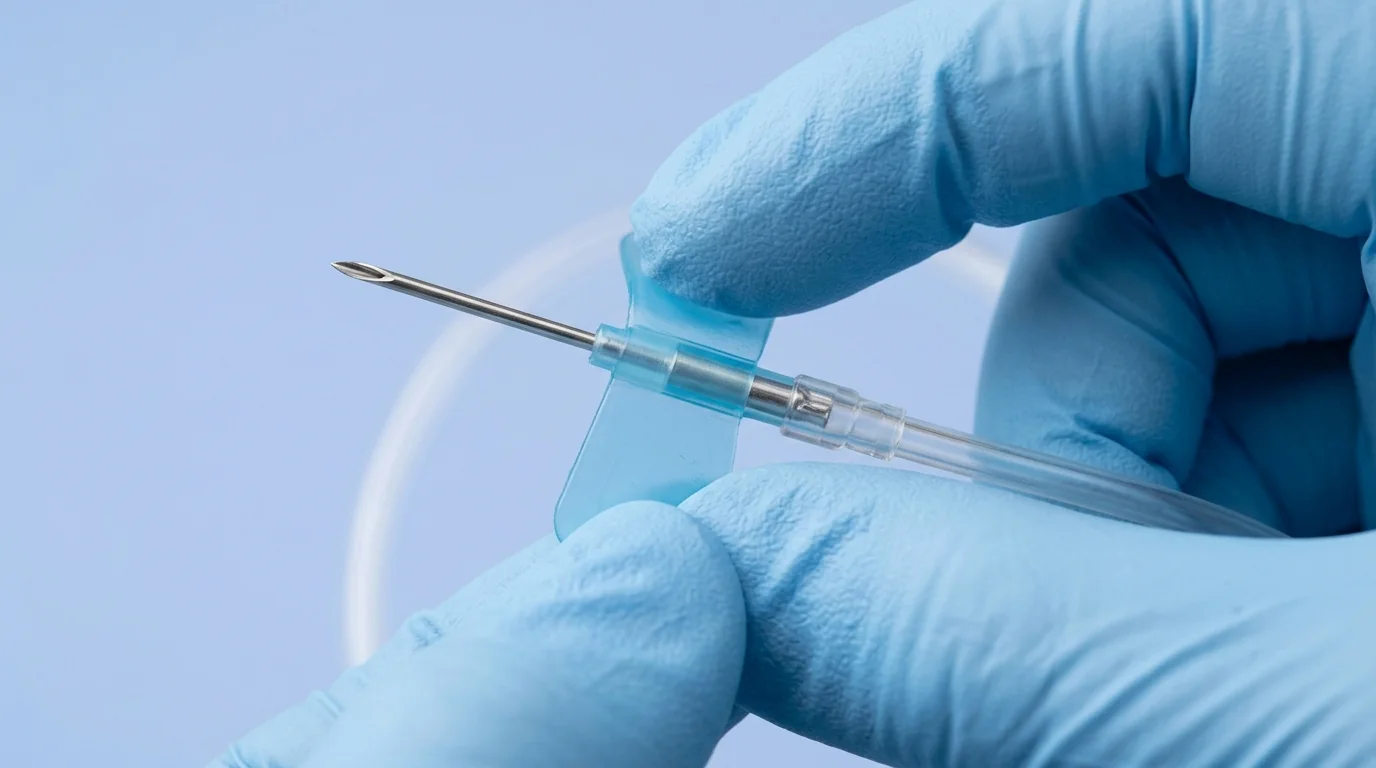 Though frequently called a "butterfly needle" or "winged infusion set," understanding the specific components helps in evaluating quality and function during procurement. Every set consists of several key parts working in unison.
- Hypodermic Needle: A short, siliconised stainless-steel needle with a sharp, short bevel designed for smooth, atraumatic venous entry.
- Flexible Wings: Two soft, textured plastic wings on either side of theneedle base. These provide a stable grip during insertion and can be flattened against the skin for secure taping.
- Flexible Tubing: A thin, transparent, and kink-resistant tube, typically 20-35 cm long, that allows for some patient movement without dislodging the needle. The transparency is crucial for visualising flashback.
- Luer Connector: The distal end that connects to an infusion line, syringe, or blood collection tube holder. This can be a Luer slip or a more secure Luer lock fitting.
- Protective Cap: A plastic sheath that covers the needle before use to maintain sterility and prevent accidental needlesticks.
Understanding Gauge and Colour Coding
The gauge (G) of the needle is the most critical specification. It has an inverse relationship with needle diameter—the higher the gauge number, the smaller the needle. International colour coding provides an immediate visual cue for the gauge, which is vital in fast-paced settings like casualty or the NICU.
Mis-selecting a gauge can lead to procedural failure, haemolysis during a blood draw, or an inadequate flow rate for an infusion. Keeping a full range of sizes is essential for any well-equipped facility.
| Gauge (G) | ISO Colour | Typical Needle Diameter (mm) | Common Clinical Use Cases |
| 18G | Pink | 1.2 | Rapid fluid or drug administration (rarely used in scalp vein set form). |
| 19G | Cream | 1.1 | Blood donation, rapid infusions. |
| 20G | Yellow | 0.9 | General infusions, blood draws on adults with good veins. |
| 21G | Green | 0.8 | Routine blood draws, infusions for most adults. A versatile and common choice. |
| 22G | Black | 0.7 | Older children, adults with smaller veins. Slower infusions. |
| 23G | Blue | 0.6 | Standard for paediatrics, geriatric patients, and difficult venous access. Blood collection. |
| 24G | Purple | 0.55 | Neonates, infants, and extremely difficult veins. |
| 25G | Orange | 0.5 | Scalp veins in neonates, very precise low-volume injections. |
| 26G | Brown | 0.45 | Used in highly specialised paediatric or micro-sampling procedures. |
| 27G | Grey | 0.4 | Primarily for specialised injections, rarely for venous access. |
Ensuring your departments have access to a reliable inventory of various gauges is a procurement priority. A comprehensive range of scalp vein sets is foundational for meeting diverse patient needs.
Clinical Applications: When to Choose a Scalp Vein Set
The scalp vein set is not a universal substitute for an IV cannula. Its utility lies in specific, well-defined clinical scenarios where its design offers a distinct advantage.
- Paediatrics and Neonatology: This is the primary domain of the scalp vein set. The fine-gauge needles and secure wings are ideal for accessing the tiny, fragile veins found on the scalp, hands, or feet of infants and newborns.
- Geriatric Patients: Elderly patients often have fragile, mobile ("rolling"), or difficult-to-visualise veins. The precise control offered by the butterfly wings allows for a more stable and less traumatic cannulation.
- Difficult Venous Access: In oncology patients, IV drug users, or others with scarred or collapsed veins from repeated cannulation, a scalp vein set can provide successful access where a standard cannula might fail.
- Phlebotomy: For blood collection from patients with difficult veins, the scalp vein set, when attached to a vacuum tube holder, provides excellent control and visual confirmation of blood flow (flashback) before the tube is engaged, reducing the incidence of "missed" draws. The Romsons Scalp Vein Set is a familiar example of a device frequently used for these precise procedures.
- Short-term, Single-dose Infusions: For administering a one-time IV medication (like an antibiotic or analgesic) where an indwelling catheter is not required, a scalp vein set is a quick and efficient option.
Scalp Vein Set vs. IV Cannula: An Operational Comparison
Choosing between a scalp vein set and a standard IV cannula is a clinical judgement based on the patient, the procedure, and the intended duration of access.
| Feature | Scalp Vein Set (Butterfly Needle) | IV Cannula (Intravenous Catheter) |
| Indwelling Time | Short-term. A few hours at most. Intended for single procedures. | Can remain in place for up to 72 hours, per facility protocol. |
| Catheter Material | None. The rigid steel needle remains in the vein. | A flexible plastic catheter is advanced into the vein. |
| Needle | Needle remains in the vein throughout use. | Needle is a stylet, removed immediately after insertion. |
| Patient Mobility | Limited. Movement can easily dislodge the rigid needle. | High. The flexible catheter allows for significant movement. |
| Flow Rate | Generally lower due to smaller bore size and tubing length. | Higher, especially with larger gauge cannulas. |
| Infiltration Risk | Higher. The rigid needle can easily puncture the vein wall. | Lower, as the flexible catheter is less likely to cause trauma. |
Best Practices for Insertion and Management
Procedural success and patient safety depend on technique. Adherence to a standardised protocol is non-negotiable.
- Site Selection: Choose the most distal, appropriate vein in the non-dominant arm first. For infants, common sites include the scalp, dorsal hand, and foot.
- Preparation: Perform hand hygiene. Wear gloves. Cleanse the site with an appropriate antiseptic (e.g., chlorhexidine or alcohol solution) using a firm, circular motion and allow it to air dry completely.
- Insertion Technique:
- Anchor the vein by applying gentle skin traction below the insertion site.
- Hold the scalp vein set by its textured wings, pinching them together.
- Align the needle with the vein, bevel-up, at a shallow 10-15 degree angle to the skin.
- Insert the needle with a single, deliberate motion. A "pop" may be felt as it enters the vein.
- Observe the transparent tubing for blood flashback, confirming successful cannulation.
- Securing the Device:
- Once flashback is confirmed, slightly lower the needle angle and advance it a few more millimetres to ensure it's fully seated in the vein.
- Release the wings and flatten them against the skin.
- Secure the wings and a loop of the tubing with sterile transparent dressing or tape, ensuring the insertion site remains visible for monitoring. The design of sets like the HMD Unolok facilitates this secure placement.
- Monitoring and Removal: Regularly inspect the site for signs of infiltration (swelling, coolness, pain) or phlebitis (redness, tenderness, warmth). To remove, release the dressing, place sterile gauze over the site, and withdraw the needle smoothly. Apply pressure to achieve haemostasis.
Procurement Checklist: Evaluating Scalp Vein Sets for Your Facility
When sourcing scalp vein sets, move beyond the per-unit number and evaluate for clinical quality and safety.
- Needle Quality: Is the needle made from high-grade Japanese or European stainless steel? Is it siliconised for smoother penetration? A poorly made needle increases patient pain and the risk of vessel trauma.
- Safety Features: Does the set incorporate a needle-stick injury prevention mechanism? This is a critical consideration for staff safety and regulatory compliance. Look for models with sliding sheaths or retractable needles. Devices like the Top Winged Scalp Vein Set are often selected with this safety-first approach in mind.
- Tubing Material: The tubing should be made from medical-grade, DEHP-free PVC. It must be flexible and kink-resistant but not so soft that it collapses under vacuum pressure during a blood draw.
- Luer Connector: A Luer lock connector is strongly preferred over a Luer slip for infusions, as it provides a secure, leak-proof connection to the infusion line, reducing the risk of disconnection and contamination.
- Sterilisation and Packaging: Confirm that sets are sterilised using Ethylene Oxide (EtO) and are individually packaged in durable, easy-to-open sterile blister packs. Each pack must clearly display the gauge, lot number, and expiry date.
- Regulatory Compliance: Ensure the manufacturer has ISO 13485 certification and the product carries appropriate regulatory markings (e.g., CE marking) indicating compliance with quality management and safety standards.
Equip Your Facility Today
A well-stocked inventory of high-quality, reliable scalp vein sets across a full range of gauges is a mark of a well-run clinical operation. Ensuring your clinical teams have the right tools for challenging venipuncture scenarios directly contributes to better patient care and procedural success. Explore the range of clinically vetted options on MedikaBazaar to meet your facility's specific standards and needs.
FAQs

