Something off with this product?
Incorrect prices? Missing information? Delivery time too high?
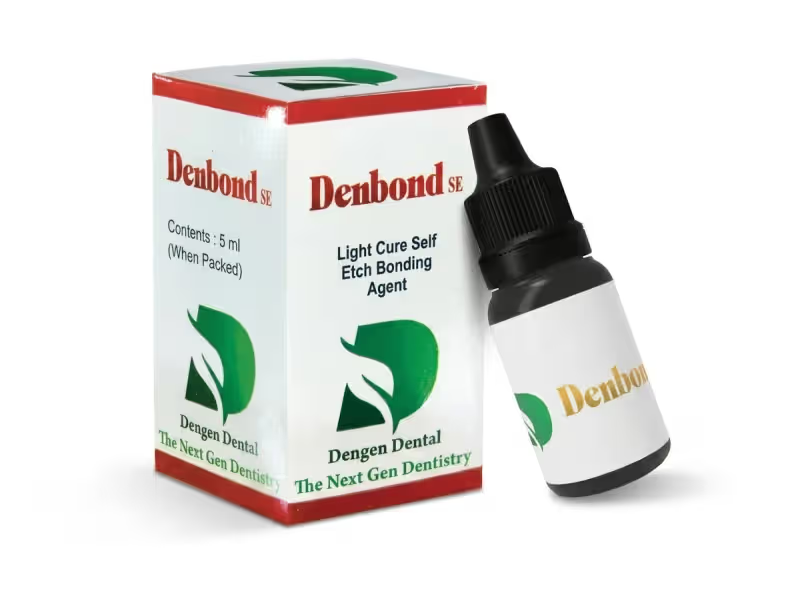
Dengen Denbond Se Self Etch 7th Gen Bonding Agent
View Product Details
₹653.10
₹662
1% Off
Inclusive of 5% GST
Your Advantages
Delivery By
Enter location
Subtotal :
₹653.10
Want to buy bulk quantity?
Brand: Dengen
Country of Origin: United States
What's in the Box
1 x 5ml Bonding Agent
Dengen Denbond SE Self-Etch 7th Generation Bonding Agent is a light-cured, one-component dental adhesive designed for reliable dentine and enamel bonding. This seventh-generation bonding agent is formulated with methacrylate-based resins and nano silica fillers, enhancing its adhesive properties for various restorative procedures.
The bonding agent is indicated for a broad range of direct and indirect restorations. Its applications include light-cured composite and compomer restorations, core build-ups, veneers, inlays, onlays, crowns, bridges, and endodontic posts. It also serves for cavity sealing prior to amalgam or indirect restorations, bonding fissure sealants, and intraoral repair of composite, metal-supported porcelain, all-ceramic, and metal restorations.
As a self-etching, single-bottle system, Dengen Denbond SE streamlines the bonding protocol by combining etching, priming, and bonding into one step, eliminating the need for separate etching. The material is applied to the enamel/dentin surface with a scrubbing motion for 20 seconds, followed by gentle air drying for at least 5 seconds, and then light-cured for 20–30 seconds.
Key Features :
7th Generation Self-Etch Technology for simultaneous etching and priming
One-component, single-bottle system for simplified application
Light-cured polymerization for controlled working time
Universal indications for direct and indirect restorations
Formulated with nano silica fillers for enhanced adhesion to enamel and dentine
| Material Type | Resin (Methacrylate-based with Nano Silica Fillers) |
| Indication | Direct and indirect restorations, including light-cured composite and compomer restorations, core build-ups, veneers, inlays, onlays, crowns, bridges, endodontic posts, and cavity sealing. |
| Mixing Method | One-component, single-bottle system (no mixing required) |
Dengen DenBond SE is a self-etching bonding agent that simultaneously etches and primes the tooth surface in a single step, eliminating the need for a separate phosphoric acid etching procedure. This self-etching capability efficiently conditions both enamel and dentin, reducing clinical steps and chairside time while maintaining reliable adhesion to the dental substrate.
Yes, Dengen DenBond SE is designed for universal compatibility with various restorative materials, including composites and compomers. This versatility allows dental practitioners to select the most appropriate restorative material for different clinical scenarios without requiring a different bonding agent.
Dengen DenBond SE provides a dual-cure option, allowing practitioners to choose between light-curing or self-curing based on specific clinical requirements. This flexibility enhances applicability in diverse restorative situations, such as when light access is limited or when self-curing is preferred for deeper restorations.
Dengen DenBond SE features low film thickness after application, which ensures that bonded restorations have minimal impact on occlusion. This characteristic promotes patient comfort and maintains a natural tooth feel by reducing unnecessary bulk at the bonded interface.
Dengen DenBond SE is a seventh-generation bonding agent that incorporates advanced self-etching formulation technology. This generation streamlines the bonding process by combining etching and priming in one step, improving time efficiency and clinical convenience while maintaining strong and durable bonds between the tooth structure and restorative materials.
The self-etching formulation of Dengen DenBond SE efficiently conditions both enamel and dentin, creating a reliable and durable bond between the tooth structure and restorative materials. This effective conditioning promotes long-term restoration stability and reduces the risk of restoration failure due to inadequate adhesion.