

Hospitals
Understanding Dialyzer Specifications: A Clinical and Operational Breakdown
A detailed guide for clinicians and procurement managers on evaluating dialyzer specifications, including membrane material, flux, surface area, and sterilization methods.


As the operational head or lead clinician of a dialysis unit, your focus is on delivering consistent, safe, and effective treatment. Central to this is the dialyzer, the "artificial kidney" at the heart of every hemodialysis procedure. Selecting the right one is not a simple matter of sourcing a commodity; it's a clinical decision that directly influences patient outcomes, from short-term solute clearance to long-term morbidity.
This guide provides a peer-to-peer breakdown of the critical parameters to evaluate when specifying a dialyzer. We will move beyond marketing materials to focus on the technical and operational data that truly matters for patient care and unit efficiency.
The Core Function: Diffusion and Convection
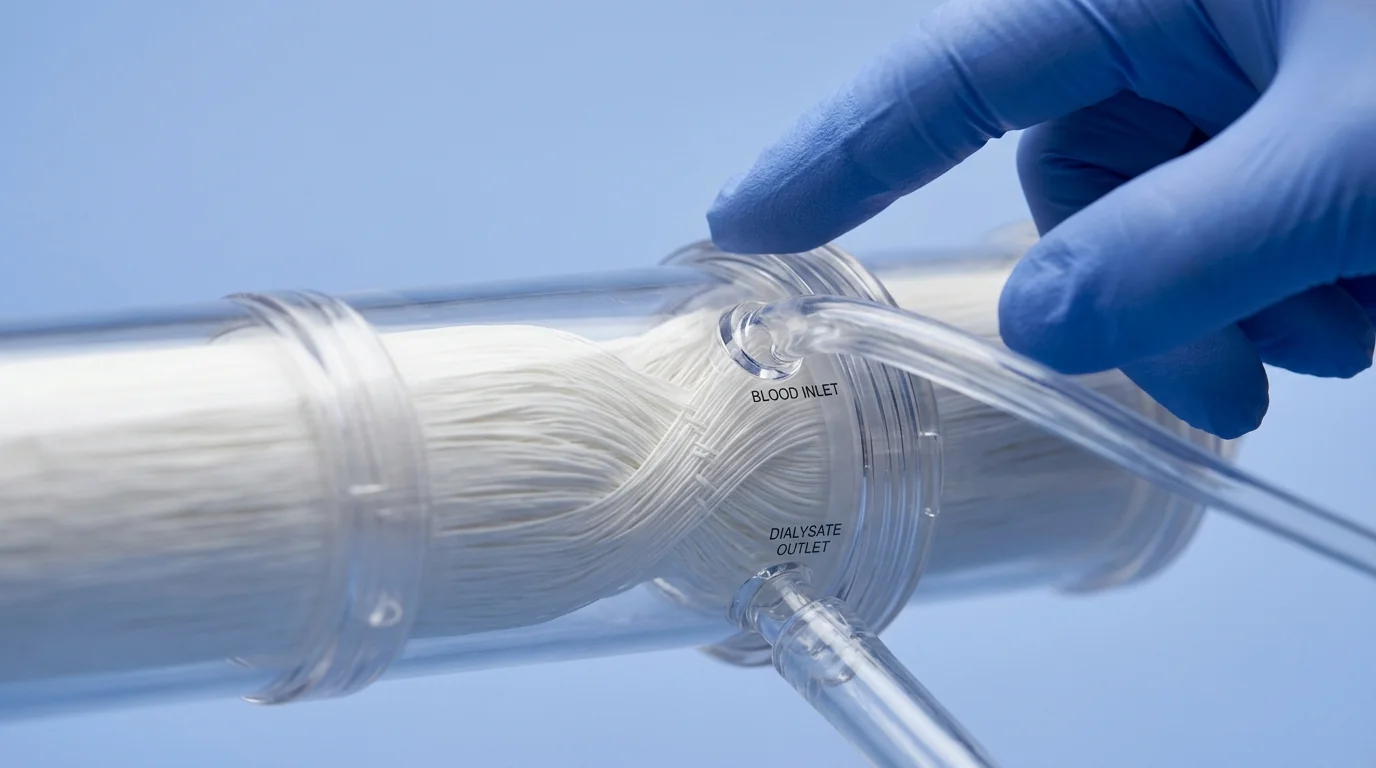 To evaluate a dialyzer effectively, it's essential to be clear on its two primary mechanisms of action. All performance specifications are designed to optimize these processes.
- Diffusion: This is the primary mechanism for removing small-molecule uremic toxins like urea and creatinine. Solutes move from an area of high concentration (the patient's blood) to an area of low concentration (the dialysate) across the semipermeable membrane.
- Convection (Ultrafiltration): This process removes excess fluid from the patient and is also critical for clearing larger "middle molecules" like β2-microglobulin. A hydrostatic pressure gradient (transmembrane pressure, or TMP) pushes water across the membrane, dragging dissolved solutes with it.
The efficiency of these two processes determines the overall effectiveness of the dialysis treatment.
Decoding Dialyzer Specifications: What the Data Sheet Tells You
The technical data sheet for any dialyzer contains the key information needed for clinical evaluation. Understanding these parameters is non-negotiable for making an informed decision.
Membrane Material and Biocompatibility
The membrane is the functional core of the dialyzer. Modern devices have largely moved away from older cellulosic membranes (like Cuprophane) due to their tendency to activate the complement system and cause inflammatory reactions.
- Synthetic Membranes: The current standard of care is synthetic membranes. Common materials include Polysulfone (PSu), Polyethersulfone (PES), and Polymethylmethacrylate (PMMA). These materials exhibit superior biocompatibility, leading to less intradialytic inflammation and better long-term patient tolerance.
- Biocompatibility: This refers to how the patient's body reacts to the foreign material of the membrane. A highly biocompatible membrane minimizes the activation of complement and coagulation cascades, reducing the risk of first-use reactions and chronic inflammation, a known contributor to cardiovascular disease in dialysis patients.
Membrane Flux: High-Flux vs. Low-Flux
Flux describes the permeability of the membrane to water and is defined by its ultrafiltration coefficient (Kuf). This is perhaps the most significant differentiator between dialyzer types.
- Low-Flux Dialyzers: These have a lower Kuf (typically <15 mL/h/mmHg) and smaller membrane pores. They rely almost entirely on diffusion for solute removal, making them effective for small molecules but inefficient at clearing middle molecules.
- High-Flux Dialyzers: With a high Kuf (typically >20 mL/h/mmHg) and larger pores, these membranes enable significant convective transport. This allows for superior clearance of middle molecules, which is associated with improved long-term outcomes, including reduced risk of dialysis-related amyloidosis and cardiovascular mortality. The use of high-flux dialyzers mandates the use of ultrapure water and dialysis machines with precise ultrafiltration control systems.
Structural Design: Hollow Fiber Dominance
The physical structure of the dialyzer is engineered to maximize the efficiency of exchange.
The modern dialyzer is almost exclusively a hollow-fiber design, where blood flows through thousands of tiny, semipermeable capillary-like tubes while dialysate flows around the outside in a counter-current direction. This structure, seen in models like the Vital Hollow Fiber Dialyzer, maximizes the surface area for exchange within a compact housing. This design is vastly more efficient than the older, bulkier parallel plate designs.
Surface Area (m²)
The effective surface area of the membrane, usually measured in square meters (e.g., 1.5 m², 1.8 m², 2.0 m²), is directly proportional to the dialyzer's diffusive clearance capacity. A larger surface area allows for more contact between blood and dialysate, enhancing the removal of small solutes. The appropriate surface area is generally selected based on the patient's body surface area (BSA) and the prescribed urea clearance target (Kt/V).
Performance Metrics: KoA and Sieving Coefficient
These numbers quantify the dialyzer's efficiency.
- Mass Transfer Area Coefficient (KoA): This is a measure of the dialyzer's maximum possible clearance for a given solute (e.g., Urea KoA) at infinite blood and dialysate flow rates. It represents the true diffusive potential of the device. When comparing two dialyzers of the same surface area, a higher KoA indicates a more efficient membrane design.
- Sieving Coefficient (S): This describes the ease with which a solute passes through the membrane via convection. A value of 1 means the solute passes as freely as water, while a value of 0 means it is completely retained. For high-flux dialyzers, you want a high sieving coefficient for middle molecules like β2-microglobulin but a very low (near zero) coefficient for albumin to prevent protein loss.
Sterilization Method
The method used to sterilize the dialyzer can have clinical implications. Check the packaging and data sheet for this information.
- Ethylene Oxide (EtO): A common method, but residual EtO can cause hypersensitivity or anaphylactoid reactions in sensitized patients.
- Gamma Irradiation: An effective method that avoids chemical residuals but can sometimes alter the polymer structure of the membrane.
- Steam (Autoclaving): Considered a very clean method, leaving no chemical residues. It is often preferred for patients with known sensitivities.
Operational Considerations for Your Dialysis Unit
Beyond the clinical specifications, several operational factors influence the suitability of a dialyzer for your facility's workflow.
Priming Volume
This is the volume of saline required to fill the blood compartment of the dialyzer before connecting it to the patient. A lower priming volume is generally desirable, as it reduces the patient's extracorporeal blood volume. This is particularly important for pediatric patients, small adults, and individuals with severe anemia.
Reprocessing and Reuse
While single-use is the gold standard and increasingly common, dialyzer reprocessing is still practiced in many centres to manage operational expenditures. If your unit follows a reuse protocol, you must select dialyzers that are validated for reprocessing. The device must be able to withstand the chemical germicides and physical stress of multiple uses without a significant drop in performance (Total Cell Volume, or TCV) or compromising membrane integrity.
System Compatibility
A dialyzer does not work in isolation. It's not just about the dialyzer, but its place within the entire ecosystem of dialysis disposables. Ensuring its compatibility with bloodlines, fistula needles, and other essential Nephrology supplies is critical for seamless operations. The blood port connectors must be compatible with your unit’s hemodialysis machines and blood tubing sets to prevent leaks and ensure a secure connection.
Putting It All Together: A Selection Checklist
When evaluating a new dialyzer for your facility, use a structured approach based on these key areas.
- Patient Population: Do you primarily treat stable chronic patients, or do you have a high number of acute kidney injury (AKI) cases? What is the average body size of your patients? Do you have patients with known hypersensitivities?
- Treatment Modality: Is your unit standardized on high-flux hemodialysis or hemodiafiltration? This will be the primary determinant of the required flux.
- Clinical Targets: What are your unit’s targets for Kt/V (for small molecules) and middle molecule clearance? This will guide your selection of surface area and flux.
- Operational Protocols: Do you practice single-use or reuse? What is your preferred sterilization method to minimize patient reactions?
- Quality and Compliance: Does the dialyzer have the necessary quality certifications, such as ISO 13485 and CE marking, and is it compliant with CDSCO regulations?
Based on these parameters, you can then evaluate specific models. Exploring a curated range of dialyzers allows you to compare specifications from different manufacturers to find the best fit for your unit's needs.
Equip Your Facility Today
Selecting the appropriate dialyzer is a foundational decision for any hemodialysis unit, directly impacting patient outcomes and operational efficiency. By carefully evaluating these technical and clinical parameters, you ensure your facility is equipped to provide the highest standard of care.
For your facility's requirements, explore the range of high-quality nephrology supplies available on MedikaBazaar.
FAQs

