

Hospitals
Thumb Spica Splint: Indications, Selection, and Best Practices
An operational guide for Indian clinicians and procurement heads on the thumb spica splint. Covers clinical indications, material selection, and application best practices.


As clinicians and operational heads, our primary goal is effective patient outcomes, supported by reliable and correctly specified medical supplies. The thumb spica splint is a cornerstone of non-operative orthopaedic management, frequently used in our OPDs, casualty wards, and physiotherapy units. Its function is precise: to immobilise the thumb's carpometacarpal (CMC) and metacarpophalangeal (MCP) joints, while allowing movement of the other fingers.
Understanding the specific clinical indications, material differences, and application protocols for a thumb spica splint is not just a clinical exercise; it's a procurement and operational imperative. Selecting an inappropriate splint can compromise treatment, lead to patient non-compliance, and result in wastage. This guide offers a peer-to-peer perspective on specifying and utilising this essential device within the context of an Indian healthcare facility.
Core Clinical Indications for a Thumb Spica Splint
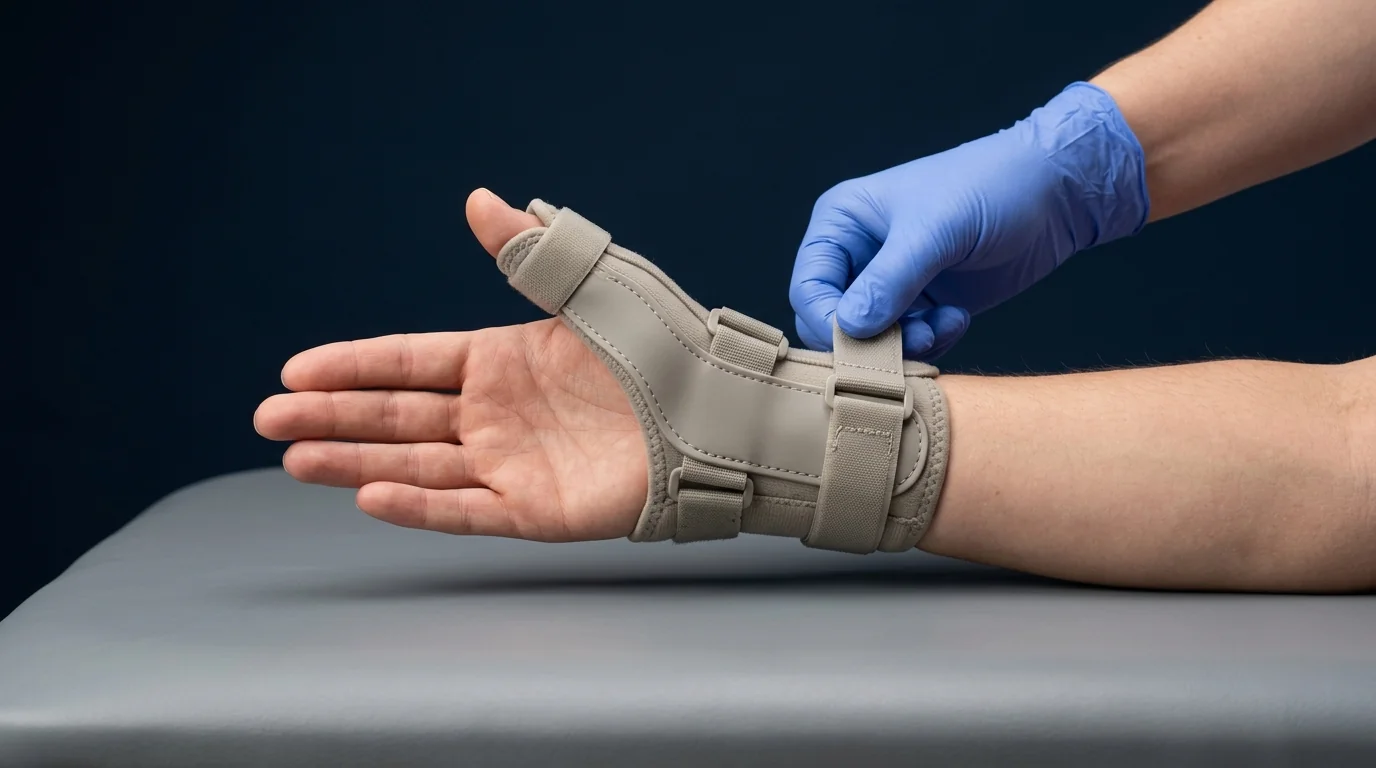 The decision to use a thumb spica splint is driven by a specific diagnosis requiring immobilisation of the thumb's basal joints. Its application is not interchangeable with a standard wrist brace.
Key indications include:
- Scaphoid Fractures: This is the textbook indication. For both suspected and confirmed non-displaced fractures of the scaphoid, immobilisation of the wrist and thumb is critical to promote healing and prevent non-union, given the bone's tenuous blood supply.
- De Quervain's Tenosynovitis: This condition involves inflammation of the tendons (abductor pollicis longus and extensor pollicis brevis) on the thumb side of the wrist. A spica splint provides rest to these tendons, reducing irritation and pain.
- Thumb Ligament Injuries: Injuries to the ulnar collateral ligament (UCL) of the MCP joint, commonly known as "Skier's Thumb" or "Gamekeeper's Thumb," require stabilisation to allow the ligament to heal.
- Basal Thumb Arthritis: For patients with osteoarthritis of the CMC joint, a spica splint can provide support, reduce pain during flare-ups, and improve function by stabilising the joint.
- Post-Operative or Post-Reduction Support: Following surgical repair of thumb ligaments or closed reduction of certain fractures (like a Bennett's fracture), a spica splint is used to protect the site and maintain alignment.
Material and Design Considerations: Prefabricated vs. Custom
The choice between a ready-to-use prefabricated splint and a custom-moulded one is a significant operational decision, balancing immediate need with clinical specificity.
| Feature | Prefabricated Splint | Custom-Moulded Splint |
| Primary Materials | Neoprene, breathable foam, nylon, with embedded aluminium or plastic stays. | Thermoplastic sheets (e.g., Polyform, Aquaplast), padded liners. |
| Speed of Application | Immediate. Can be applied in minutes in an ER or OPD setting. | Requires 15-30 minutes for heating, moulding, and finishing. |
| Skill Requirement | Minimal training required for correct application. | Requires a trained Occupational or Physiotherapist. |
| Typical Use Case | Acute injuries, suspected fractures, inflammatory conditions like De Quervain's. | Complex fractures, long-term arthritic support, post-operative care requiring a precise fit. |
| Inventory Management | Simpler. Sized (S, M, L) or universal models can be stocked. | Requires stocking of raw thermoplastic sheets, strapping, and heating equipment. |
For most high-volume departments like Casualty and Ortho OPD, stocking high-quality prefabricated splints is the most efficient approach. Many modern prefabricated options, such as a well-designed Dyna thumb spica splint made from breathable materials, feature a malleable metal stay that can be contoured to the patient's anatomy, offering a good compromise between a universal fit and individual customisation.
Key Evaluation Criteria for Procurement and Clinical Use
When evaluating thumb spica splints for your facility, move beyond the basics and assess the features that directly impact clinical efficacy and patient compliance.
- Degree of Immobilisation: The primary function. The internal stay must be rigid enough to effectively prevent movement at the CMC and MCP joints. Check if the stay extends sufficiently along the thumb and wrist. A flimsy stay renders the splint ineffective for fracture management.
- Material Quality and Breathability: In our climate, skin maceration is a real concern. Prioritise splints made from breathable, perforated, or moisture-wicking fabrics. The material should also be durable and free of common irritants like latex.
- Adjustability and Anatomical Fit: A good splint will have multiple fastening points—typically three or four hook-and-loop straps at the forearm, wrist, and thumb. This allows for a secure fit and accommodates post-injury swelling. While universal (left/right) models simplify inventory, hand-specific splints often provide superior anatomical contouring.
- Radiolucency: For fracture follow-ups, a splint with a removable stay is operationally superior. It allows for X-rays to be taken without removing the entire support structure, saving clinical time and improving patient comfort.
- Ease of Use: The fastening system should be intuitive for both clinicians and patients (or their caregivers). Complex strapping can lead to incorrect application and poor compliance.
- Durability and Hygiene: For conditions requiring long-term wear, assess the quality of the stitching and fasteners. The material should be hand-washable with mild soap and water to maintain hygiene.
Application and Patient Guidance: A Standard Operating Procedure
Correct application is as important as the splint itself. An improperly fitted splint can create pressure points or fail to provide adequate support.
- 1. Sizing: For sized splints, measure the patient's wrist circumference as per the manufacturer's guidelines. Ensure the splint length is appropriate for the patient's forearm.
- 2. Contouring the Stay: If the splint has a malleable stay, remove it and carefully bend it to match the contours of the patient's thenar eminence and forearm. The goal is a snug fit with no pressure spots. Re-insert the stay.
- 3. Positioning the Hand: Place the patient's hand in a functional position: wrist at 15-20 degrees of extension and the thumb abducted (the "grasping a can" position).
- 4. Securing the Straps: Apply the splint. Secure the forearm and wrist straps first to anchor the splint, then secure the thumb strap. Straps should be snug enough to prevent movement but not so tight that they restrict circulation.
- 5. Checking for Comfort and Circulation: Ask the patient about any pinching or discomfort. Check the capillary refill in the fingernails to ensure blood flow is not compromised.
- 6. Patient Education: This is a critical final step. Instruct the patient on signs of a poor fit (numbness, tingling, swelling, skin discolouration), how to perform basic finger exercises to prevent stiffness, and proper skin care and hygiene for the splinted area.
Equip Your Facility Today
Ensuring your orthopaedic, emergency, and physiotherapy departments are equipped with reliable, well-designed splints is fundamental to consistent patient care. For a full selection of orthopaedic supports, including various types of splints and braces suitable for a range of clinical needs, explore the comprehensive catalogue available on MedikaBazaar.
FAQs

