

Dentist
Orikam Alginate Powder: The Complete Guide to Neoalgin Dental Alginate
Complete guide to Orikam Neoalgin alginate: composition, water-powder ratio, setting time, impression steps, common errors & where to buy it in India.

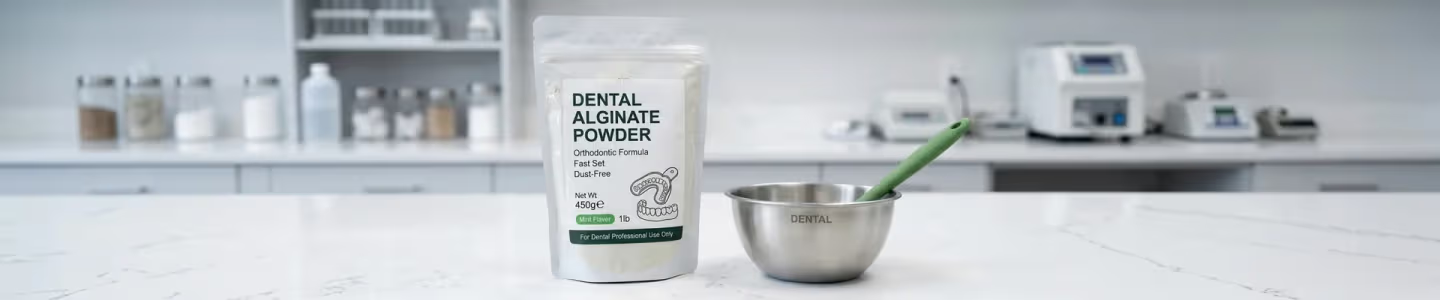
Alginate is the most widely used impression material in dentistry, and Orikam Neoalgin is one of the most popular alginate powders in Indian clinics. This guide covers everything you need to know: what alginate is, its composition and setting reaction, the correct water-powder ratio, how to mix and take an alginate impression, how to disinfect and store it, the most common errors, and how to choose a reliable Orikam alginate powder supplier.
Orikam Neoalgin at a Glance
| Specification | Orikam Neoalgin Dental Alginate |
| Type | Dust-free, non-chromatic alginate impression material |
| Colour and flavour | Sky blue, spearmint |
| Working time | About 30 seconds* |
| Setting time in the mouth | About 60 seconds* |
| Consistency | Thixotropic, for smooth, bubble-free mixing |
| Mixing method | Manual or automatic mixer |
| Yield | About 25 impressions per 450gm pack (medium trays) |
| Standard | ISO 1563 |
| Pack | 450gm foil pouch |
| Country of origin | India |
*As stated on the product listing. Always confirm times with the instructions supplied with your batch.
What Is Alginate Impression Material?
Alginate impression material is an irreversible hydrocolloid: a powder that, when mixed with water, turns into a paste and then sets into a flexible, elastic gel. "Irreversible" means that once it sets, it cannot be softened and reused, unlike agar (a reversible hydrocolloid). Alginate is derived from alginic acid, a natural polysaccharide extracted from brown seaweed.
Dentists prefer alginate because it is easy to mix, sets quickly, captures good surface detail, is comfortable for patients and costs far less than elastomeric materials. It is the standard choice for preliminary impressions, study models and orthodontic records.
Uses of Alginate in Dentistry
Alginate is used wherever good accuracy is needed without the cost of a final impression material. Common applications include:
- Study models and diagnostic casts for treatment planning
- Orthodontic records, retainers and aligner planning
- Preliminary impressions for complete and removable partial dentures
- Opposing (antagonist) arch impressions for crown and bridge work
- Impressions for temporary crowns and bridges
- Custom trays, bleaching trays, mouthguards and night guards
Orikam Neoalgin is indicated for removable prostheses, study models, temporary crown and bridge impressions, and antagonist models in fixed and removable prosthodontics.
Composition of Alginate Impression Material
Most alginate powders share a similar formulation. The table below shows a typical alginate powder composition and what each ingredient does.
| Ingredient | Typical amount | Function |
| Potassium or sodium alginate | ~15% | Main reactive ingredient; dissolves in water and forms the gel |
| Calcium sulphate dihydrate | ~16% | Reactor; releases calcium ions that cross-link the alginate |
| Trisodium phosphate | ~2% | Retarder; controls working and setting time |
| Diatomaceous earth | ~60% | Filler; adds strength, stiffness and body |
| Zinc oxide | ~4% | Filler; improves the properties of the set gel |
| Potassium titanium fluoride | ~3% | Accelerator for gypsum; gives a smooth, hard cast surface |
| Colour, flavour, glycols | Traces | Patient comfort; glycols make dust-free alginates less dusty |
Setting Reaction of Alginate
When alginate powder is mixed with water, the calcium sulphate starts releasing calcium ions. The trisodium phosphate reacts with these ions first, which gives you working time. Once the retarder is used up, the calcium ions cross-link the soluble potassium alginate into an insoluble calcium alginate gel. This is the setting reaction, and it cannot be reversed.
Types of Dental Alginate
| Type | Setting time | Best for |
| Fast set (Type I) | About 1–2 minutes | Quick impressions, children, patients with a strong gag reflex |
| Normal set (Type II) | About 2–4.5 minutes | Full-arch impressions, beginners, complex cases |
| Chromatic | Varies | Colour change shows mixing, loading and insertion stages |
| Dust-free | Varies | Cleaner handling and less airborne dust (Orikam Neoalgin is dust-free) |
Browse fast set, normal set, chromatic and dust-free options in our dental alginate range.
Properties of Alginate Impression Material
- Elasticity: the set material flexes over undercuts and springs back when removed.
- Tear strength: good alginate resists tearing in thin sections and interproximal areas. Removing the impression with one quick snap improves tear resistance.
- Detail reproduction: adequate for study models and preliminary work, though not as fine as elastomers.
- Dimensional stability: relatively poor. Set alginate loses water and shrinks (syneresis) or absorbs water and swells (imbibition), so it must be poured quickly.
- Gypsum compatibility: alginate works well with dental plaster and stone when the impression is properly rinsed.
Alginate Water-Powder Ratio
The alginate water-powder ratio has a direct effect on strength, setting time and accuracy. Always use the powder scoop and water measure supplied by the manufacturer, because scoop sizes differ between brands.
- A common guide is two scoops of powder with two measures of water for a lower arch, and three of each for an upper arch. Tray size and brand instructions may change this.
- Use clean water at room temperature (around 20–23°C).
- Add water to the bowl first, then the powder, to reduce dust and lumps.
| Change | Effect |
| Too much water | Weak, runny mix; longer setting time; lower tear strength |
| Too little water | Thick, grainy mix; shorter working time; poor detail |
| Warm water | Faster setting, less working time |
| Cold water | Slower setting, more working time |
How to Mix Alginate (Manipulation)
Correct manipulation of alginate is the key to a smooth, void-free impression.
- Shake or tumble the pouch gently before opening to loosen the powder, and reseal it immediately after use.
- Measure the water into a clean rubber mixing bowl, then add the measured powder.
- Stir gently until the powder is wet, then spatulate vigorously in a figure-of-eight motion, pressing the mix against the side of the bowl. This removes air bubbles.
- Mix until smooth and creamy, usually within 30–45 seconds, or as the manufacturer directs. Fast-setting materials like Neoalgin leave little time, so work efficiently.
- Load the tray immediately and smooth the surface with a wet gloved finger.

How to Take an Alginate Impression
Before You Start
- Choose a perforated or rim-lock tray that covers the whole arch with 4–6 mm of space for the material.
- Apply tray adhesive if using a non-perforated tray.
- Seat the patient upright, explain the procedure and ask them to rinse to reduce saliva.
Mandibular (Lower) Alginate Impression
- Rotate the loaded tray into the mouth from one side.
- Centre it over the teeth and seat it from back to front.
- Ask the patient to lift the tongue and then relax it, so the material records the floor of the mouth.
- Pull the cheeks and lips out gently to capture the vestibule, and hold the tray still until set.
Maxillary (Upper) Alginate Impression
- Stand behind or beside the patient and insert the tray from one side.
- Seat the back of the tray first, then the front, so excess material flows forward rather than down the throat.
- Tilt the patient's head slightly forward and ask them to breathe through the nose to reduce gagging.
- Hold the tray steady with light pressure until the material sets.
Removing the Impression
Wait until the alginate is no longer tacky, then break the seal and remove the tray with one quick snap along the long axis of the teeth. A slow, rocking removal causes tearing and distortion. Taking the lower impression first often helps patients cope better with the upper one.
Disinfection, Storage and Pouring Time
Alginate impressions must be handled quickly to stay accurate.
- Rinse the impression under cool running water to remove saliva and blood.
- Disinfect it with a disinfectant approved for alginate (such as a sodium hypochlorite or iodophor spray), following your clinic's infection-control protocol. Spraying is preferred over long immersion, which can cause swelling.
- Store briefly in a sealed bag with a damp paper towel if it cannot be poured at once. Do not soak it in water or leave it exposed to air.
- Pour it in dental stone or plaster as soon as possible, ideally within 10–15 minutes, or within the time stated by the manufacturer.
- Separate the cast once the gypsum has fully set, usually after about 45–60 minutes, and do not leave the cast in the impression for hours.
Common Alginate Impression Errors and How to Fix Them
| Problem | Likely cause | How to prevent it |
| Air bubbles or voids | Air trapped during mixing or loading | Spatulate against the bowl wall; load from one side |
| Grainy, lumpy material | Too little water or short mixing time | Follow the ratio; mix until smooth and creamy |
| Tearing | Thin material, early removal or slow removal | Use the right tray; wait until set; remove with a snap |
| Distorted cast | Delayed pouring, tray movement, or rocking removal | Hold the tray still; pour promptly |
| Rough or chalky cast surface | Saliva left on impression or excess water | Rinse and gently blot before pouring |
| Setting too fast | Warm water or high room temperature | Use water at room temperature or slightly cooler |
Alginate vs Agar vs Silicone Impression Material
| Feature | Alginate | Agar | Addition silicone |
| Type | Irreversible hydrocolloid | Reversible hydrocolloid | Elastomer |
| Accuracy | Good | Very good | Excellent |
| Dimensional stability | Low; pour quickly | Low; pour quickly | High; can be poured later |
| Equipment needed | None | Conditioning bath | Dispenser or mixing tips |
| Cost | Low | Moderate | High |
| Typical use | Study models, preliminary impressions | Duplication, some final impressions | Final crown, bridge and implant impressions |
Alginate, including Orikam Neoalgin, is not recommended for final impressions for crowns and bridges. Use an elastomeric material, such as addition silicone, for that work.
Orikam Neoalgin vs Other Alginates
| Feature | Orikam Neoalgin | Economy alginate | Premium chromatic alginate |
| Detail reproduction | Good to very good | Adequate | Excellent |
| Tear strength | Good | Fair to poor | Very good |
| Dust-free formula | Yes | Often not | Usually yes |
| Setting indicator | None (time-based) | None (time-based) | Colour change |
| Cost per impression | Moderate | Low | High |
| Batch consistency | High | Variable | High |
Orikam Neoalgin sits in the practical middle ground. It avoids the re-takes that cheap alginates can cause, without the higher cost of chromatic alginates, which makes it well suited to high-volume study models and routine impressions.
How to Choose a Reliable Orikam Alginate Powder Supplier
The right material only performs if it reaches your clinic in good condition. When sourcing Orikam alginate powder, check the following:
- Authenticity: buy from Orikam or its authorised distributors to avoid counterfeit or poorly stored stock.
- Freshness and shelf life: alginate typically has a shelf life of 2–3 years from manufacture. Check the manufacturing and expiry dates, and lot numbers on delivery.
- Storage conditions: alginate powder absorbs moisture. It should be stored in a cool, dry place in sealed foil pouches.
- Compliance: look for conformity with ISO standards for hydrocolloid impression materials (ISO 1563 or its successor, ISO 21563).
- Pricing and invoicing: transparent bulk pricing and GST-compliant invoices simplify purchasing for clinics and hospitals.
Why Buy Orikam Neoalgin from Medikabazaar
- 100% authentic products sourced from brands and authorised distributors
- Competitive B2B pricing with bulk options for clinics, hospitals and dental colleges
- GST invoices on every order
- Pan-India delivery, including Tier-2 and Tier-3 cities
- One-stop sourcing for alginate, mixing bowls, spatulas, trays, dental stone and other consumables
Buy Orikam Neoalgin Dental Alginate online at the best B2B price, or explore the full dental alginate collection to compare Zhermack, DPI, Prime Dental, GC and other brands.
FAQs

