

Hospitals
Selecting the Right Gauze: A Clinical and Operational Breakdown
An operational guide for procurement managers and clinicians on selecting medical gauze. Covers types, material science, sterility, and standards for hospital use.


Gauze is one of the most fundamental consumables in any healthcare facility, from a multi-speciality OT to a local dental clinic. Its ubiquity, however, often masks the critical operational and clinical decisions involved in its selection and management. Sourcing the correct type of gauze is not a trivial matter; it directly impacts patient outcomes, infection control, and procedural efficiency.
This guide moves beyond the basics to provide a functional breakdown for procurement heads, senior clinicians, and operations managers. We will examine the material science, construction, and compliance standards that differentiate one gauze product from another, ensuring you specify the right consumable for the right clinical application.
Understanding Gauze Fundamentals: Beyond the Basic Weave
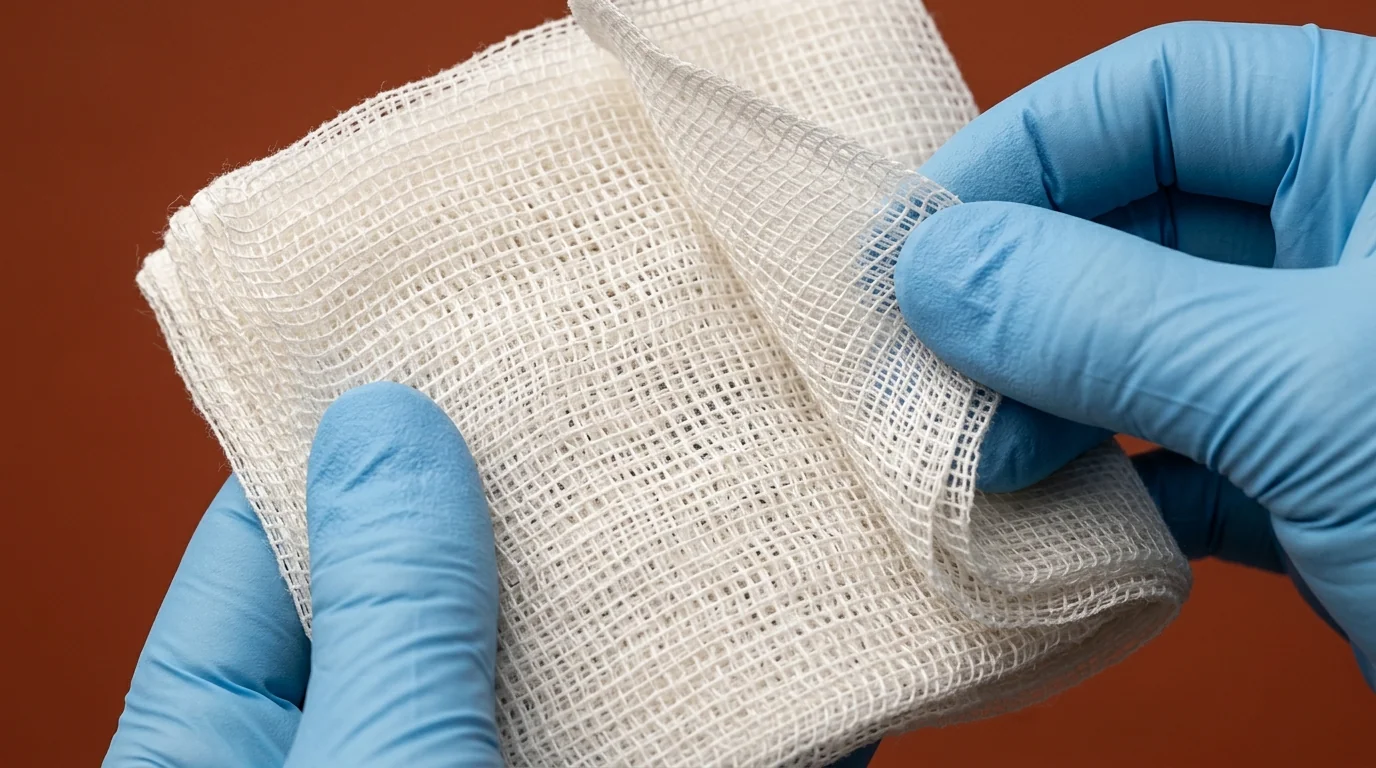 The effectiveness of any gauze product begins with its core construction. Understanding these properties is the first step in making an informed sourcing decision.
- Material Science: The base material dictates absorbency, texture, and biocompatibility.
- 100% Cotton: This remains the clinical standard for its high absorbency, softness, and breathability. It's gentle on tissues, making it suitable for direct wound contact.
- Synthetic & Blended Fibres (Polyester/Rayon): These materials are often used in non-woven gauze. They produce significantly less lint than woven cotton, a critical feature for applications where particulate contamination is a concern. They also offer excellent wicking action, pulling fluid away from the wound surface.
- Weave and Thread Count (Mesh): For woven gauze, the construction of the weave is defined by its thread count, often classified by Indian Pharmacopoeia (IP) standards.
- Type VII / Type 13: A looser weave (e.g., 20 x 12 threads per square inch). This construction is excellent for packing wounds or for debridement, as the open structure helps trap and remove debris.
- Type VIII / Type 17: A tighter, denser weave (e.g., 24 x 20 threads per square inch). This type offers higher tensile strength and greater absorbency, making it ideal for creating primary wound dressings and for surgical sponging.
- Ply and Size:
- Ply: Refers to the number of layers folded together to form the sponge or pad. Common configurations are 8-ply, 12-ply, and 16-ply. Higher ply counts provide greater cushioning and absorbency without increasing the surface area.
- Size: Standard sizes like 5x5 cm, 7.5x7.5 cm, and 10x10 cm are used for a vast range of applications, from cleaning small sites to dressing medium-sized wounds.
Woven vs. Non-Woven Gauze: A Functional Comparison
The choice between woven and non-woven gauze is application-dependent. Neither is universally superior; they are simply engineered for different tasks.
| Feature | Woven Gauze | Non-Woven Gauze |
| Structure | Interlaced cotton threads | Pressed and bonded synthetic fibres |
| Primary Advantage | High mechanical strength, excellent for scrubbing & packing | High absorbency, low lint, superior softness |
| Key Weakness | Can fray at edges, potential for linting | Lower tensile strength, not ideal for debridement |
| Common Uses | Wound packing, surgical sponging, mechanical debridement | Primary and secondary dressings, skin prep, applying ointments |
At a glance: For procedures requiring physical strength, such as packing a deep wound or aggressive debridement, woven gauze is the instrument of choice. For general wound dressing, cleaning, and applications where lint control is paramount, non-woven gauze provides a distinct advantage.
The Critical Distinction: Sterile vs. Non-Sterile Gauze
This is the most crucial classification from an infection control and patient safety perspective. Misusing one for the other has serious clinical implications.
- Sterile Gauze:
- Process: Sterilized, typically by Ethylene Oxide (EO) or gamma radiation, and sealed in individual peel-open pouches.
- Mandatory Use: Any procedure that breaks the skin barrier. This includes dressing open wounds, surgical site preparation, and use within any sterile field (OT, cath lab, minor procedure rooms).
- Procurement Focus: Packaging integrity is paramount. The pouches must be durable enough to withstand storage and handling without being compromised. Check for clear sterilization indicators and expiry dates.
- Non-Sterile (Bulk) Gauze:
- Process: Manufactured in a clean environment but not subjected to a terminal sterilization process. It is typically supplied in larger packs or rolls.
- Acceptable Use: General purpose cleaning of intact skin, secondary dressing layers (to secure a primary sterile dressing), padding, or cushioning where the gauze does not make direct contact with broken skin or a wound bed.
- Procurement Focus: Bulk packaging efficiency and storage conditions. Even though non-sterile, it must be stored in a way that prevents gross contamination from dust or moisture.
Specialized Gauze Types for Specific Clinical Needs
Beyond standard pads and sponges, several specialized gauze products are designed for particular clinical challenges.
- X-Ray Detectable (XR) Gauze: This is a non-negotiable patient safety requirement for all invasive procedures. A barium sulfate thread is woven into the gauze, making it visible on post-operative X-rays. This is the single most effective countermeasure against retained foreign objects (gossypiboma), a significant and preventable medical error. Procuring high-quality, sterile X-ray detectable gauze swabs is a foundational responsibility for any surgical department.
- Gauze Than/Mops: These are large, highly absorbent pads, often with a stitched loop or tail for easy retrieval. They are used in major surgeries (abdominal, thoracic) for packing and absorbing large volumes of fluid. Sourcing a range of specialized gauze than and abdominal mops ensures your OTs are prepared for complex cases with significant blood loss.
- Impregnated Gauze: These are pre-treated with substances to provide additional therapeutic benefits. Common examples include petrolatum gauze for a non-adherent dressing on burns or skin grafts, and iodoform gauze for packing infected wounds due to its antimicrobial properties.
- Gauze Rolls/Bandages: These are long strips of woven gauze used for securing dressings, providing light compression, and conforming to difficult body contours like joints.
An Operational Checklist for Sourcing Gauze
Use this framework to evaluate and standardize your facility's gauze procurement.
- Clinical Application Mapping:
- OT/Cath Lab/Minor Procedures: Sterile, X-ray detectable woven gauze is mandatory.
- ICU/Wards/Post-Op Care: Sterile woven or non-woven for dressing changes on open wounds.
- OPD/Casualty: A mix of sterile packs for minor procedures and non-sterile bulk packs for cleaning intact skin.
- Dental: Sterile pads for post-extraction care; non-sterile rolls for general absorption.
- Compliance and Quality Standards:
- Verify manufacturer compliance with Pharmacopoeia standards (IP, BP, USP).
- Confirm the manufacturer holds ISO 13485 certification, indicating a robust quality management system for medical devices.
- For sterile products, ensure compliance with Schedule M-III of the Drugs and Cosmetics Act, as regulated by the CDSCO.
- Packaging and Sterility Assurance:
- Assess the durability of sterile packaging. Can it be opened aseptically without tearing or shedding fibres?
- Are expiry dates and lot numbers clearly legible for tracking and inventory management?
- Physical Property Evaluation:
- Request samples to assess absorbency, linting, and strength. A gauze that falls apart when wet is unsuitable for debridement.
- Check for foreign particles, stains, or weaving defects in the material.
- Supplier and Supply Chain:
- Partner with suppliers who can guarantee consistent batch-to-batch quality.
- Ensure a stable supply chain to prevent stock-outs of this high-volume, critical item.
Best Practices for Storage and Handling
Proper storage and handling are as important as proper selection to maintain product integrity and patient safety.
- Storage: Always store gauze in a cool, dry, and clean environment, away from direct sunlight and potential contaminants.
- Inventory Management: Implement a strict First-Expiry, First-Out (FEFO) system to minimize waste.
- Segregation: Maintain clear physical separation between sterile and non-sterile stock to prevent accidental misuse.
- Pre-Use Inspection: Train clinical staff to inspect every sterile pack for damage (tears, watermarks, broken seals) before opening. If the package integrity is compromised, it is considered non-sterile and must be discarded.
- Disposal: Used gauze is considered biomedical waste. Dispose of it according to your facility's protocol and national guidelines, typically in a yellow or red bag depending on the level and type of contamination.
Equip Your Facility Today
Ensuring your departments are equipped with the appropriate gauze for every clinical scenario is fundamental to patient care and operational efficiency. A well-managed inventory of high-quality, compliant gauze products reduces clinical risk and supports better procedural outcomes. Explore a comprehensive range of sterile, non-sterile, and specialized gauze consumables to meet your facility's specific requirements.
FAQs

