

Hospitals
Kelly Forceps in Clinical Practice: The Complete Guide to Types, Uses, and Sourcing
Understand the mechanics of Kelly hemostatic forceps. From placenta removal to vascular occlusion, get professional insights on sourcing surgical forceps in bulk.


Kelly forceps, also known as hemostats or hemostatic forceps, are a type of locking forceps used primarily in the medical field for clamping blood vessels and controlling bleeding during surgical procedures. They provide immediate hemostatic control, reducing the risk of complications associated with blood loss, such as hypovolemic shock, which can be life-threatening.
What Are Kelly Forceps and Their Primary Clinical Uses?
Kelly Forceps are, stainless steel locking, hinged instruments used in medicine to clamp, grab, and hold tissues or vessels, commonly for hemostasis (stopping blood flow) during surgery, with transversally serrated jaws that extend halfway or three-quarters down the length. Available in straight or curved designs, they act as a medium-sized, versatile clamp essential for general surgery, gynecology, and emergency medicine.
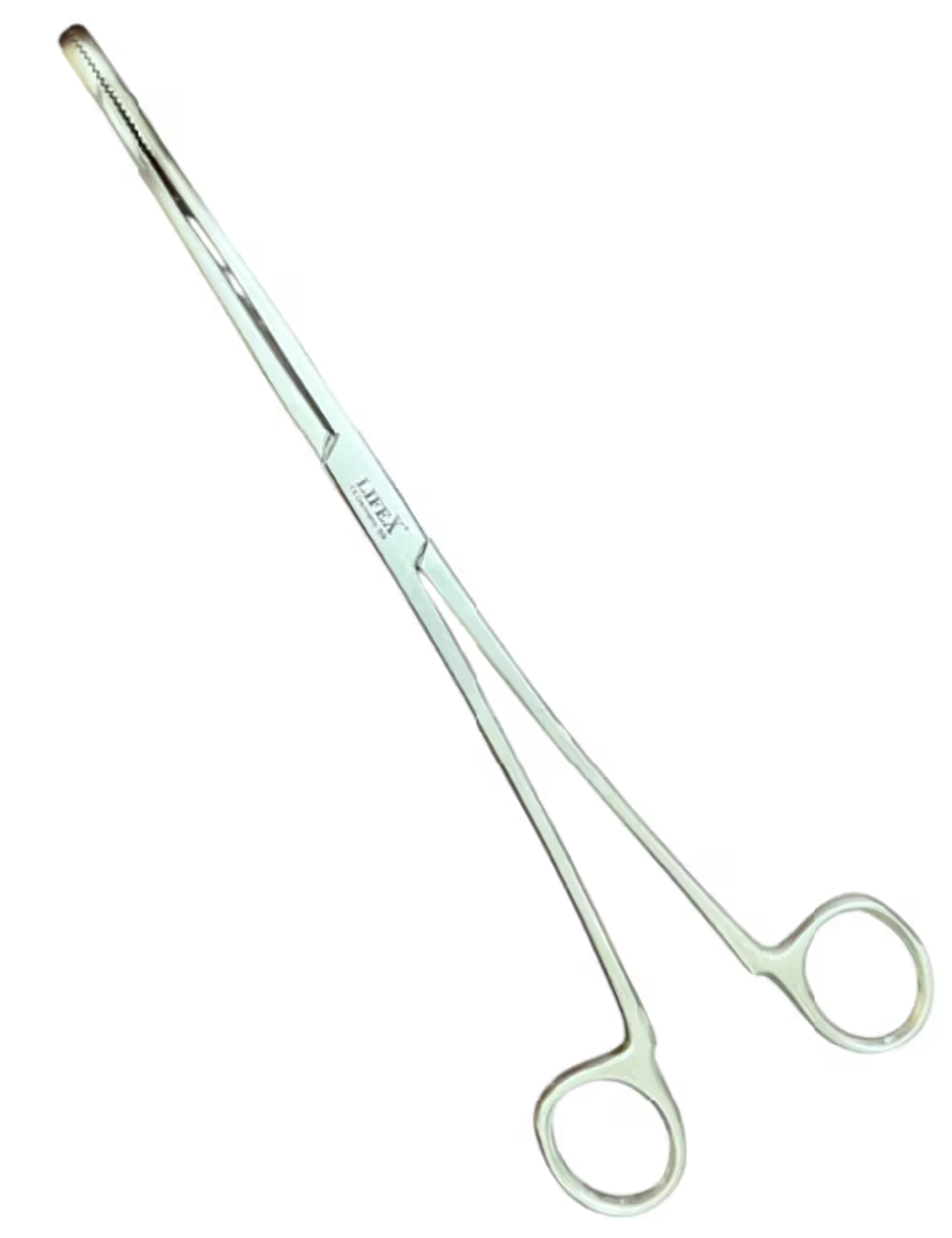
Key Features and Uses of Kelly Forceps -
- Purpose: Primarily designed for hemostasis (controlling blood flow) and handling heavy tissues
- Design: These forceps have serrated jaws that span only the distal half (approx. 5.5 inches) of the instrument, distinguishing them from Crile forceps, which have serrations along the entire jaw
- Locking Mechanism: Equipped with a ratcheted finger-ring handle to lock the clamp securely in place
- Types: Available in both straight and curved forms
Kelly Hemostatic Forceps vs. Kelly Artery Forceps: Key Differences
In surgical practice, Kelly Hemostatic Forceps and Kelly Artery Forceps are two names for the same instrument. These terms are used interchangeably in the Operating Room (OR) to describe a specific type of locking clamp used to achieve hemostasis.
Kelly hemostatic forceps and Kelly artery forceps are generally the same instrument, often referred to interchangeably as "Kelly clamps." They are 5.5-inch surgical tools featuring blunt, serrated jaws (fully or partially) with a ratcheting mechanism, designed for clamping medium-sized vessels or grasping tissue. Key distinctions lie in, at most, subtle variations of manufacturer design rather than function.
Comparison: Kelly vs. Crile Forceps
While they look identical at first glance and are both approximately 14 cm (5.5 inches) long, the serration pattern is the key differentiator:
| Feature | Kelly Forceps | Crile Forceps |
| Serration Coverage | Distal half only (Half-serrated) | Full length of the jaws |
| Best Used For | Clamping medium-to-large vessels and manipulating heavy/fatty tissue | Clamping medium-to-large vessels where a full-length grip is needed |
| Tissue Trauma | Lower (due to smooth proximal portion) | Higher (serrations run the entire length) |
Exploring Variations: Kelly Long Forceps and Placenta Forceps
Kelly Long Forceps and Kelly Placenta Forceps are specialized, often overlapping, gynecological instruments designed for procedures requiring deep access within the uterine cavity. They are essential tools for obstetricians and gynecologists, particularly for the removal of retained placenta and PPIUCD (Postpartum Intrauterine Contraceptive Device) insertions.
While the name "Kelly" often refers to standard 5.5-inch artery forceps, Kelly Long Forceps or similar Kelly-type instruments are utilized when increased length is required for deeper tissues. It is primarily used for clamping blood vessels, tissue manipulation, and handling during gynecological or general surgeries. Its serrated jaws are designed to securely grasp tissues, often half-serrated or fully serrated.
Kelly Placenta Forceps (PPIUCD Forceps) are specifically designed for obstetric care, particularly for managing the postpartum uterus. Primary used for removing retained placental tissue and inserting or removing PPIUCDs. The jaws are slightly curved with oval, fenestrated (hollow), and serrated jaws to firmly hold delicate tissues without causing excessive damage.
The Role of Kelly Tissue Forceps and Clamp Forceps in Surgery
In surgical settings, Kelly Forceps serves a dual role as both a grasping instrument and a hemostatic tool. While the term "forceps" generally refers to tools that grasp or manipulate, and "clamps" refers to tools that occlude or compress, Kelly instruments uniquely bridge these functions due to their locking mechanism and specialized jaw design.
When used as "tissue forceps," Kellys are valued for their ability to handle heavier or tougher structures where standard tweezers (thumb forceps) might slip. Surgeons use them to gently pull back or hold fatty and heavy tissues to expose the surgical site. They can hold the ends of sutures or assist in knot-tying during wound closure.
The primary surgical function of a Kelly clamp is hemostasis—the temporary stopping of blood flow by compressing a blood vessel. They are used to clamp medium-to-large blood vessels until they can be permanently closed via suturing or cauterization. : A built-in ratchet locking mechanism allows the clamp to maintain constant pressure on a vessel without the surgeon needing to hold it continuously.
How to Source High-Quality Surgical Instruments for Your Facility?
Sourcing high-quality surgical instruments is critical for patient safety, clinical precision, and long-term cost savings. Prioritize instruments made from premium, AISI-standard surgical-grade stainless steel for corrosion resistance and precise alignment. Partner with trusted, certified suppliers like Medikabazaar to ensure instruments meet strict ISO 13485 standards for durability and sterilization. Looking for Surgical Forceps?
FAQs

