

Labs
The Ultimate Guide to Bactigras Antiseptic Dressing: Application, Benefits, and Safety
Learn how to apply Bactigras gauze dressing correctly for wound healing. Discover how long to leave it on, when to change it, and how it prevents infection.


Bactigras Antiseptic Dressing is a highly effective wound care solution designed to soothe, protect, and prevent infections. This tulle gras dressing features chlorhexidine acetate, a proven antiseptic agent active against a wide range of Gram-positive and Gram-negative organisms, including MRSA.
Bactigras dressing is a gauze of leno weave impregnated with white soft paraffin BP containing 0.5% chlorhexidine acetate BP. Bactigras Dressing is proven to be antiseptically active and reduce bacterial colonization in vitro and in vivo. It is a sterilized dressing which is ready for immediate use. It is indicated for a wide range of wounds where there is a risk of infection, or already infected wounds in conjunction with systemic antibacterials. The open weave structure allows viscous exudate to pass through efficiently into an absorbent secondary dressing, facilitating optimal healing.
Bactigras Dressing is suitable for various wounds, including minor burns, scalds, donor sites, leg ulcers, and other skin loss wounds. Packaged in a sterile environment, this dressing ensures maximum safety and efficacy for clinical and personal use.
Indications:
The range of wounds on which Bactigras Dressing may be used include:
- Minor burns and scalds
- Lacerations
- Abrasions and other skin loss wounds
- Recipient graft sites
Direction to use:
- Selection -
Choose appropriately sized Bactigras dressing and cut-to-fit to size of wound. For a wound with depth, choose appropriate wound filler for amount of exudate expected and the anticipated frequency of dressing change. Choose secondary dressing based on amount of wound exudate expected and anticipated frequency of dressing change.
- Preparation -
Cleanse wound and periwound/surrounding skin with sterile normal saline or agency approved wound cleanser. Dry periwound/surrounding skin. If required and appropriate for cover dressing, apply barrier film to periwound skin. Refer to Product Information Sheet for cover dressing to determine if barrier film is appropriate.
- Application -
Remove protective papers from Bactigras. For wounds with minimal depth (less than 1 cm): lay Bactigras over wound in a single layer in direct contact with wound bed. For wounds with depth (more than 1 cm) or undermining: cover wound bed with single layer of Bactigras. Lightly fill the dead space up to skin level with appropriate wound filler. Apply secondary dressing to cover the wound.
- Removal -
Consider using adhesive remover to remove adhesives (e.g., border dressings, tape). Remove cover dressing and wound filler (if present). Gently lift the edge of Bactigras and remove from wound. If Bactigras sticks, soak it off gently using normal saline.
- Frequency of Dressing Change -
May be left in place up to 4 days. Secondary dressing can be changed while leaving Bactigras in place.
- Expected Outcomes -
Expected Outcomes S&S of wound infection resolved within 14 days. If used prophylactically, S&S of wound infection did not develop. Secondary dressing and Bactigras did not adhere to wound bed.
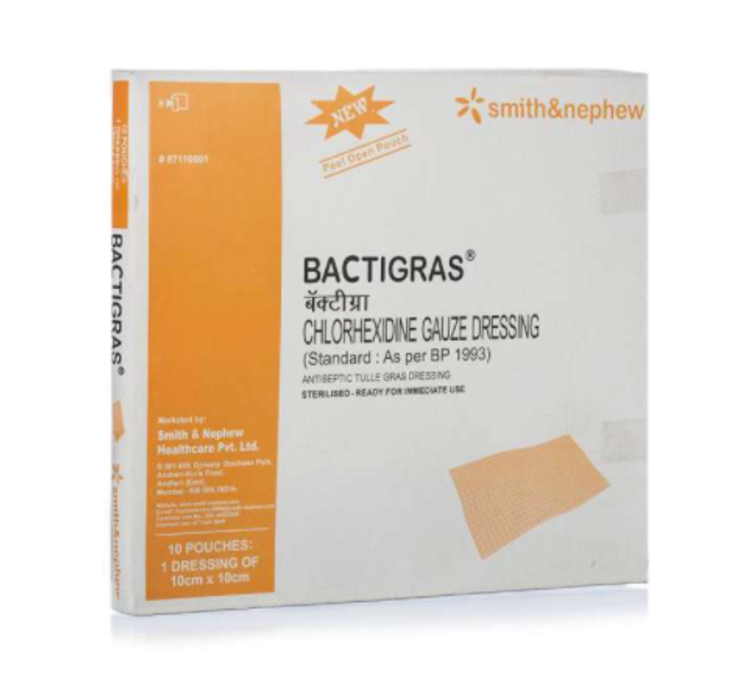
Key Benefits of Using Bactigras for Wound Care:
- Suitable for a wide range of wounds: Including burns, ulcers, minor burns and scalds, lacerations, abrasions and other skin loss wounds
- Facilitates the passage of viscous exudate: The open weave of BACTIGRAS Dressing facilitates the passage of viscous exudate into an absorbent secondary dressing
- Proven antiseptic: Bactigras Dressing is proven antiseptically active against a range of Gram-positive and Gram-negative organisms, including Meticillin-resistant Staphylococcus aureus (MRSA)
- Designed to soothe and protect: BACTIGRAS Dressing is intended to soothe, with chlorhexidine acetate whilst protecting the wound by minimizing the risk of infection
- Tulle sheet dressing: impregnated with Chlorhexidine 0.5% in white paraffin. Acts as a barrier between the wound and secondary dressing and allows exudate to pass through into the secondary dressing
- Chlorhexidine acetate antiseptic: Slowly released from the dressing. Can remain in place for up to four days, minimizing the need for frequent changes
Specifications:
- Designed to Soothe and Protect
- Chlorhexidine Gauze Dressing
- Used as a Wound Dressing
- Antiseptic Tulle Gras Dressing
- Standards as per BP 1993
- Each Dressing Size : 15cm X 1mtr Roll
- Sterilised - Ready For Immediate Use
FAQs

