

Hospitals
Dora Hollow Fiber Dialyzers: A Comparative Guide for Indian Nephrology Units
An operational guide for procurement teams comparing Dora Hollow Fiber Dialyzers (B-14P, B-13PF, B-16P). Evaluate key specs and select the right one for your facility.


As a procurement manager or clinical head, selecting the right hemodialysis consumables is a critical operational decision that directly impacts patient outcomes and unit efficiency. When evaluating options from any dialysis consumables supplier, the specifications of the dialyzer itself—the core component of the treatment—demand the closest scrutiny. This guide provides a structured, peer-to-peer comparison of three distinct Dora Hollow Fiber Dialyzer models to help you align your selection with your facility's specific clinical and operational requirements.
We will evaluate the B-14P, B-13PF, and B-16P models on their technical merits and ideal use cases, providing a clear framework for your team's decision-making process.
Initial Needs Assessment: A Checklist for Your Facility
Before comparing specific models, a rigorous internal needs assessment is essential. This ensures your final selection is grounded in your unit's reality, not just a catalogue listing.
- Patient Demographics: What is the average Body Surface Area (BSA) of your patient population? Do you serve a significant number of pediatric patients, or patients with low body weight?
- Treatment Volume: How many hemodialysis sessions does your unit conduct daily or weekly? This impacts inventory velocity and the need for a versatile, workhorse dialyzer versus more specialized options.
- Clinical Acuity: Are you primarily treating stable, chronic ESRD patients, or do you manage acute kidney injury (AKI) cases that may require gentler, lower-efficiency initial treatments?
- Equipment Compatibility: Confirm the connector types and performance parameters of your existing
dialysis machinefleet. Ensure the priming volume and required blood flow rates of a new dialyzer are compatible. - Storage and Logistics: Do you have the climate-controlled storage capacity for a
hollow fiber dialyzer pack of 24? Assess your supply chain from the supplier to your facility to ensure consistent availability.
Key Specifications for Technical Evaluation
When you order hemodialysis dialyzers, move beyond basic line items and evaluate these critical performance indicators.
- Membrane Surface Area (m²): This is the single most important factor determining a dialyzer's clearance capacity. A larger surface area generally provides more efficient removal of uremic toxins.
- Ultrafiltration Coefficient (Kuf; mL/hr/mmHg): This measures the rate of fluid removal. A higher Kuf is suitable for patients with significant fluid overload but requires precise control by the
dialyzer machineto prevent hypotension. - Solute Clearance (KoA): This indicates the efficiency of small molecule removal (e.g., urea, creatinine). Higher KoA values can contribute to achieving target Kt/V ratios more effectively.
- Priming Volume (mL): The amount of blood required to fill the dialyzer's blood compartment. Lower priming volumes are critical for pediatric patients, small adults, or those with anemia to minimize extracorporeal blood volume.
- Sterilization Method: The two common methods are Gamma irradiation and Ethylene Oxide (EtO). While both are effective, EtO can, in rare cases, be associated with hypersensitivity reactions in some patients. Knowing the method is a key part of clinical risk management.
- Regulatory & Quality Standards: Verify that the dialyzers are manufactured in an ISO 13485 certified facility. The presence of CE marking or other relevant certifications provides an additional layer of quality assurance.
Option 1: Dora Hollow Fiber Dialyzer - B-14P Pack of 24
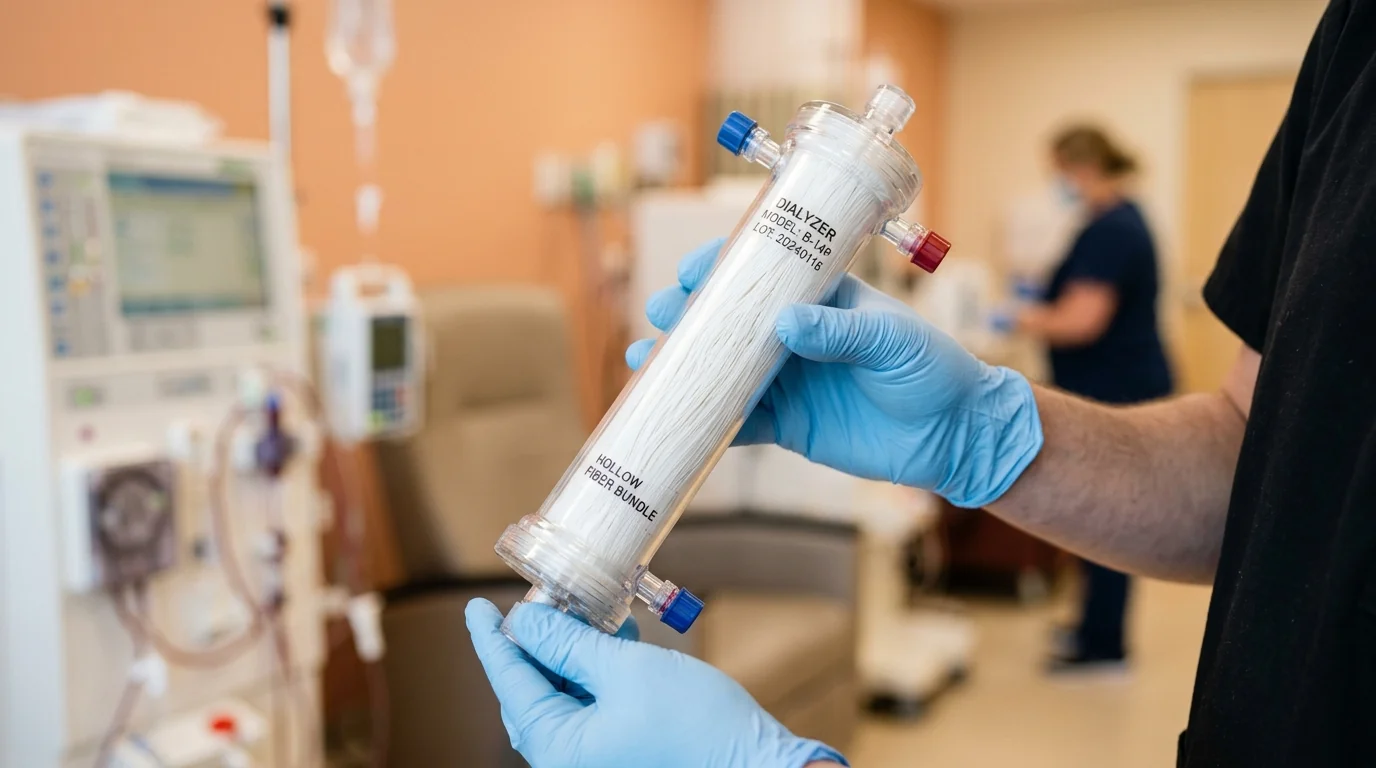 The B-14P is best understood as the standard, high-utility workhorse for a busy dialysis unit. With a probable membrane surface area around 1.4 m², this
 dora hollow fiber dialyzer b-14p model is engineered to provide a reliable balance of solute clearance and ultrafiltration for the average adult patient.
Ideal Use Case: Routine maintenance hemodialysis for stable, chronic end-stage renal disease (ESRD) patients with an average BSA. It is the default choice for high-volume centers where consistency and predictable performance across a broad patient population are paramount.
Clinical & Operational Strengths: Its specifications are designed to consistently meet Kt/V adequacy targets in standard 4-hour treatment sessions. The B-14P offers a dependable performance profile that technicians are familiar with, simplifying workflows and reducing the potential for operational variability in a busy clinical setting.
Option 2: Dora Hollow Fiber Dialyzer - B-13PF Pack of 24
The B-13PF model is a specialized tool for specific patient profiles. The "13" likely indicates a smaller membrane surface area (e.g., 1.3 m²), and the "F" suffix could denote finer fibers or a different membrane characteristic. This design points towards a lower priming volume and a gentler treatment profile.
Ideal Use Case: This dialyzer is indicated for patients with a lower body weight, pediatric patients (if specifications align), or individuals who are hemodynamically sensitive. It is also an excellent choice for the first few sessions for a new dialysis patient, where a less aggressive initiation to treatment is clinically prudent to avoid disequilibrium syndrome.
Clinical & Operational Strengths: The primary advantage is its lower extracorporeal blood volume, which helps mitigate the risk of intradialytic hypotension and reduces the need for saline boluses. For any facility treating a diverse patient population, having a stock of B-13PF dialyzers is essential for tailoring treatment to individual patient needs.
Option 3: Dora Hollow Fiber Dialyzer - B-16P Pack of 24
The B-16P represents the high-efficiency option in this lineup. With a probable surface area around 1.6 m², this dialyzer is designed for maximum solute clearance. It is a high-performance tool intended for patients who require more intensive toxin removal.
Ideal Use Case: This model is best suited for larger patients with a high BSA, those who are struggling to meet their Kt/V adequacy targets on smaller dialyzers, or in facilities that employ high-efficiency hemodialysis protocols to potentially shorten treatment times.
Clinical & Operational Strengths: Its main strength is superior clearance of both small and middle molecules. However, its effective use requires a dialysis machine capable of high blood flow rates and precise ultrafiltration control. It is a necessary option for optimizing care for a specific, more demanding patient subset.
At-a-Glance Comparison
This table summarizes the primary applications for each Dora dialyzer model.
| Feature | B-13PF | B-14P | B-16P |
| Probable Surface Area | Smaller (~1.3 m²) | Standard (~1.4 m²) | Larger (~1.6 m²) |
| Ideal Patient Profile | Low body weight, pediatric, sensitive patients | Average adult ESRD patients | Large BSA, patients needing higher clearance |
| Primary Clinical Use | Gentle initiation, low-volume requirements | Routine maintenance hemodialysis | High-efficiency or high-flux hemodialysis |
| Operational Role | Specialized, tailored care | Unit workhorse, high-volume consistency | Performance optimization, difficult cases |
Evaluating Your Medical Dialyzers Supplier
The product is only one part of the equation. Your supplier is a critical partner. Use this checklist to evaluate them:
- Supply Chain Resilience: Can they guarantee consistent stock and predictable delivery lead times to your location? What are their contingency plans for supply disruptions?
- Quality Assurance: Do they provide batch traceability and expiry date management? A reliable
medical dialysis filters supplywill have a clear, documented process for handling product issues or recalls. - Regulatory Documentation: Can the supplier readily provide a Certificate of Analysis (CoA) or documentation of ISO/CE compliance for the products?
- Clinical & Technical Support: Is there a knowledgeable point of contact who can answer specific questions about the
hollow fiber dialyzerand its application? - Product Portfolio: A supplier with a broad and deep inventory of other essential Nephrology supplies can streamline your overall procurement process. Exploring a comprehensive catalogue of Dialyzers can help consolidate vendors and improve logistical efficiency.
Common Procurement Pitfalls to Avoid
- Selection Based on Unit Metric Alone: A lower-performing dialyzer might require longer treatment times or additional medications (like phosphate binders), negating initial savings.
- Ignoring Clinical Team Input: The nephrologists and dialysis technicians who use the product daily must be integral to the vetting and selection process. Their feedback on performance and ease of use is invaluable.
- Failing to Trial a New Product: Before committing to a large volume, conduct a small-scale clinical trial in your unit to assess performance with your patient population and equipment.
- Overlooking Inventory Management: Shifting to a new dialyzer requires a clear plan to phase out old stock and manage the transition without disrupting patient care.
Choosing the right hollow fiber dialyzer is a strategic decision that balances clinical efficacy with operational reality. By systematically evaluating your patient needs, understanding the technical specifications of each model, and vetting your supply partner, you can equip your nephrology unit for consistent, high-quality patient care. For a full overview of consumables to support your dialysis services, explore the complete range of Nephrology products on MedikaBazaar.
FAQs

