

Hospitals
Core Considerations for Selecting a Clinical Trial Lens Set
An essential resource for procurement managers and clinicians on how to evaluate and select the right clinical trial lens set for accurate refraction and diagnostics.


In any ophthalmology or optometry department, the trial lens set is a foundational diagnostic tool. Its role goes far beyond simply checking a patient's power; it is the definitive instrument for subjective refraction, enabling the precise determination of a prescription that provides the clearest and most comfortable vision. For a procurement manager or head clinician evaluating options for clinical trial lens set acquisition, the decision hinges on precision, durability, and clinical workflow efficiency.
This guide provides a peer-level breakdown of the key factors to consider when selecting a new trial lens set for your facility. We will move beyond the basic component list to examine the material science, design features, and maintenance protocols that separate a workhorse instrument from a frequent source of clinical frustration.
What Constitutes a Standard Clinical Trial Lens Set?
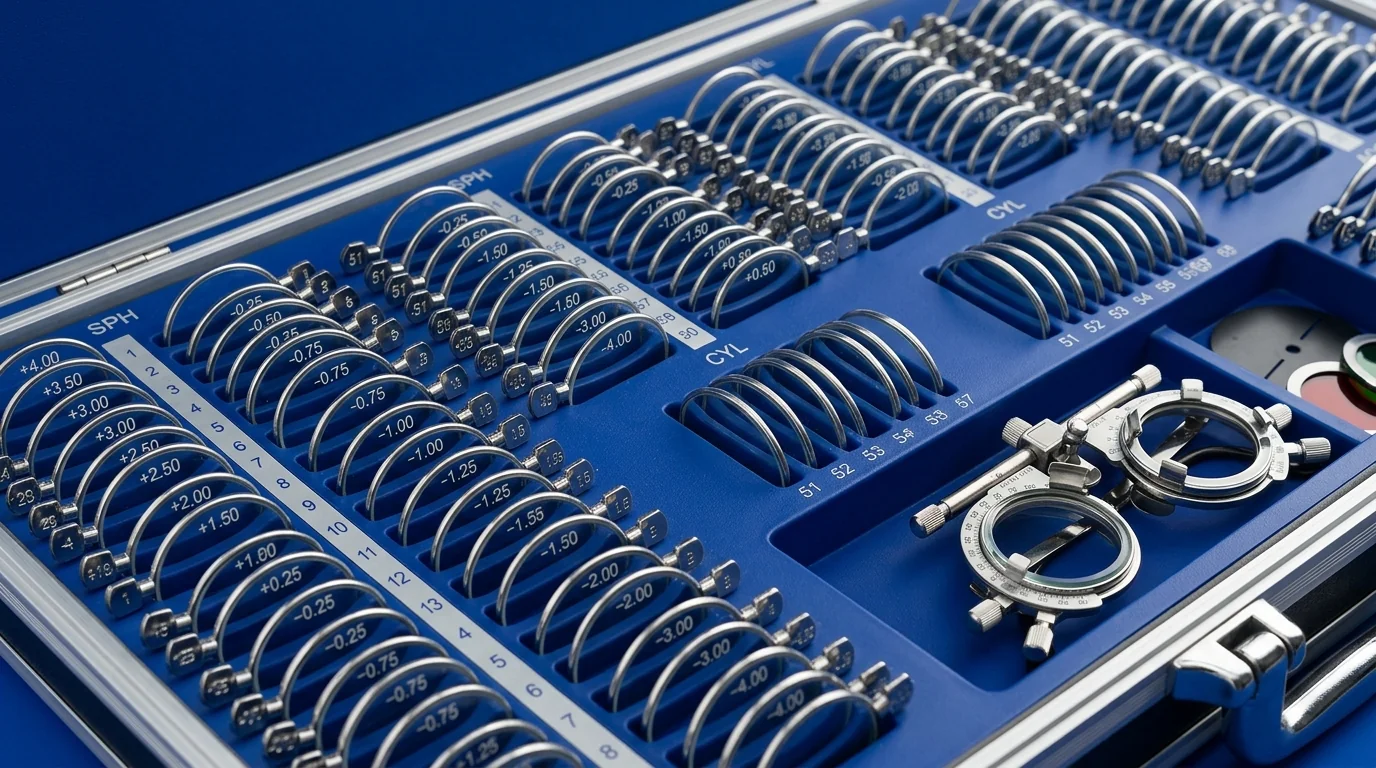 A comprehensive trial lens set is an organised collection of lenses and accessories that allows a clinician to systematically determine a patient's refractive error. While the total number of pieces can vary, a professional-grade set should contain the following core components:
- Spherical Lenses (Concave and Convex): These correct for myopia (nearsightedness) and hyperopia (farsightedness). A standard set includes a wide range of powers, typically from ±0.12 or ±0.25 Diopters (D) up to ±20.00 D, in precise 0.25 D increments for most of the range.
- Cylindrical Lenses (Concave and Convex): Used to correct for astigmatism. These typically range from ±0.25 D to ±6.00 D, also in 0.25 D steps. The axis markings on these lenses must be exceptionally clear and accurate.
- Prismatic Lenses: Essential for evaluating and quantifying phorias (latent eye deviations) and tropias (manifest strabismus). They are measured in prism diopters and are crucial for binocular vision assessment.
- Accessory Lenses: These specialised tools are non-negotiable for a thorough examination. Key accessories include:
- Occluder: To completely block vision in one eye during monocular testing.
- Pinhole Disc: To differentiate between refractive errors and vision loss from pathology.
- Maddox Rod: For detecting and measuring heterophorias.
- Stenopaeic Slit: To determine the principal meridians of astigmatism.
- Red & Green Filters: Used for Worth 4-dot tests and other binocular vision assessments.
- Jackson Cross Cylinder (JCC): The primary tool for refining both the axis and power of astigmatic correction.
Key Evaluation Criteria for Procurement and Clinical Use
Selecting a trial lens set requires a detailed look at its construction and design. These factors directly influence clinical accuracy, instrument lifespan, and ease of use in a busy OPD.
Lens Material and Optical Quality
The optical medium is the heart of the set. The two primary materials are crown glass and high-index plastic.
- Crown Glass: This is the traditional standard, offering superior optical clarity (high Abbe value, meaning low chromatic aberration) and excellent scratch resistance. The trade-off is weight; a full glass set is noticeably heavier.
- High-Index Plastic: Lighter than glass, which can reduce the weight of the trial frame on the patient's face during prolonged testing. However, plastic lenses are more susceptible to scratching and require meticulous handling and cleaning.
Key Consideration: For a high-volume public or private hospital, the durability and scratch resistance of glass often present a better long-term investment. An anti-reflective (AR) coating on the lenses is a critical feature, as it minimizes distracting reflections and improves light transmission for a more accurate refraction.
Rim Design, Markings, and Durability
The lens rim is a critical component for handling, identification, and longevity.
- Material: Metal rims (typically anodized aluminum) are far more durable than plastic. They resist cracking and flexing, ensuring the lens remains securely seated and centered.
- Markings: Diopter powers and cylinder axes must be permanently engraved or high-contrast printed. Faded or worn markings lead to clinical errors.
- Color-Coding: A standardized color scheme—typically red for concave/minus lenses and black or blue for convex/plus lenses—is essential for rapid, error-free lens selection during the refraction process.
Case, Layout, and Portability
The carrying case is an integral part of the system, not an accessory. A poorly designed case can slow down workflow and increase the risk of instrument damage.
- Organization: Look for a logical, clearly labeled layout. Lenses should fit snugly in their slots without rattling, but be easy to remove.
- Durability: A robust case with secure latches is necessary to protect the lenses from impact.
- The physical footprint is also a practical concern. The dimensions, such as those of the Sugra Trial Lens Set Golden and Silver - 50 x 35 x 10cm (SUGRA-002), determine how easily the set can be stored in a cabinet or moved between examination rooms.
The Trial Frame
Often sourced separately but sometimes included, the trial frame is as important as the lenses. An inadequate frame will compromise the results of even the highest quality lens set. Evaluate the frame for its range of adjustability, including pupillary distance (PD), vertex distance, pantoscopic tilt, and temple length.
Integrating the Trial Lens Set into Your Clinical Workflow
The trial lens set is the central tool for subjective refraction, but its utility is amplified when used correctly alongside other core ophthalmic instruments. The data it provides is fundamental to multiple diagnostic and therapeutic pathways.
For example, a complete ocular health examination may involve using a gonio lens to inspect the anterior chamber angle in glaucoma suspects. Subsequently, the trial lens set is used to determine the final refractive correction that maximizes the patient's vision post-treatment.
Its role is also critical in surgical planning. Before a patient undergoes cataract surgery with an intraocular lens (IOL) implant, the trial lens set is used for a precise manifest refraction. This data helps in IOL power calculation and in counseling the patient on their expected post-operative vision.
Furthermore, a patient's systemic health can directly influence refractive stability. For diabetic patients, a final prescription should only be determined when their blood glucose is stable. Cross-departmental awareness, even regarding a simple tool like a sugar testing kit, is part of a holistic approach to patient care that ensures refractive findings are accurate and not skewed by transient metabolic states.
Maintenance and Longevity: Protecting Your Investment
A trial lens set is a significant capital investment that, with proper care, can serve a clinic for decades. Adhering to a strict maintenance protocol is non-negotiable.
- Daily Cleaning: Lenses should be cleaned with a dedicated optical microfiber cloth and an approved lens cleaning solution. Avoid using alcohol or other harsh solvents, which can damage AR coatings and plastic components.
- Handling: Always handle lenses by their metal or plastic rims. Touching the optical surface leaves fingerprints that can degrade performance and require more frequent, aggressive cleaning.
- Storage: At the end of each procedure, return every lens to its designated slot in the case. This prevents loss and accidental damage. Store the closed case in a dry, temperature-controlled environment.
- Periodic Verification: On an annual basis, it is good practice to spot-check the powers of several lenses from the set using a calibrated lensometer. This quality control step ensures the lenses remain within acceptable tolerance levels, safeguarding the integrity of your clinical examinations.
Equip Your Facility Today
A meticulously chosen clinical trial lens set is a cornerstone of precise ophthalmic care. Ensuring your facility is equipped with a durable, accurate, and well-organized set directly impacts diagnostic quality and patient outcomes. For a comprehensive selection of ophthalmic instruments tailored for the demands of modern clinical practice, explore the range available on MedikaBazaar.
FAQs

