

Hospitals
A Clinician's Reference for Selecting Insulin Syringe Sizes
A detailed operational guide for Indian hospitals on insulin syringe sizes. Covers barrel capacity (0.3/0.5/1ml), needle gauge, U-40 vs. U-100, and dosing safety.


Insulin administration is a daily, high-frequency procedure in nearly every clinical setting. While routine, the selection of the correct equipment is a critical control point for patient safety. An error in specifying insulin syringe sizes or types can lead directly to significant dosing errors. For procurement managers and senior clinicians, a precise understanding of the available parameters is not just about inventory management; it's a fundamental aspect of clinical governance.
This resource provides a direct, operational breakdown of insulin syringe specifications—barrel capacity, concentration markings, and needle dimensions—to support accurate sourcing and safe clinical practice.
Decoding Insulin Concentration: U-100 vs. U-40 Markings
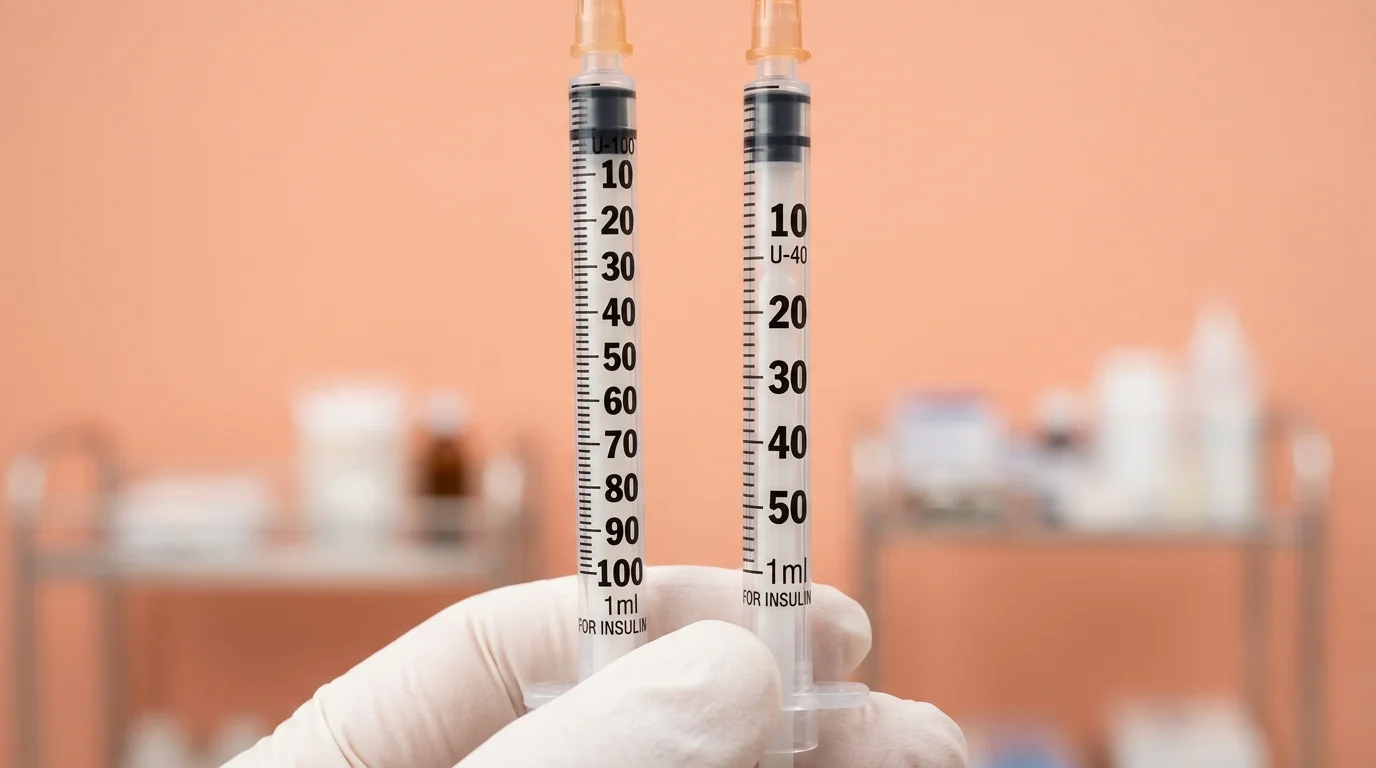 This is the single most critical parameter in insulin syringe selection. The markings on the syringe barrel must precisely match the concentration of the insulin vial to prevent severe under- or over-dosing.
-
U-100 Insulin: This is the global standard for human insulin. The concentration is 100 units of insulin per millilitre (mL) of fluid. Syringes designed for this concentration are marked "U-100" and are calibrated to measure doses from a U-100 vial accurately. Nearly all insulin prescribed in human medicine today is U-100. For these standard applications, a reliable U-100 concentration insulin syringe is the required consumable.
-
U-40 Insulin: This concentration provides 40 units of insulin per millilitre (mL). While less common in human medicine now, it is still used for certain specific formulations and is prevalent in veterinary practice. A syringe marked "U-40" is calibrated specifically for this lower concentration. Using this type of syringe is only appropriate when administering from a vial clearly labelled as U-40 concentration insulin.
At a glance: The Critical Mismatch Risk
A mismatch between insulin concentration and syringe type creates a 2.5-fold dosing error.
- Using a U-40 syringe with U-100 insulin will result in a 2.5x overdose.
- Using a U-100 syringe with U-40 insulin will result in a 2.5x underdose (delivering only 40% of the intended dose).
This is not a matter of approximation; it is a fundamental incompatibility. Facility-level protocols must ensure that the syringe type stocked and available at the point of care directly corresponds to the insulin type on the formulary.
Barrel Capacity: Matching Volume to Dose
The total volume of the syringe barrel determines the maximum insulin dose it can hold and affects the precision of measurement. Selecting the smallest syringe that can accommodate the prescribed dose enhances accuracy.
-
0.3 mL Syringes: Designed for small doses, holding a maximum of 30 units of U-100 insulin. The graduation marks are typically in 1-unit or even 0.5-unit increments, providing the highest level of precision. These are essential for paediatric departments, endocrinology clinics, and for any patient requiring very small, carefully titrated doses.
-
0.5 mL Syringes: These hold up to 50 units of U-100 insulin. They are a versatile choice for moderate doses, common in many adult diabetic patients. The scale is typically marked in 1-unit increments, offering excellent accuracy for most standard prescriptions.
-
1 mL Syringes: Capable of holding up to 100 units of U-100 insulin, these are intended for patients requiring larger single doses. The markings on a 1 mL syringe are usually in 2-unit increments, making them less suitable for precise measurement of small or odd-numbered doses.
The operational principle is clear: to minimise measurement error, the syringe capacity should be as close as possible to the dose being administered.
Needle Specifications: Gauge and Length
Beyond the barrel, the needle's physical dimensions directly impact patient comfort and the physiological effectiveness of the injection.
Needle Gauge (G) The gauge refers to the outer diameter of the needle. In a counter-intuitive system, a higher gauge number corresponds to a thinner, finer needle.
- Common Gauges: 29G, 30G, and 31G are standard for insulin syringes.
- Clinical Impact: Thinner needles (e.g., 31G) are associated with less injection site pain and are generally preferred for patient comfort, especially for individuals requiring multiple daily injections. The difference in flow rate for standard insulin doses is clinically negligible.
Needle Length (mm) The length of the needle is critical for ensuring the insulin is delivered into the correct tissue layer.
- Common Lengths: 6 mm, 8 mm, and 12.7 mm (or 1/2 inch).
- Clinical Impact: Modern clinical practice has shifted towards shorter needles (6 mm and 8 mm) for the vast majority of patients, including those with a higher BMI. The objective is a subcutaneous injection (into the fatty tissue below the skin), not an intramuscular one. Shorter needles reliably achieve this without needing to "pinch up" the skin, reducing the risk of accidental intramuscular injection which can lead to rapid, unpredictable insulin absorption and subsequent hypoglycaemia.
A Note on Insulin Pen Needles
Insulin pen devices are an alternative to the traditional vial and syringe method. These devices use pre-filled cartridges and require a disposable needle to be attached for each dose.
While the delivery device is different, the principles for the needle component are identical. When sourcing disposable insulin pen needles, the key specifications remain gauge and length. The same clinical reasoning applies: a higher gauge and shorter length are generally preferred for patient comfort and reliable subcutaneous delivery.
Insulin vs. Tuberculin Syringes: A Critical Distinction
This is another potential source of serious medication error. While they may appear similar, insulin and tuberculin syringes are calibrated differently and are not interchangeable for insulin administration.
- Insulin Syringes: Calibrated in international units to match insulin concentrations.
- Tuberculin Syringes: Calibrated in millilitres (mL). They are designed for administering other types of medication, such as PPD for tuberculin skin tests.
Attempting to use a tuberculin syringe for insulin requires a complex and error-prone mathematical conversion by the clinician at the bedside. This practice introduces an unacceptable risk and violates medication safety principles. Hospital policy must strictly mandate that only insulin syringes are used for administering insulin.
Procurement Checklist: Specifying the Right Insulin Syringe
For procurement heads and department managers, a systematic approach to specification ensures both safety and supply chain efficiency.
-
Confirm Insulin Concentration: The primary step. Verify your facility's standard insulin formulary (almost certainly U-100) and source only the corresponding U-100 syringes. If a special case requires U-40, that procurement must be handled as a distinct, carefully controlled process.
-
Analyse Departmental Dose Requirements: Review the typical dose ranges administered in different settings.
- Paediatrics/Endocrinology: Require a stock of 0.3 mL syringes for precision.
- General Wards/OPD: A mix of 0.5 mL and 1 mL syringes will likely cover most adult patient needs.
-
Standardise Needle Dimensions: For general use, standardising on a higher gauge (30G or 31G) and a shorter length (6 mm or 8 mm) can simplify inventory, improve patient comfort, and align with current best practices for subcutaneous injection.
-
Evaluate Syringe Features: Check for clear, high-contrast barrel markings that are easy to read. A low dead-space design, where the plunger extends fully into the needle hub, is preferable as it minimises insulin wastage with each injection.
-
Verify Quality and Sterility: Ensure that all sourced syringes are individually sterile-packed and conform to relevant quality standards (e.g., ISO 13485). Clear labelling of all parameters on the packaging is non-negotiable.
Safe Handling and Disposal Protocols
The correct syringe must be supported by correct practice.
-
Strictly Single Use: Insulin syringes are single-use devices. Reuse increases the risk of needle-stick injuries, infection, and cross-contamination. The needle also becomes dull after one use, making subsequent injections more painful.
-
Biomedical Waste Management: Used syringes must be disposed of immediately in a designated, puncture-proof sharps container. This is a mandatory compliance requirement under India's Bio-Medical Waste Management Rules. These containers should be located at the point of use to prevent accidental injuries.
-
Continuous Staff Training: Regular refreshers for nursing staff on the different types of insulin syringes, the critical importance of matching syringe to vial, and correct administration technique are essential for mitigating risk.
Equip Your Facility Today
Ensuring the correct selection and use of insulin syringes is a foundational element of medication safety and operational efficiency. For facilities looking to standardise their consumables and streamline procurement, exploring a comprehensive range of quality-assured insulin syringes and related disposables is a crucial step in supporting best clinical practices.
FAQs

