

Dentist
Zhermack Tropicalgin vs Zetalgin: How These Two Chromatic Alginates Differ
How do Zhermack Tropicalgin and Zetalgin differ? Compare working time, setting time, colour indicators and clinical uses of these two chromatic alginates.


Zhermack Tropicalgin vs Zetalgin: How These Two Chromatic Alginates Differ
Zhermack Tropicalgin and Zetalgin are both chromatic dental alginates from the Italian manufacturer Zhermack. Both change colour as they set, both come in 453 g packs and both are used for preliminary impressions and study models. The main difference is timing. Zetalgin sets faster, with a working time of about 1 minute 10 seconds and a setting time of about 2 minutes 10 seconds. Tropicalgin gives a longer working window of about 1 minute 35 seconds, which allows more time to mix, load and seat the tray.
This guide explains how chromatic alginate works, how the two materials compare and which clinical situations each one tends to suit.
What Is Chromatic Alginate?
Chromatic alginate is an irreversible hydrocolloid impression material that contains colour indicators. As the powder and water react, the mix changes colour in stages. Each colour signals a phase of the procedure: mixing, working (loading the tray) and positioning in the mouth until set.
The colour change comes from pH-sensitive dyes that respond to the chemical changes taking place as the alginate sets. Because the indicator follows the reaction itself rather than a fixed clock, it gives a practical visual cue when water temperature or room conditions shift the timing slightly. This makes chromatic alginates especially helpful in teaching clinics, busy practices and settings where assistants mix the material.
Zhermack Tropicalgin at a Glance
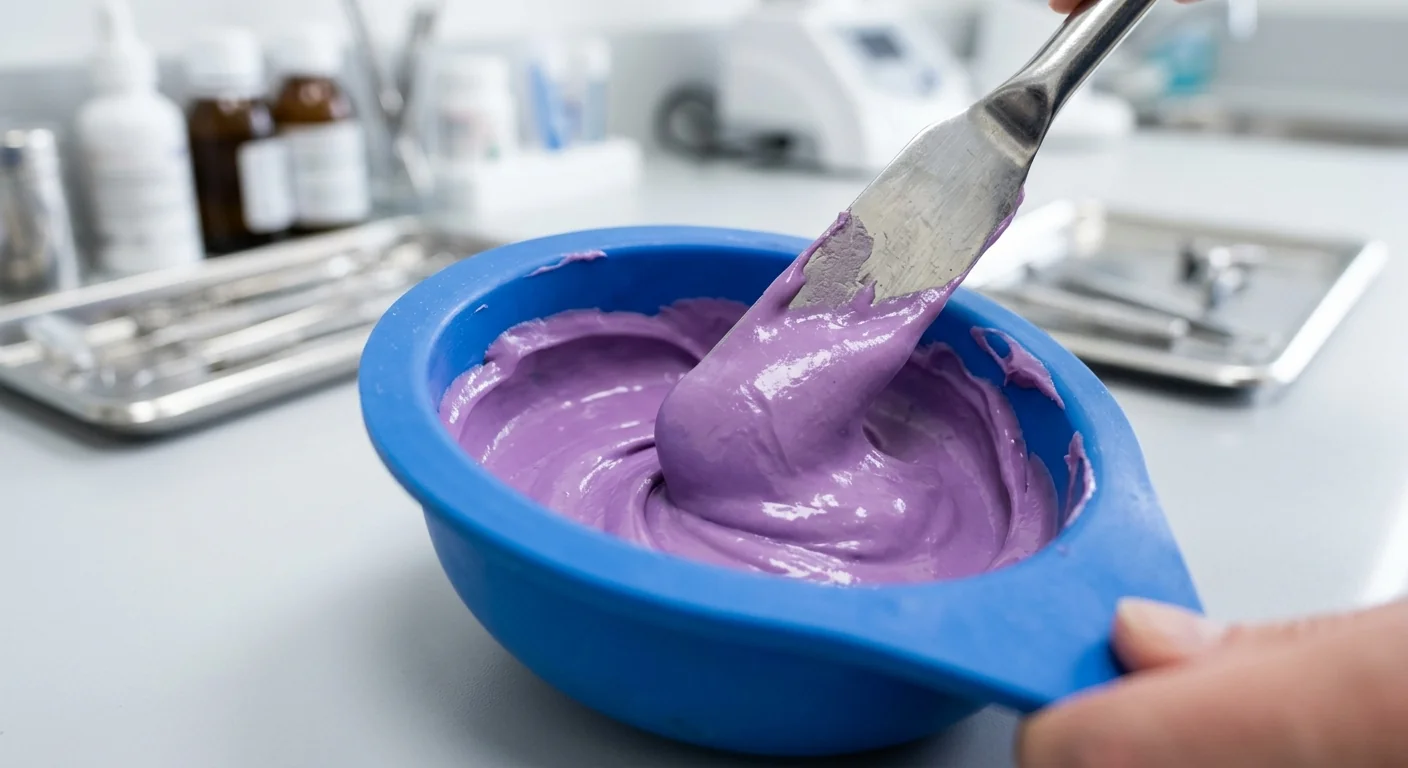 Zhermack Tropicalgin chromatic alginate is designed for routine preliminary impressions. Its colour indicator moves from red during mixing to orange or salmon pink during the working phase, and to yellow for positioning in the mouth and final set.
- Working time: about 1 minute 35 seconds, including mixing.
- Time in mouth: about 60 seconds.
- Setting time: within 2 to 4.5 minutes.
- Flavour: mango scent, intended to improve patient comfort.
- Listed applications: study models, orthodontic models, removable prosthetics and opposing arch (antagonist) models in fixed and removable prosthodontics.
Its longer working window gives the operator time to load the tray carefully and seat it without rushing, which is useful for full-arch impressions and for less experienced operators. It can be hand-mixed or used with an automatic alginate mixer for a smooth, bubble-free consistency.
Zhermack Zetalgin at a Glance
Zhermack Zetalgin chromatic alginate is a faster-setting chromatic option. Its colour indicator guides the operator through the mixing, working and positioning phases.
- Working time: about 1 minute 10 seconds, including mixing.
- Time in mouth: about 1 minute.
- Setting time: about 2 minutes 10 seconds.
- Flavour: flavoured formulation.
- Listed applications: preliminary impressions for crown and bridge, denture and orthodontic treatment planning, plus study models and diagnostic casts.
- Model compatibility: suitable for pouring in Type 3 and Type 4 gypsum.
The shorter overall time suits quick impressions and patients who find impression-taking difficult, such as children and people with a strong gag reflex.
Tropicalgin vs Zetalgin: Side-by-Side Comparison
| Parameter | Zhermack Tropicalgin | Zhermack Zetalgin |
| Material type | Chromatic alginate (irreversible hydrocolloid) | Chromatic alginate (irreversible hydrocolloid) |
| Manufacturer and origin | Zhermack, Italy | Zhermack, Italy |
| Pack size | 453 g | 453 g |
| Setting profile | Longer working window | Faster setting |
| Working time (including mixing) | 1 min 35 sec | 1 min 10 sec |
| Time in mouth | 60 sec | 60 sec |
| Setting time | 2 to 4.5 min | 2 min 10 sec |
| Colour indicator | Red (mixing), orange to salmon pink (working), yellow (positioning and set) | Chromatic; refer to the instructions for use for the colour sequence |
| Flavour | Mango scent | Flavoured |
| Listed applications | Study models, orthodontic models, removable prosthetics, opposing arch models | Preliminary impressions for crown and bridge, denture and orthodontic work; study models and diagnostic casts |
| Model material | Dental stone | Type 3 and Type 4 gypsum |
Timings are as listed by the manufacturer for standard room temperature. Warmer water shortens these times and cooler water extends them. Always follow the instructions for use supplied with the product.
Key Differences Explained
Working time and setting speed
This is the most practical difference. Zetalgin gives about 25 seconds less working time and sets sooner, so the whole procedure is shorter. Tropicalgin allows more time between mixing and seating the tray, which reduces pressure on the operator during full-arch or multiple impressions.
Colour indicator
Both are chromatic, so both remove much of the guesswork from timing. Tropicalgin uses a red, orange and yellow sequence. Zetalgin has its own colour sequence, so clinics that use both materials should brief staff on each one to avoid confusing the stages.
Patient comfort
Both are flavoured. Tropicalgin has a mango scent. With either material, a shorter time in the mouth and a well-fitted tray do more for comfort than flavour alone.
Clinical applications
The listed applications overlap heavily. Both are suitable for study models, diagnostic casts, orthodontic records and preliminary impressions in prosthodontics. Neither is a substitute for an elastomeric material when a final impression is needed for crowns, bridges or implants.
Which One Suits Which Situation?
Neither material is better across the board. The choice depends on the procedure and who is taking the impression.
- Tropicalgin may suit: full-arch impressions, multiple impressions in one sitting, teaching environments and operators who prefer more working time.
- Zetalgin may suit: quick single-arch impressions, children, patients with a strong gag reflex and experienced operators working at speed.
- Either may suit: study models, orthodontic records, opposing arch impressions and preliminary denture impressions.
For a wider view of setting types, dust-free formulations and other brands, see this overview of dental alginate impression materials.
Handling Tips for Chromatic Alginates
- Measure accurately: use the scoop and water measure supplied with the product. An incorrect water-powder ratio affects setting time, strength and detail.
- Control water temperature: water at room temperature gives the most predictable results. Warm water speeds up setting and cool water slows it down.
- Mix thoroughly: spatulate firmly against the bowl wall until the mix is smooth and uniform, and watch for the colour change that signals the working phase.
- Remove with a snap: remove the set impression in one quick movement along the long axis of the teeth to reduce distortion and tearing.
- Rinse, disinfect and pour promptly: alginate impressions lose accuracy as they lose or absorb water. Rinse, disinfect with a hydrocolloid-compatible disinfectant and pour the model as soon as possible.
- Store powder correctly: keep the pack sealed in a cool, dry place, as moisture and heat affect working time and colour change.
When Alginate Is Not the Right Choice
Alginate records good detail for diagnostic and preliminary work, but it has lower tear strength and poorer long-term dimensional stability than elastomers. For final impressions for crowns, bridges, inlays and implants, elastomeric impression materials such as addition silicone (PVS) are generally used.
FAQs

