
Hospitals
Bone Marrow Biopsy Needles: Key Considerations for Haematology and Oncology Units
An authoritative guide for clinicians and procurement heads on selecting the right bone marrow biopsy needle. Covers types, evaluation criteria, and best practices.


In haematology and oncology, a bone marrow examination is often the definitive diagnostic step. The quality of the aspirate and trephine biopsy core is paramount, directly influencing diagnostic accuracy for conditions ranging from aplastic anaemia to metastatic malignancies. While the clinician's technique is crucial, the choice of the bone marrow biopsy needle itself is a foundational decision with significant clinical and operational implications. An unsuitable or poorly designed needle can lead to a sub-optimal sample, procedural difficulties, and unnecessary patient discomfort, potentially forcing a repeat procedure.
This resource provides a direct, peer-to-peer overview of the critical factors to consider when selecting and standardising these essential instruments for your facility. We will cover the functional anatomy of the needles, the key evaluation criteria from both a clinical and procurement perspective, and operational best practices for ensuring procedural success.
Understanding the Core Anatomy of a Bone Marrow Biopsy Needle
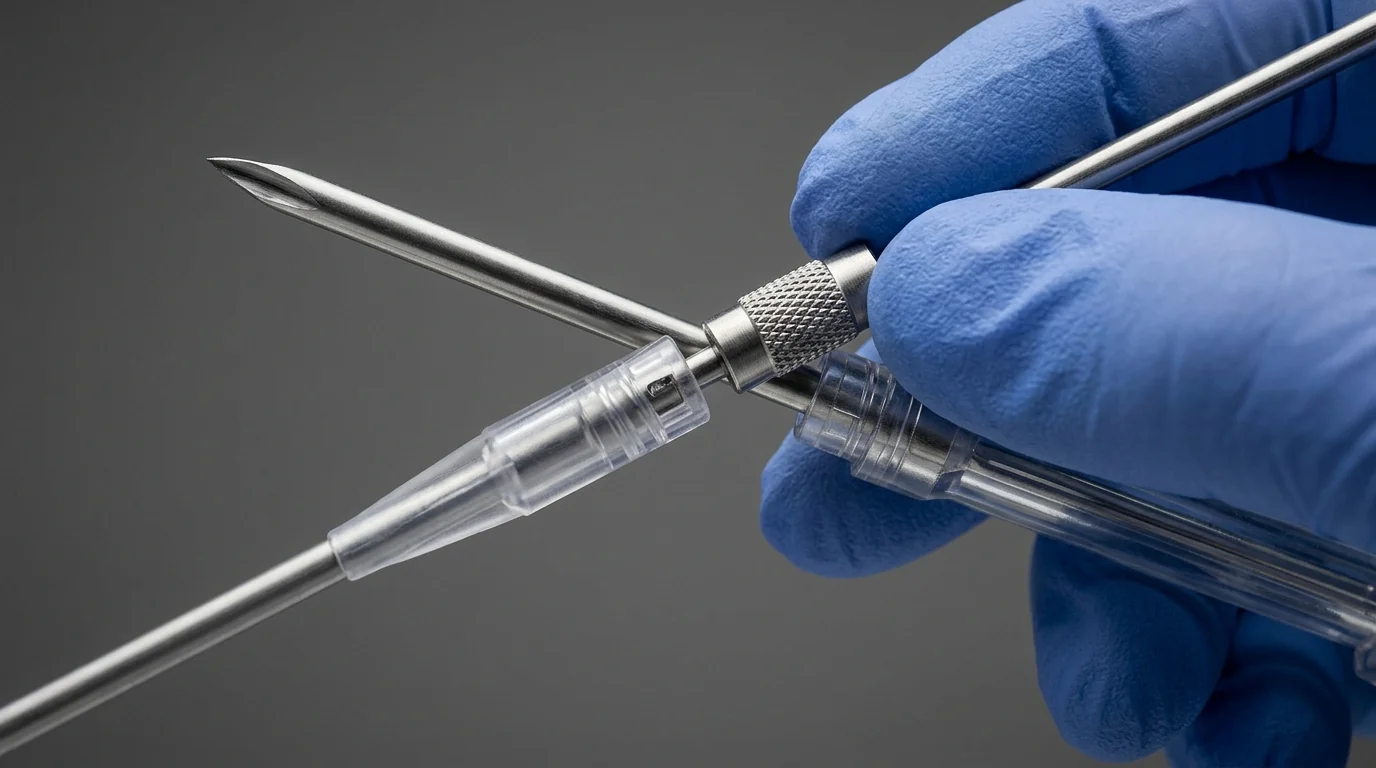 While designs vary slightly, most bone marrow biopsy and aspiration needles share a common set of components, each with a specific function. Understanding these is the first step in making an informed selection.
- Cannula: This is the hollow outer needle shaft. Its specifications are defined by gauge (G) for diameter and length (in mm or inches). Common adult gauges include 8G, 11G, and 13G. The selection depends entirely on patient anatomy—paediatric patients and slender adults may require a higher gauge (thinner) needle, while larger or obese patients require a longer cannula to reach the medullary cavity.
- Stylet: The stylet is the solid inner needle that fits perfectly inside the cannula, obturating it during insertion. Its primary role is to pierce soft tissue and cortical bone. The tip is typically designed for penetration, with a sharp trocar or bevelled point. Once the medullary cavity is reached, the stylet is removed to allow for aspiration or core biopsy.
- Handle: The handle provides the clinician with grip and control to apply the precise pressure and twisting motion required for bone penetration. Ergonomic design is not a luxury; it is critical for control and reducing operator fatigue. Most handles feature a standard Luer lock connection to securely attach a syringe for aspiration.
- Probe/Extractor Rod: After the biopsy, the core sample resides within the cannula. The extractor rod is a simple, blunt-ended probe used to safely push the delicate core sample out of the cannula from the distal tip, ensuring its integrity is maintained for pathological examination.
Types of Bone Marrow Needles and Their Applications
The procedure dictates the type of needle required. While many modern needles are multipurpose, understanding the traditional classifications helps clarify their primary design intent.
- Jamshidi Needle (For Trephine Biopsy): This is the workhorse for obtaining a solid core of bone marrow tissue. Its defining feature is a tapered distal tip on the cannula. This design securely "traps" the core sample as the needle is advanced and rotated, preventing it from being lost or fragmented during withdrawal. It is the standard for histological assessment, which is crucial for evaluating cellularity and architecture.
- Aspiration Needles (e.g., Salah, Klima): These are designed specifically to aspirate liquid bone marrow for cytological analysis, flow cytometry, or cytogenetics. They are often shorter than biopsy needles and typically feature an adjustable depth guard or stop. This allows the clinician to precisely control the depth of penetration, which is particularly important at sites like the sternum.
- Combined/Multipurpose Needles: Most contemporary sets are designed to perform both aspiration and biopsy in a single insertion. They typically incorporate the Jamshidi-style tapered cannula for a high-quality core sample but may also have features like side ports to facilitate aspiration before the core is taken. This approach minimises patient trauma by reducing the number of insertion sites.
Critical Evaluation Criteria for Procurement and Clinical Use
When evaluating a bone marrow biopsy needle for your facility, move beyond the spec sheet. The following criteria have direct operational and clinical impact.
1. Sample Quality and Integrity This is the single most important outcome. A needle must consistently deliver an intact, uncompressed core sample.
- Cutting Edge Sharpness: The distal tip of the cannula must be exceptionally sharp to cut a clean core without crushing cellular structures. A dull or poorly machined edge will fragment the sample.
- Cannula Material: Look for high-quality surgical stainless steel that resists bending or flexing under the pressure of insertion.
- Internal Finish: A smoothly polished internal cannula surface reduces friction, making it easier to extrude the sample without damage.
2. Patient Safety and Comfort The procedure is inherently uncomfortable; the right instrument can significantly mitigate this.
- Stylet Tip Design: A well-designed trocar or bevelled tip on the stylet requires less forward pressure to penetrate the cortex, reducing the force transmitted to the patient.
- Ergonomic Control: A secure, non-slip handle gives the clinician superior control, reducing the risk of sudden, deep penetration (overshooting) or slippage.
- Depth Indicators: Clearly marked depth gauges on the cannula help in judging insertion depth, adding a layer of safety.
3. Clinician Ergonomics and Procedural Efficiency The instrument should feel like an extension of the clinician's hand.
- Handle Design: A T-handle or a wider, textured palm-style handle can accommodate different grip preferences and allow for effective force transmission. Evaluate how it feels when wearing sterile gloves.
- Weight and Balance: The needle should feel well-balanced, not tip-heavy or handle-heavy, allowing for fine, controlled movements.
- Intuitive Assembly: The components (stylet, cannula) should lock together securely and be easy to disassemble during the procedure.
4. Sourcing and Inventory Management Operational readiness depends on having the right size for every patient.
- Range Availability: Your chosen supplier must provide a comprehensive range of gauges and lengths. A facility needs access to everything from paediatric sizes (e.g., 13G, 1-2 inches) to longer needles for bariatric patients (e.g., 11G, 6 inches). Ensuring you have access to a full spectrum of sizes is operationally critical. You can review a range of bone marrow biopsy and aspiration needles to assess the available gauges and lengths for your facility's needs.
The Procedure in Practice: Operational Best Practices
The correct instrument must be paired with meticulous technique.
- Site and Patient Preparation: The posterior superior iliac crest (PSIC) is the standard site for adults, accessed with the patient in a prone or lateral decubitus position. A pre-procedural check confirming patient identity, consent, coagulation status, and allergies to local anaesthetics is mandatory.
- Technique is Key: Insertion should be a controlled, steady twisting or drilling motion, not an application of brute force. The clinician will feel a distinct "give" upon entering the marrow cavity. For combined procedures, aspiration is performed first to prevent the aspirate from being contaminated with peripheral blood drawn in by the biopsy.
- Securing the Core: Before withdrawal, the needle is rotated 360 degrees and angled slightly to sever the core sample at its base. This is a critical step for obtaining a full-length sample. For most adult trephine biopsies at the PSIC, a standard Jamshidi-type needle is the instrument of choice. Models like the Vaishnav Surgicals Bone Marrow Needle exemplify this design, featuring a sharp trocar stylet for efficient bone penetration and a tapered cannula to help secure the core sample.
- Post-Procedure: Firm, direct pressure must be applied to the site for several minutes to ensure haemostasis. The site should be monitored for any signs of bleeding or haematoma formation.
Compliance and Quality Assurance in Sourcing
Sourcing medical devices in India requires diligence. Look for clear indicators of quality and regulatory compliance.
- Manufacturing Standards: Prioritise needles manufactured in facilities compliant with ISO 13485, the international standard for medical device quality management systems. CE marking is another common and reliable indicator of adherence to European health and safety standards.
- Sterility and Traceability: Every needle must be supplied in a sterile, individually sealed, and undamaged package. The packaging must be clearly marked with the product details, lot number, and expiry date. This traceability is non-negotiable for quality control and in the unlikely event of a product recall.
- Strictly Single-Use: Bone marrow biopsy needles are single-use devices. Any attempt at reprocessing severely compromises sterility, introduces a high risk of cross-contamination with blood-borne pathogens, and degrades the sharpness of the cutting tip, leading to poor sample quality and increased patient trauma.
Equip Your Facility Today
Standardising on a high-quality, reliable bone marrow biopsy needle is a direct investment in your facility's diagnostic capability. It ensures your clinical teams can work efficiently, safely, and obtain the high-quality samples necessary for accurate patient diagnoses.
For a comprehensive review of clinically approved bone marrow biopsy and aspiration needles suitable for your haematology, oncology, or pathology departments, explore the curated selection available on MedikaBazaar.
FAQs


