

Dentist
Understanding Dental Waxes: Properties, Classification, and Clinical Applications
An expert resource for dental professionals on classifying, selecting, and applying different types of dental waxes for clinical and laboratory procedures.


In any dental clinic or laboratory, precision is non-negotiable. From a simple inlay to a complex full-mouth rehabilitation, the materials we use directly impact the final outcome. Among the most fundamental yet critical of these materials are dental waxes. While they may seem basic, a thorough understanding of their properties, classifications, and correct handling is essential for any clinician or technician focused on quality and consistency.
This guide provides an operational overview of dental waxes, moving beyond simple descriptions to focus on the practical knowledge needed for selection and application in a busy practice. We will cover the core properties that dictate performance, a functional classification system, and best practices for handling to minimise errors and ensure predictable results.
The Fundamental Properties of Dental Waxes
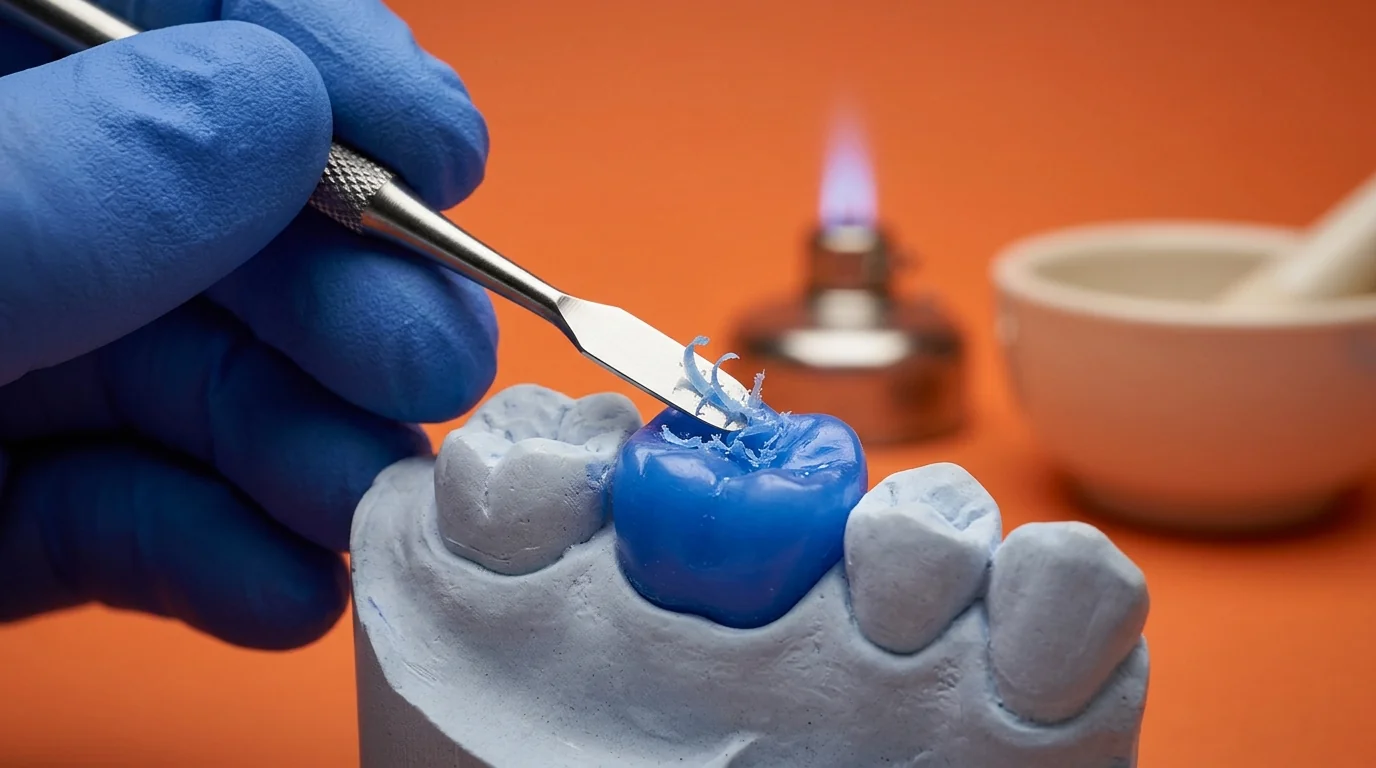 The behaviour of a wax is dictated by its physical properties. Understanding these is key to troubleshooting common issues like distortion, poor fit, or casting defects. All dental waxes are blends of natural and synthetic waxes, gums, fats, and resins, formulated to achieve specific characteristics.
Key properties include:
- Thermal Expansion: Waxes have the highest coefficient of thermal expansion of any material we use in dentistry. This means they expand significantly when heated and contract as they cool. A lack of control over temperature during fabrication and investing is a primary source of inaccuracy in the final restoration.
- Melting Range: Waxes do not have a single melting point but rather a melting range. This property is critical; a wax must be soft enough to be manipulated at a workable temperature but firm enough to be carved and hold its shape at room temperature without distortion.
- Flow: This refers to the movement of the wax under pressure, and it is highly dependent on temperature. For instance, an inlay wax must have a high flow at its working temperature to capture detail, but zero flow at mouth temperature to prevent distortion during a direct-technique try-in.
- Ductility: This is the ability to be stretched or deformed without fracturing, and it increases with temperature. A ductile wax can be shaped into a thin sheet or pulled into a sprue without breaking.
- Residual Stress: This is the internal stress locked within the wax as a result of manipulation (carving, cooling, pressure). Over time, this stress will be released, causing the wax pattern to warp or distort. This is why a wax pattern should be invested as soon as possible after fabrication.
Classification of Dental Waxes: A Functional Approach
The most practical way to classify dental waxes is by their intended use. This aligns directly with clinical and laboratory workflows. Waxes are broadly grouped into three categories: pattern, processing, and impression waxes.
1. Pattern Waxes
These are used to form the general size and contour of a dental restoration, which is then cast in metal or processed into a polymer.
- Inlay Waxes: Used to create patterns for restorations like inlays, onlays, crowns, and bridges. They are formulated for precision, good carving characteristics, and complete burnout.
- Type I: A harder wax used for the direct technique, where the pattern is fabricated intraorally. It must have low flow at mouth temperature.
- Type II: A softer wax used for the indirect technique, where the pattern is made on a die outside the mouth.
- Casting Waxes: Used to fabricate the pattern for the metallic framework of removable partial dentures and other similar structures. They are available in sheets, ready-made shapes, and bulk.
- Baseplate Waxes: Used mainly to establish the occlusal relationship for dentures, to arrange artificial teeth, and to create the initial denture contour for a try-in. They are supplied in sheets and are classified by hardness (Type I: soft, for contouring; Type II: medium, for patterns in temperate climates; Type III: hard, for patterns in tropical climates).
2. Processing Waxes
These are auxiliary materials used in various stages of fabricating restorations.
- Boxing Wax: Used to form a container around an impression before it is poured with gypsum to create a clean, properly-formed base for the cast. It is typically supplied in strips.
- Utility Wax: A soft, pliable, and adhesive wax used for a variety of tasks, such as contouring the periphery of an impression tray to improve patient comfort and detail capture, or blocking out undercuts on a cast.
- Sticky Wax: A hard, brittle wax that is very firm at room temperature but becomes soft and sticky when heated. Its primary use is to temporarily and rigidly join components together, such as fixing parts of a broken denture before repair or securing a sprue to a wax pattern.
3. Impression Waxes
These waxes are formulated to flow at or near mouth temperature and are used to record details of oral tissues.
- Corrective Impression Waxes: Used as a wax veneer over an original impression to record the details of soft tissues in their functional state.
- Bite Registration Waxes: Used to accurately record the occlusal relationship between the maxillary and mandibular arches. They are formulated to be soft on insertion and to set into a rigid, distortion-free record.
Operational Best Practices for Handling Dental Waxes
Mishandling wax is a frequent and preventable source of error. Adhering to strict protocols in the lab or clinic is crucial for precision.
Heating and Manipulation Always heat wax evenly and slowly. Using a thermostatically controlled water bath or a properly adjusted, clean flame is recommended. Overheating can volatilize some components, permanently altering the wax's properties. When adding wax, apply it in small increments and ensure each addition is fully molten to prevent lamination and internal voids.
Investing Patterns As mentioned, residual stress is the enemy of accuracy. To minimise distortion from stress release, a wax pattern should be invested within 30 minutes of its completion. If storage is unavoidable, keep the pattern in a refrigerator (not a freezer) to slow the rate of stress release, but allow it to return to room temperature before investing.
Storage and Contamination Store all dental waxes in a cool, dry environment away from direct heat sources. Extreme temperature fluctuations can alter their properties. Ensure all instruments, spatulas, and carving tools are scrupulously clean to prevent contamination from other materials like stone, investment, or other types of wax.
Selecting the Right Wax: An Evaluation Checklist
When sourcing dental waxes for your facility, the decision should be based on application-specific requirements rather than just the material type.
- What is the specific procedure? Match the wax directly to its intended function—inlay, baseplate, boxing, etc. Using a baseplate wax for a precision casting pattern will lead to failure.
- What are the carving and flow characteristics? The wax must carve cleanly to a smooth surface without flaking or chipping. Its flow properties must be appropriate for the technique (e.g., low flow for direct inlay, high flow for corrective impressions).
- Is there sufficient colour contrast? The colour of the wax should provide good visibility against the die or cast material, enabling precise carving of margins and contours.
- Does it ensure a clean burnout? For any casting procedure, the wax must vaporize completely without leaving any residue that could lead to a porous or incomplete casting. This is a critical specification for all pattern waxes.
- Is it dimensionally stable? The wax should hold its shape after cooling and resist distortion from minor temperature changes or handling stresses during the brief period before investing.
Beyond waxes, a well-equipped lab requires a range of materials for casting, modelling, and finishing. Sourcing these from a reliable supplier is key to consistent outcomes across your entire Dental consumables inventory.
Equip Your Facility Today
Achieving precision in restorative and prosthetic dentistry starts with the fundamentals. Ensuring your clinic or laboratory is equipped with the appropriate, high-quality dental waxes for each specific procedure is a foundational step toward predictable, excellent clinical outcomes.
For a complete selection of dental materials and consumables tailored for professional use, explore the curated range on MedikaBazaar to meet your facility's requirements.
FAQs

