

Dentist
Operational Guide to UV Chambers in a Dental Practice
An operational guide for dental procurement managers on evaluating, using, and maintaining a UV chamber for sterile instrument storage and infection control.


In any modern dental practice, the chain of infection control is only as strong as its weakest link. While the autoclave remains the cornerstone of instrument sterilization, maintaining that sterility until the point of use is a critical, often overlooked, step. This is the precise operational role of a uv chamber, a device designed to provide a sterile environment for storing already sterilized instruments, protecting them from airborne microbial contamination.
Understanding its function, selection criteria, and proper integration into your workflow is essential for ensuring patient safety and operational efficiency. This is not a primary sterilizer but a dedicated sterile storage solution that complements the work of your autoclave.
Understanding the Mechanism: UVC Germicidal Irradiation
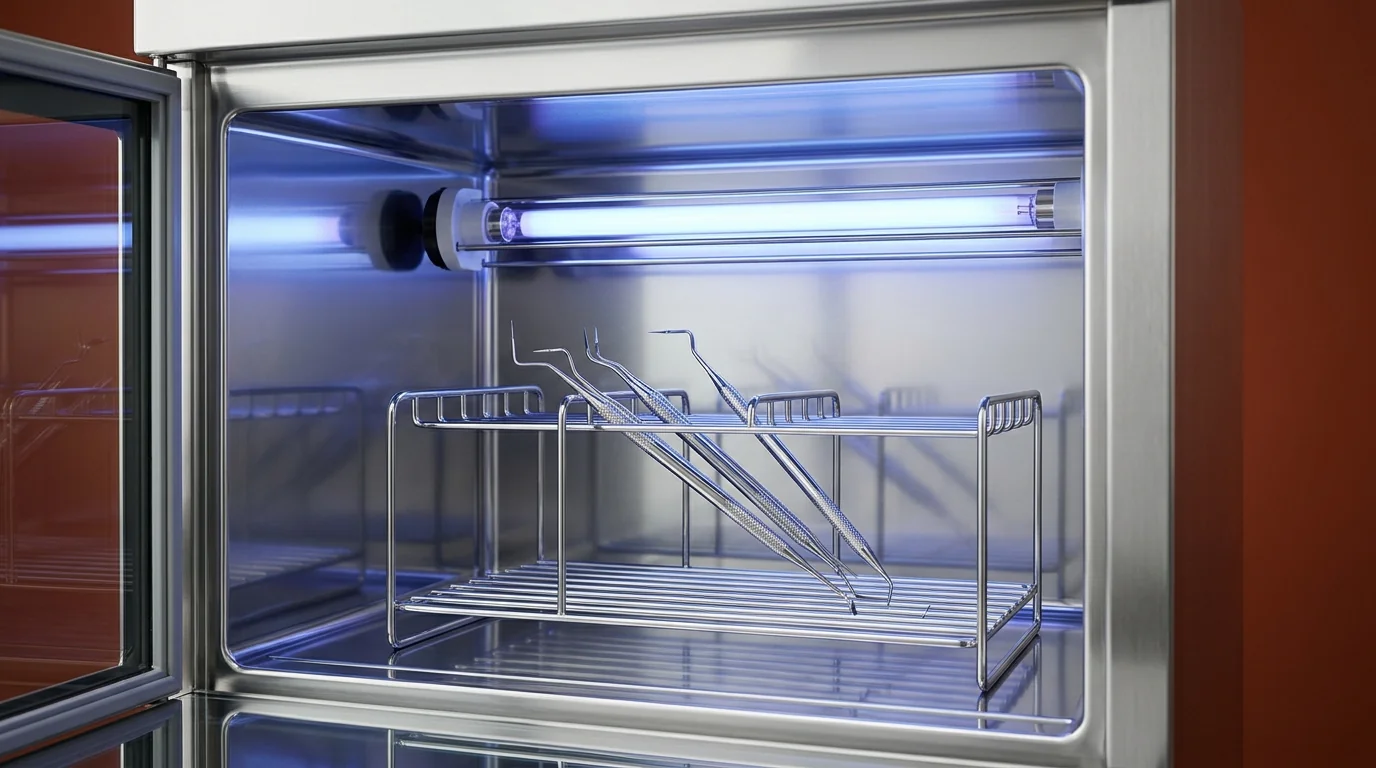 A UV chamber functions on the principle of ultraviolet germicidal irradiation (UVGI). The core of the unit is a lamp that emits short-wavelength ultraviolet-C (UVC) light, specifically at a wavelength of 253.7 nanometers.
This particular wavelength is highly effective at disrupting the DNA and RNA of microorganisms—bacteria, viruses, and fungi. By damaging their nucleic acids, UVC light prevents these microbes from reproducing or causing infection, effectively neutralizing them.
Key Distinction: It's crucial to understand that a UV chamber provides surface disinfection. It does not penetrate materials like an autoclave's pressurized steam. Its purpose is to continuously sanitize the air and surfaces within the chamber, ensuring that instruments placed inside remain in a sterile field after they have been properly sterilized through other means.
Clinical Applications in a Dental Setup
The primary role of a UV chamber is to hold pouched, autoclaved instruments in a ready-to-use state. This bridges the gap between the central sterilization area and the operatory, minimizing the risk of contamination.
Common clinical applications include:
- Post-Autoclave Storage: Storing sealed pouches containing handpieces, scalers, explorers, forceps, mirrors, and other critical instruments after they have completed a full autoclave cycle.
- Chairside Readiness: Keeping frequently used instruments sterile and accessible between patient appointments, reducing turnaround time while upholding strict hygiene standards.
- Protection from Aerosols: In the dynamic environment of a dental clinic, aerosols are a constant. A UV chamber protects sterile instruments from environmental contaminants that may settle on surfaces.
For a busy multi-chair practice, a unit with sufficient capacity, such as the Denfort DFUV 690 UV Chamber, provides the necessary tray space to manage instrument turnover effectively without compromising the sterilization protocol.
Key Evaluation Criteria for Procurement
When selecting a UV chamber for your facility, move beyond the basic specifications and evaluate the features that impact safety, efficacy, and longevity.
- Chamber Construction and Material: The interior should be made of a non-corrosive, reflective material like stainless steel (SS-304 grade is preferable). A reflective surface ensures that the UVC light bounces to reach all corners of the chamber, maximizing exposure and eliminating shadows where microbes could potentially survive. Avoid materials that can degrade or off-gas under UV exposure.
- UV Lamp Specifications: Verify the lamp's quality. It should explicitly state that it emits UVC radiation at the germicidal wavelength (~254 nm). Note the wattage and the manufacturer's rated lifespan (typically measured in thousands of hours). A higher-quality lamp provides consistent UVC output throughout its life.
- Capacity and Tray Design: Assess the number of trays and the total internal volume. The trays should be made of stainless steel wire mesh, which allows for maximum air circulation and UVC light penetration around the instruments. Ensure the capacity aligns with your practice's daily patient load and instrument reprocessing volume.
- Essential Safety Features: This is non-negotiable. The chamber must have a door interlock switch that automatically cuts power to the UV lamp when the door is opened. This prevents accidental exposure of staff to harmful UVC radiation. The door itself should be made of UV-blocking glass or polycarbonate.
- Controls and Timers: While simple analog timers suffice, digital controls offer greater precision. Look for features like an indicator light to confirm the lamp is operational. The unit is designed for continuous operation to maintain the sterile environment.
- Build Quality and Compliance: Check for a sturdy build, a tight-fitting door with a good magnetic or mechanical seal, and stable footing. While specific BIS standards for UV chambers are less common, look for general electrical safety compliance and CE marking as indicators of manufacturing quality.
Integrating a UV Chamber into Your Sterilization Protocol
A UV chamber is an integral part of a larger infection control workflow, not a standalone solution. Proper integration is key to its effectiveness.
- Pre-Cleaning: All instruments must first be manually or ultrasonically cleaned to remove all bioburden.
- Drying and Pouching: Instruments must be thoroughly dried and sealed in appropriate sterilization pouches.
- Sterilization: The pouched instruments must undergo a complete, validated cycle in an autoclave or dry heat sterilizer.
- Sterile Storage: Once the autoclave cycle is complete and the pouches are dry, they can be transferred directly to the UV chamber. Place them on the wire mesh trays without overcrowding to allow for proper light exposure and air circulation around each pouch.
A robust sterilization workflow, from ultrasonic cleaners to autoclaves and finally to UV storage, is the backbone of any modern practice. Sourcing reliable equipment across your entire Dental setup is critical for patient safety and compliance.
Maintenance and Operational Best Practices
To ensure your UV chamber functions optimally and safely, a regular maintenance schedule is essential.
- Daily Check: Visually confirm that the UV lamp's indicator light is on when the door is closed. Check the integrity of the door seal.
- Weekly Cleaning: With the unit unplugged, wipe the interior surfaces and trays with a soft, lint-free cloth lightly dampened with isopropyl alcohol. Dust and smudges can absorb UVC radiation, reducing the chamber's effectiveness.
- Lamp Replacement: The most critical maintenance task. UVC lamps lose their germicidal effectiveness over time, long before they actually burn out. You cannot judge a lamp's efficacy by eye. Adhere strictly to the manufacturer's recommended replacement schedule (e.g., every 6,000 or 8,000 hours of use). Maintain a log to track usage and replacement dates.
- Staff Training: Ensure all clinical staff understand that the UV chamber is for storing already sterile instruments. They must be trained on the importance of the door safety interlock and instructed never to attempt to bypass it or look directly at the lamp.
Distinguishing UV Chambers from Other Sterilization Equipment
A common point of confusion for procurement teams is differentiating the UV chamber's role from other sterilization devices.
| Equipment | Mechanism | Primary Function |
| UV Chamber | UVC Irradiation | Maintains sterility of pouched, pre-sterilized instruments. Surface disinfection of air and contents. |
| Autoclave | Pressurized Steam | Primary sterilization of instruments, killing all microbial life including bacterial spores. |
| Dry Heat Sterilizer | High Temperature | Primary sterilization, typically for instruments that cannot withstand moisture. |
While an autoclave handles the heavy lifting of sterilization, the choice of appropriate UV cabinets ensures those instruments remain sterile until the point of use, completing the chain of infection control.
Equip Your Facility Today
Ensuring your practice is equipped with the right sterilization and storage solutions is fundamental to patient care and operational efficiency. Explore a curated selection of professional-grade equipment on MedikaBazaar to meet your clinic's specific needs and uphold the highest standards of infection control.
FAQs

