

Dentist
An Operational and Clinical Guide to Ultrasonic Scalers in Dental Practice
A detailed guide for clinicians and procurement managers on selecting, using, and maintaining ultrasonic scalers. Covers piezoelectric vs. magnetostrictive types.


The ultrasonic scaler has become an indispensable instrument in modern dental practice, fundamentally changing the efficiency and efficacy of prophylaxis and periodontal therapy. Moving beyond the tactile limitations of manual curettes, these devices use high-frequency vibrations to dislodge calculus and disrupt biofilm with minimal operator fatigue and often improved patient comfort. For any procurement head or senior clinician, understanding the core technology, evaluation criteria, and operational protocols is essential for making a sound investment that aligns with your practice's clinical standards.
This guide provides a direct, peer-to-peer overview of what matters when specifying, integrating, and maintaining an ultrasonic scaler in a demanding clinical environment.
The Core Mechanism: How Ultrasonic Scalers Function
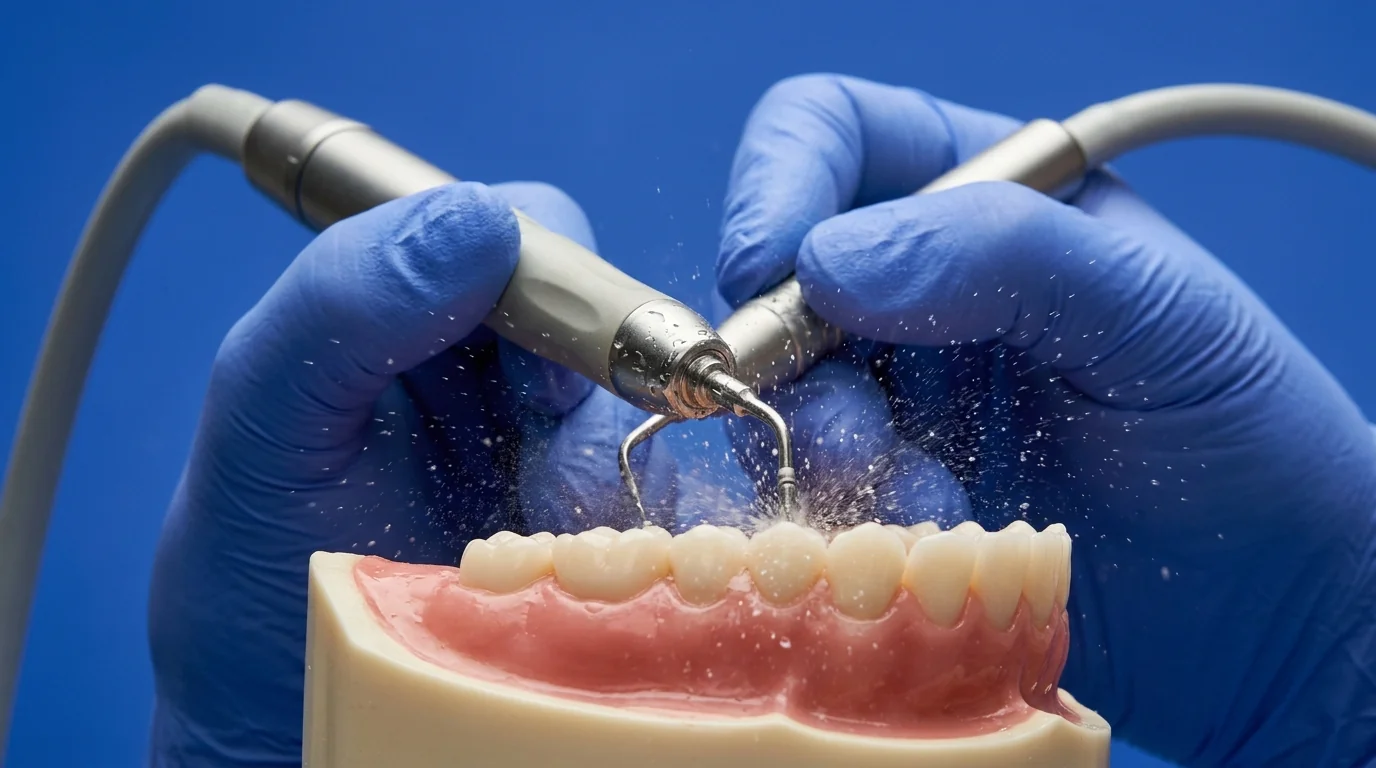 At its heart, an ultrasonic scaler converts electrical energy into high-frequency mechanical vibrations, typically in the range of 25,000 to 50,000 cycles per second (kHz). These vibrations are transmitted through a handpiece to an interchangeable metal tip. When the vibrating tip makes contact with calculus deposits, the energy transfer fractures and removes the accretion from the tooth surface.
This mechanical action is complemented by two critical fluid dynamics principles, collectively known as lavage:
- Cavitation: The continuous flow of water over the vibrating tip creates microscopic bubbles that rapidly form and implode. This implosion generates a shockwave that helps to disrupt bacterial cell walls within the biofilm.
- Acoustic Microstreaming: The water flow itself produces significant turbulence and pressure, flushing away debris and endotoxins from the sulcus or periodontal pocket.
The efficacy of an ultrasonic scaler relies on the synergy between the mechanical vibration of the tip and the therapeutic effects of the water lavage.
Magnetostrictive vs. Piezoelectric: A Clinical Comparison
The two primary technologies that generate these ultrasonic vibrations are magnetostrictive and piezoelectric. The choice between them has direct clinical and operational implications.
Magnetostrictive Technology
This system uses a stack of ferromagnetic metal strips or a ferrite rod within the handpiece. A magnetic field causes this stack to expand and contract, generating vibrations that are transferred to the tip.
- Tip Movement: The vibration pattern is elliptical or orbital. This means the entire surface of the tip—front, back, and sides—is active and can be used for scaling.
- Clinical Use: Highly effective for removing heavy, tenacious calculus due to the multi-directional movement. It can be less technique-sensitive for bulk debridement.
- Operational Notes: Tends to generate more heat, requiring a higher volume of water for cooling. The handpiece can sometimes be bulkier compared to piezoelectric models.
Piezoelectric Technology
This system utilizes ceramic crystals within the handpiece that change shape when an electrical voltage is applied. This dimensional change produces the high-frequency vibrations.
- Tip Movement: The vibration pattern is linear, a forward-and-backward or side-to-side motion. Only the two lateral surfaces of the tip are active for scaling.
- Clinical Use: The linear movement is generally considered more comfortable for the patient and allows for greater precision, making it excellent for fine scaling, root planing, and accessing deep periodontal pockets.
- Operational Notes: Produces significantly less heat, requiring less water. The handpieces are often lighter and more slender, improving ergonomics. Requires more precise technique, as only the lateral surfaces of the tip should be adapted to the tooth.
| Feature | Magnetostrictive | Piezoelectric |
| Tip Vibration Pattern | Elliptical / Orbital | Linear |
| Active Tip Surfaces | All surfaces | Lateral surfaces only |
| Heat Generation | Higher | Lower |
| Water Requirement | Higher | Lower |
| Primary Application | Heavy calculus removal | Fine scaling, periodontal debridement |
| Ergonomics | Can be bulkier | Often lighter and more slender |
Key Evaluation Criteria for Your Practice
Selecting the right ultrasonic scaler extends beyond the core technology. Consider these operational and clinical factors during procurement.
Operating Frequency and Power
Units typically operate between 25 kHz and 50 kHz. Higher frequencies result in shorter, more rapid strokes. The ability to adjust the power setting is non-negotiable. A low power setting is crucial for debriding around sensitive areas and implants, while a higher setting is necessary for tenacious calculus.
Water Delivery System
The unit will either connect to the dental unit's main water line or have a self-contained reservoir. An independent reservoir offers a distinct advantage: the ability to use therapeutic irrigants like chlorhexidine gluconate or povidone-iodine directly during periodontal procedures. This is a critical feature for practices with a strong perio focus.
Handpiece and Ergonomics
The handpiece is the primary interface for the clinician. Evaluate its weight, balance, and grip diameter. A lightweight, well-balanced handpiece reduces the risk of musculoskeletal strain during long procedures. Ensure the handpiece is fully autoclavable to meet infection control standards.
Tip Availability and Specialisation
The versatility of an ultrasonic scaler is defined by its available tips. A robust system will offer a wide array of options:
- Standard/Universal Tips: For routine scaling of moderate to heavy deposits.
- Perio/Slimline Tips: Thinner and longer to access deep pockets and furcations without causing tissue trauma.
- Implant Maintenance Tips: Made from softer materials like carbon composite or PEEK to safely debride implant abutments without scratching the titanium surface.
- Endodontic Tips: For locating canals, removing posts, and agitating irrigants within the canal system.
Evaluating the full ecosystem of compatible tips is as important as selecting the unit itself, and a comprehensive range of ultrasonic scalers will be supported by a diverse tip selection.
Unit Configuration
Tabletop units are standalone devices that offer portability between operatories. Integrated modules are built directly into the dental delivery unit, saving counter space and simplifying connections. For practices requiring a straightforward, portable solution, an air-driven ultrasonic scaler can be a practical option, connecting directly to the high-speed handpiece tubing, though they typically offer lower power than dedicated electronic units.
Operational Best Practices and Maintenance Protocols
Proper use and maintenance are critical for patient safety, instrument longevity, and clinical outcomes.
Daily Infection Control
- Flush Waterlines: Begin and end each day by flushing the waterlines for at least 2 minutes to reduce microbial load.
- Sterilisation: The handpiece and tips must be cleaned and steam autoclaved after every patient, following the manufacturer's specific instructions for time and temperature.
- Surface Disinfection: The main unit, power cord, and foot pedal should be barrier-protected or disinfected with a hospital-grade intermediate-level disinfectant between patients.
Waterline Management
Biofilm can accumulate rapidly inside the narrow tubing. If using a self-contained reservoir, use only distilled or sterile water to minimise mineral buildup and contamination. Follow a regular waterline disinfection protocol as recommended by the manufacturer.
Tip Inspection and Replacement
A worn tip is one of the most common causes of poor scaling performance and potential tooth damage. A tip that has lost just 2 mm of its length can lose up to 50% of its scaling efficiency.
- Regular Inspection: Use a tip wear guide (often provided by the manufacturer) to check tips after every 10-15 uses.
- Immediate Replacement: Discard any tip that is bent, broken, or worn beyond the guide's tolerance. Using a worn tip requires more power and pressure, generating excess heat and reducing patient comfort.
A well-thought-out approach to instrument selection is foundational to a modern practice, impacting everything from periodontal therapy to restorative procedures. This extends across the entire spectrum of Dental consumables and equipment.
Equip Your Practice for Modern Prophylaxis
The selection of an ultrasonic scaler is a decision that directly influences clinical efficiency, treatment outcomes, and patient experience. By focusing on the core technology, ergonomic factors, and long-term maintenance protocols, you can equip your team with an instrument that meets the high standards of your practice.
For a detailed look at units and tips suited for your specific clinical requirements, explore the range of solutions available on MedikaBazaar.
FAQs

