

Labs
The Ultimate Guide to Sourcing N95 Masks for Healthcare Facilities
Optimize your hospital’s inventory with our expert guide on N95 respirators. Learn about NIOSH standards, filtration types, and wholesale procurement for clinics.


An N95 respirator or mask is a respiratory protective device designed to achieve a very close facial fit and very efficient filtration of airborne particles. The edges of the respirator are designed to form a seal around the nose and mouth, meaning it has been tested to block at least 95% of very small (0.3 micron) test particles. Hence, the N95 Designation.
The N95 respirator is commonly made of a fine mesh of synthetic polymer fibers, specifically a nonwoven polypropylene fabric. It is produced by melt blowing and forms the inner filtration layer that filters out hazardous particles. The N95 standard does not preclude alternative means of filtration, so long as the respirator meets N95 standards.
How do N95 masks work?
N95 masks work by combining a physical ‘maze’ of fibers with a specialized electrostatic charge to trap particles of all sizes. Unlike a simple sieve or strainer that only blocks objects larger than its holes, an N95 respirator uses four distinct physical and electrical mechanisms to capture at least 95% of airborne particles.
N95 masks are typically made of melt-blown polypropylene, a non-woven fabric with a tangled fiber structure. This creates a dense, multi-layered maze that forces air to twist and turn, increasing the likelihood that any particle will bump into a fiber and stick to it.
Are N95 masks reusable?
While N95 masks are officially labeled as single-use and disposable, they can be safely reused a limited number of times by the public if proper care is taken.
N95 masks can be reused by the general public a limited number of times (typically up to 5 times) if they are stored properly in a breathable container between uses. They must be discarded if they are soiled, damaged, or if the straps become loose, as they lose their filtering effectiveness.
- The inventor of the N95 material, Dr. Peter Tsai, suggests rotating 3–4 masks, using a new one each day to allow germs on previous masks to die
- Store in a dry, breathable paper bag, not plastic, for at least 24-48 hours between uses
- Immediately throw away if the mask becomes dirty, wet, or hard to breathe through
- You should never wash an N95 mask with soap, water, or alcohol. Liquids destroy the electrostatic charge that traps microscopic particles and can damage the filter fibers
Medical vs. Industrial: Understanding the Types of N95 Masks
While all N95 masks must filter at least 95% of airborne particles, the primary difference between Medical (Surgical) and Industrial versions lies in fluid resistance and regulatory clearance.
- Medical N95 Masks -
These are designed for healthcare scenarios wherein there is a high risk of exposure to blood, body fluids, and infectious diseases.
- Fluid Resistance: Tested to resist high-pressure splashes and sprays of fluids (simulating a burst artery or cough)
- Source Control: They do not have exhalation valves. This ensures that the wearer’s breath is filtered, protecting the patient (e.g., during surgery)
- Approvals: They are "dual-regulated," meaning they are NIOSH-approved for filtration and FDA-cleared as a medical device for fluid resistance and flammability
- Industrial N95 Masks -
These are built for construction, mining, and manufacturing where the goal is to protect the wearer from dust, wood shavings, or silica.
- No Fluid Barrier: They are not tested for resistance against liquids or blood
- Exhalation Valves: Many industrial N95s feature a plastic cool-flow valve. This makes it much easier to breathe out and reduces heat buildup during physical labor, but it lets the wearer's unfiltered breath escape
- Approvals: Regulated solely by NIOSH. They are generally not permitted in sterile environments like operating rooms
Comparison Table: Medical vs. Industrial N95
| Feature | Medical (Surgical) N95 | Industrial N95 |
| Primary Protection | Airborne pathogens + Fluid resistance | Airborne particles, dust, fumes |
| Fluid Resistant | Yes | No (typically) |
| Regulation | NIOSH & FDA (21 CFR 878.4040) | NIOSH (42 CFR Part 84) |
| Exhalation Valve | No (usually) | Yes (often) |
| Typical Setting | Hospitals, Clinics | Construction, Mining, Painting |
How to Choose the Best N95 Masks?
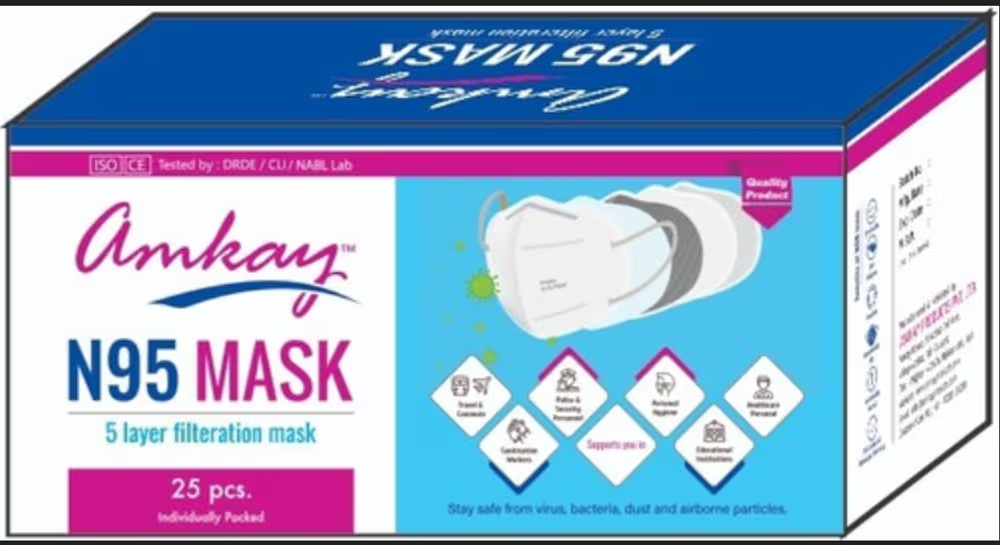
The air quality in Indian metros is often very bad, with the air being full of PM2.5 particles, allergens, and pathogens. If your aim is to be shielded from the air pollution in the urban cities, you cannot just put on any mask, rather you need to find the one which corresponds with higher standards. You need a mask that has undergone all the steps of verification, testing, and confirmation of its reliability. We recommend the Amkay N95 Mask featuring a 5-layer protection and the skin-friendly non-woven fabric. This product is ideal for departments where staff wear masks for 8+ hours.
- Genuine Quality: Look for the N95, NIOSH logo and 2 straps
- Ensure Correct Fit: The mask only works if air passes through the filter, not around the edges
- Perform Seal Check: After putting the mask on, cup your hands over it and exhale sharply. If you feel air escaping near your eyes or cheeks, readjust the straps or nose clip
- Consider Environment/Purpose: Know exactly why you need an N95 Masks – For everyday city pollution, medical scenario or industrial scenario
Why do you need N95 Masks in 2026?
The pollution season in India is no longer seasonal—it’s year-round. No matter if you are commuting, walking your pet, stepping out for groceries, or just sitting in traffic, you are always exposed to it. Such a prolonged exposure to pollutants has been revealed to be connected to:
- Chronic respiratory issues
- Cardiovascular diseases
- Lowered immunity
- Cognitive and developmental disorders in children
- Premature aging and skin damage
Wearing the right mask can cut your exposure risk by more than 99%. Get N95 Masks based on your requirements.
FAQs

