

Dentist
Mani Dental Instruments Supplier: A Procurement Guide to Stainless Steel K-Files
Your B2B guide to choosing the right Mani stainless steel K-files. Compare 21mm vs 25mm, ISO sizes, and find a reliable mani dental instruments supplier.


Sourcing endodontic files isn't just about stocking a drawer; it's about ensuring your clinicians have the precise tools for predictable outcomes, case after case. When you're managing inventory for a busy practice, finding a reliable mani dental instruments supplier is paramount. Mani is a staple in Indian endodontics for a reason: consistent quality and performance.
But with over 24 variants of Mani stainless steel K-files available, choosing the right mix of lengths and sizes can be a logistical challenge. This guide is built for procurement teams. It's a direct, comparison-style breakdown to help you match the right file to your facility's specific clinical demands, ensuring you don't overstock on sizes you don't need or run out of the ones you do.
Your Procurement Checklist: Assessing Your Endodontic Needs
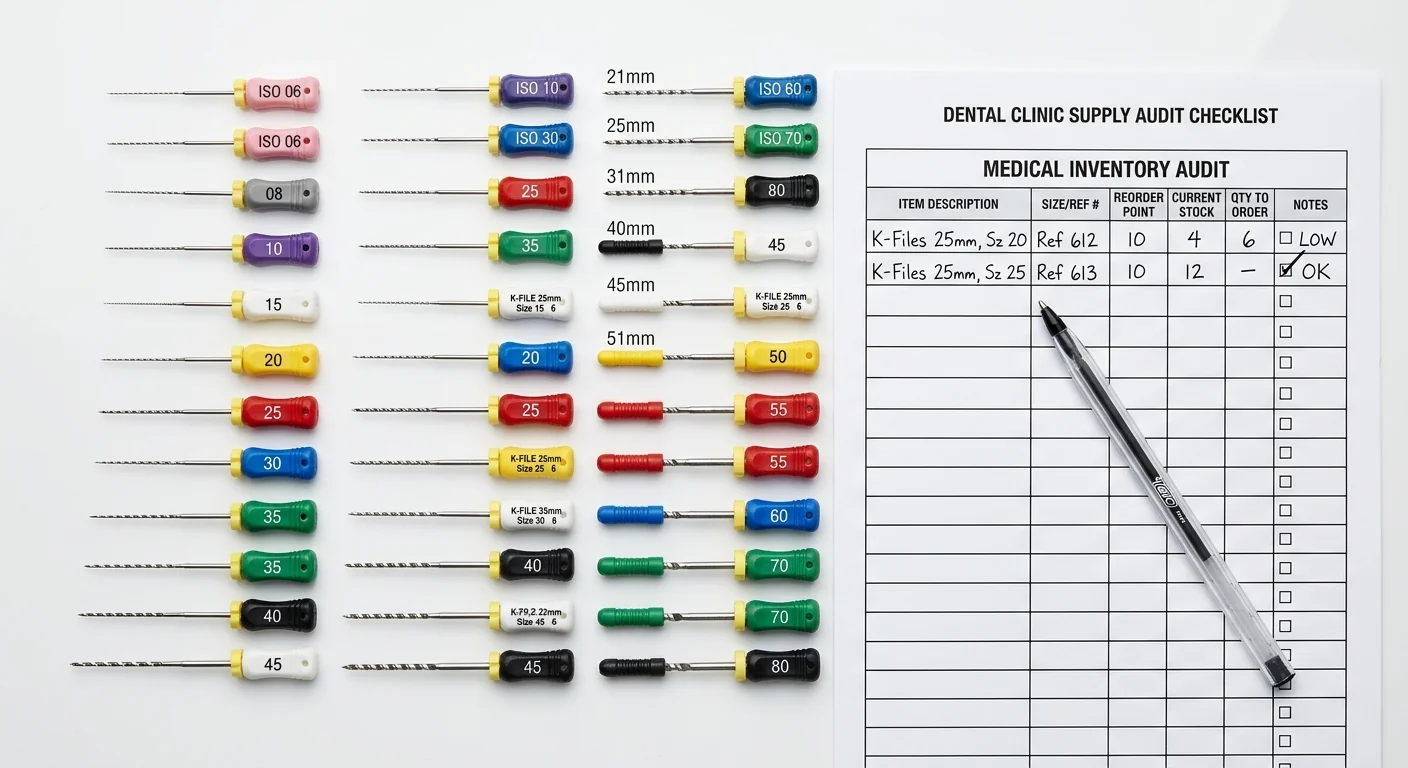 Before you place your next bulk order, run through this quick assessment. Having clear answers here will streamline your purchasing decision.
- Case Volume: How many root canal treatments (RCTs) does your facility perform weekly? Are they primarily single-rooted anterior teeth or multi-rooted molars? High-volume molar work means a higher consumption of smaller-sized, flexible files for negotiation.
- Canal Morphology: Does your practice handle a high number of complex cases, such as calcified canals or significant curvatures? This will influence the need for smaller files (like ISO size 08) and potentially NiTi files alongside your stainless steel inventory.
- Clinician Preference: Survey your endodontists and general dentists. Do they prefer a specific length for anterior vs. posterior teeth? Do they have a standard sequence they follow? Aligning procurement with clinical protocols prevents waste.
- Inventory Management: What is your current reorder point? K-files are small and easily misplaced. A clear system for tracking usage of specific sizes (e.g., 21mm #10 vs. 25mm #15) is critical to avoid stockouts.
- Sterilization Protocol: Are you using single-use pre-sterilized files or do you have a robust system for autoclaving and tracking the number of uses per file to mitigate cyclic fatigue? This impacts your required stock levels and ordering frequency.
Decoding Mani K-File Specifications
Every Mani K-file box has a series of numbers. Here’s what they mean from a procurement standpoint.
- Material: Mani uses a proprietary 18-8 hard-fiber stainless steel. This provides a necessary balance of flexibility for navigating canals and stiffness for effective debridement. It's the workhorse material for establishing a glide path.
- Length (21mm vs. 25mm): This is the most basic filter. The choice is dictated entirely by dental anatomy.
- 21mm: Primarily for anterior teeth (incisors, canines) and some premolars where the working length is shorter. Stocking these is essential for any general practice.
- 25mm: The standard for posterior teeth (molars) which have longer root canals. A higher volume of these is typically required for practices that perform more complex RCTs. Some clinicians also prefer the longer handle for better posterior access.
- ISO Size (e.g., 08, 10, 15): This number indicates the diameter of the file tip in hundredths of a millimeter (e.g., size 10 is 0.10 mm at the tip).
- Sizes 06, 08, 10: These are "pathfinding" files. Their primary job is to negotiate the canal to its full working length, especially if it's narrow, calcified, or curved. You need a reliable stock of these.
- Sizes 15 and up: These files begin the work of shaping the canal after the glide path is established. The consumption of these sizes is typically high and predictable.
- Regulatory Standards: Ensure your supplier provides Mani files that are CE-marked and manufactured in an ISO 13485 certified facility. This is a non-negotiable baseline for patient safety and product traceability.
With this framework, let's compare five of the most frequently ordered Mani K-file variants. The same evaluation criteria can be applied across our entire catalogue of K Files to find the perfect fit for your needs.
Mani Stainless Steel K Files - 21mm 08
This is a specialist's tool that has become a staple in general practice. The Mani Stainless Steel K Files - 21mm 08 is your first line of attack for difficult canals.
- Who It's For: Endodontic specialists, and general practices that regularly treat geriatric patients or complex cases with calcified or constricted canals.
- Key Selling Point: Its extremely fine 0.08mm tip diameter provides the flexibility needed to "find" the canal path without creating ledges or perforations. It's essential for initial negotiation.
- Ideal Use Case: Locating the orifice and negotiating the initial few millimeters of a tight, calcified canal in an anterior tooth or premolar before introducing larger files. If your clinicians are struggling to get to the apex, this is the file they reach for.
Mani Stainless Steel K Files - 21mm 10
The Mani Stainless Steel K Files - 21mm 10 is one of the most-ordered endodontic files for any dental setup. It's the standard for establishing a glide path in most non-molar teeth.
- Who It's For: Every dental clinic, from single-chair practices to large multi-specialty hospitals. This is a core inventory item.
- Key Selling Point: It offers the perfect blend of flexibility to follow canal curvature and stiffness to confirm a smooth, reproducible glide path. The 21mm length is ideal for the working length of most anterior teeth.
- Ideal Use Case: After initial negotiation (sometimes with a #08), the #10 file is used to create a clear, unimpeded path to the apical foramen. When this file moves freely, the canal is ready for shaping. Many clinicians consider this the most important step in an RCT.
Mani Stainless Steel K Files - 25mm 10
This is the posterior equivalent of the file above. For molar endodontics, the Mani Stainless Steel K Files - 25mm 10 is indispensable.
- Who It's For: Any practice performing molar RCTs. Given the longer roots of molars, the 25mm length is required to reach the apex.
- Key Selling Point: The hard-fiber stainless steel construction ensures it resists buckling in the long, often curved, canals of molars. Its reliability is key to preventing instrument separation.
- Ideal Use Case: Creating the glide path in the mesiobuccal, distobuccal, and palatal/lingual canals of maxillary and mandibular molars. This is a high-consumption item in any endo-focused practice.
Mani Stainless Steel K Files - 21mm 15
Once the glide path is secure, shaping begins. The Mani Stainless Steel K Files - 21mm 15 is the first step in that process for anterior teeth.
- Who It's For: All dental practices. This is the next logical file in the standard instrumentation sequence after the #10.
- Key Selling Point: As a #15 file, it begins to actively shape and debride the canal walls, removing tissue and creating the initial funnel shape needed for effective irrigation and obturation.
- Ideal Use Case: Used immediately after the #10 file is "loose" in the canal of an incisor, canine, or premolar. It enlarges the glide path, preparing it for sequentially larger files or rotary instrumentation.
Mani Stainless Steel K Files - 25mm 15
Completing the core set, the Mani Stainless Steel K Files - 25mm 15 is the workhorse for initial shaping in molars.
- Who It's For: Clinics and hospitals performing molar endodontics. Its consumption rate is as high as the 25mm #10 file.
- Key Selling Point: The 25mm length provides access to the full working length of molar canals, while the #15 size offers enough substance to begin shaping without being overly aggressive, which reduces the risk of transportation or ledging.
- Ideal Use Case: The primary file for initial canal enlargement in molars after the glide path has been established with a #10 file. It sets the stage for the rest of the shaping sequence.
At-a-Glance Comparison: Core Mani K-Files
This table summarizes the operational differences for your procurement planning.
| Products | Length (mm) | ISO Size | Primary Application | Best For Facility Type |
| K Files - 21mm 08 | 21 | 08 | Initial negotiation, calcified canals | Endodontic specialty; high-volume general |
| K Files - 21mm 10 | 21 | 10 | Glide path creation (anterior) | All dental clinics |
| K Files - 25mm 10 | 25 | 10 | Glide path creation (posterior) | All clinics performing molar RCTs |
| K Files - 21mm 15 | 21 | 15 | Initial shaping (anterior) | All dental clinics |
| K Files - 25mm 15 | 25 | 15 | Initial shaping (posterior) | All clinics performing molar RCTs |
Common Pitfalls in K-File Procurement
- Focusing Solely on Unit Price: Cheaper, non-verified files have a higher rate of manufacturing defects, leading to instrument separation. The cost of a retrieval procedure far outweighs the savings on a box of files.
- Ignoring the "Tails": It's easy to stock up on #15-40 files, but a stockout of #08 or #10 files can bring your entire endodontic schedule to a halt. Monitor the usage of these pathfinding files closely.
- Sourcing from Unverified Channels: The risk of counterfeit products is real. A fake file will not have the same metallurgical properties, leading to poor performance and increased patient risk. Always source from an authorized B2B platform.
- One-Size-Fits-All Ordering: Don't assume the needs of your general dentistry wing are the same as your endodontic department. Analyse consumption data separately to optimize inventory for both.
Why Procure Mani K-Files from MedikaBazaar?
As a procurement manager, your choice of supplier is as critical as your choice of product. Partnering with MedikaBazaar simplifies the entire process.
- Guaranteed Authenticity: We source directly from Mani or their authorized distributors. You receive genuine, traceable products every time.
- Competitive Bulk Pricing: Our platform is designed for B2B procurement. Get transparent, competitive pricing for mani endo files wholesale orders, complete with proper GST invoicing.
- PAN-India Logistics: Whether your clinic is in a metro or a Tier-3 city, our supply chain ensures timely, reliable delivery, minimizing the risk of stockouts.
- Consolidated Procurement: Stop managing multiple vendors. Source your Mani K-files along with every other consumable, device, and piece of equipment your facility needs from a single, unified platform.
FAQs

