

Dentist
Evaluating mb+ AlgiMax Dental Alginate for High-Volume Clinical Use
A peer-to-peer guide for procurement managers on selecting the right bulk dental alginate supplier, focusing on clinical specs, operational efficiency, and standards.


In any busy dental practice, diagnostic lab, or hospital department, alginate is a foundational material. It’s the workhorse for preliminary impressions, study models, and fabricating orthodontic appliances. The challenge for any procurement head or senior clinician isn’t just finding an alginate, but establishing a reliable supply chain. Sourcing from a dependable bulk dental alginate supplier ensures consistency, which directly impacts chairside efficiency, lab accuracy, and ultimately, patient outcomes.
This is not about the cheapest bag of powder. It’s about specifying a material that performs predictably, mix after mix, day after day. A poor-quality or inconsistent alginate leads to retakes, wasted chair time, and frustration for both the clinical team and the patient. This resource outlines the critical factors to consider when evaluating and standardizing an alginate impression material for institutional use.
Understanding Alginate Impression Material: Beyond the Basics
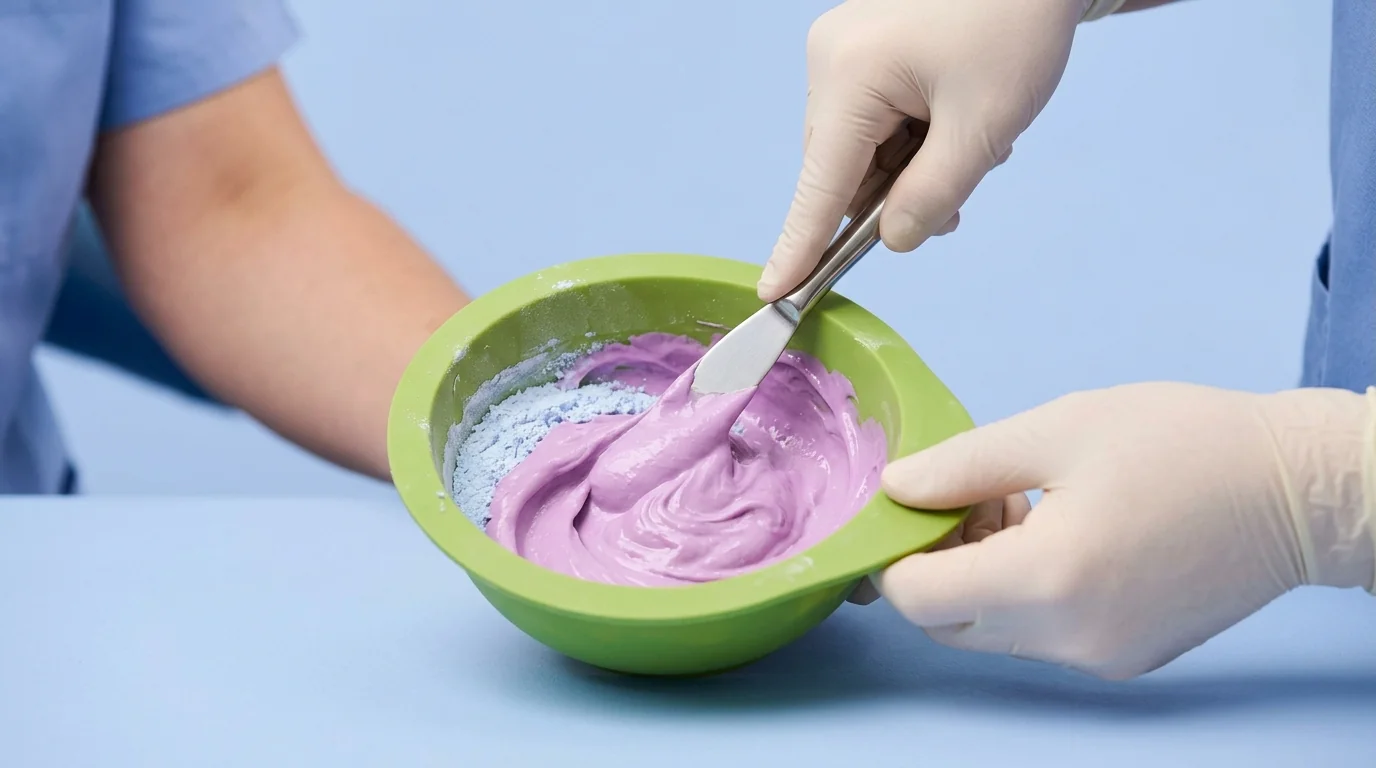 Alginate is an irreversible hydrocolloid derived from brown algae. Its primary function is to create a negative replica of the teeth and surrounding oral tissues. The setting reaction is a chemical process where soluble potassium or sodium alginate reacts with calcium sulfate to form an insoluble calcium alginate gel.
The performance of any given alginate powder is determined by the precise formulation and ratio of its key components:
- Potassium/Sodium Alginate: The reactive base ingredient.
- Calcium Sulfate Dihydrate: The reactor that creates the gel structure.
- Diatomaceous Earth: A filler that increases strength, stiffness, and provides a smooth texture. The particle size and amount dictate the final handling properties.
- Trisodium Phosphate: A retarder that controls the working time. It reacts with the calcium sulfate first, delaying the primary setting reaction and giving the clinician adequate time to mix and seat the tray.
- Indicators & Modifiers: Many modern alginates include pH indicators that change colour to signal different clinical phases (e.g., end of mixing, end of setting time), as well as flavouring agents for patient comfort.
It is this carefully balanced formulation that distinguishes a high-performance clinical material from a generic powder.
Key Evaluation Criteria for Bulk Sourcing
When you order AlgiMax alginate for dental clinics or any other bulk material, the assessment should go beyond the data sheet. It involves a holistic look at both clinical and operational characteristics.
Clinical Performance Characteristics
These factors directly influence the quality of the final impression and the chairside experience.
- Setting Time: Alginates are typically classified as either regular-set or fast-set.
- Fast-Set: Ideal for patients with a strong gag reflex, pediatric dentistry, or simple impressions where speed is paramount. Typical in-mouth setting time is 1-2 minutes.
- Regular-Set: Provides a longer working time (2-3 minutes) which is advantageous for full-arch impressions, cases with complex anatomy, or for less experienced operators.
- Flow and Consistency (Thixotropy): A quality alginate exhibits thixotropic properties. This means it flows well under pressure to capture fine detail but is viscous enough to remain in an inverted maxillary tray without slumping. A non-thixotropic, runny mix is a common cause of poor impressions and patient discomfort.
- Detail Reproduction: The material must be capable of capturing fine surface detail. The international standard, ISO 21563, specifies that a dental alginate must reproduce a line of at least 50µm. High-quality materials often exceed this, capturing details as fine as 25µm.
- Elastic Recovery: This is a measure of the material's ability to spring back to its original shape after being deformed during removal from the mouth, especially around undercuts. A high elastic recovery rate (typically >95%) is critical for accuracy.
- Tear Strength: The material must resist tearing in thin sections, such as the interproximal areas or along the gingival margin. Poor tear strength leads to an incomplete or inaccurate impression.
Operational and Logistical Factors
These are crucial for a procurement manager ensuring smooth clinic operations.
- Dust-Free Formulation: This is a non-negotiable workplace safety feature. Dust-free powders are treated to minimise airborne silicate particles during dispensing and mixing, protecting the respiratory health of clinical staff.
- Consistency Across Batches: The core advantage of partnering with a reliable supplier. The setting time, viscosity, and colour-changing properties must be identical from one 454g bag to the next. Batch-to-batch variability disrupts clinical protocols and introduces uncertainty.
- Packaging and Shelf Life: For bulk stocking, moisture-proof packaging is essential. Alginate is highly susceptible to moisture degradation. Look for heavy-duty, resealable bags with a clearly marked expiration date. For instance, a product like the mb+ AlgiMax Dental Alginate - 454g comes in packaging designed to maintain material integrity in a clinical stockroom. A shelf life of at least two years is standard.
Alginate vs. Putty Impression Material: A Clinical Decision Matrix
It's vital to use the right material for the right application. While both are impression materials, alginate dental materials and PVS (polyvinyl siloxane) putty serve different clinical purposes. Using alginate where PVS is indicated (or vice-versa) will compromise the final restoration.
The following table clarifies the distinct roles of alginate and PVS putty impression material.
| Feature | Alginate Impression Material | PVS Putty Impression Material |
| Primary Use Case | Diagnostic models, study casts, temporary crowns, orthodontic records, opposing arch impressions. | Final impressions for crowns, bridges, inlays, onlays, and implants. |
| Dimensional Stability | Fair. Must be poured immediately (within 15 mins) due to water loss/gain. | Excellent. Stable for days and can be re-poured multiple times. |
| Detail Reproduction | Good (captures sufficient detail for preliminary work). | Excellent (captures fine subgingival margins required for fixed prosthodontics). |
| Elastic Recovery | Good. Sufficient for most cases. | Excellent. Superior for cases with deep undercuts. |
| Technique Sensitivity | Low. Relatively forgiving mixing and handling process. | Moderate. Requires precise mixing of base and catalyst, proper tray adhesive, and moisture control. |
| Material Nature | Irreversible Hydrocolloid (water-based). | Addition Silicone (elastomeric polymer). |
Best Practices for Handling and Storage in a Clinical Setting
Even the best material will fail if handled incorrectly. Standardising these procedures across your team is key to achieving consistent results.
- Preparation: Before measuring, "fluff" the alginate powder by inverting the sealed bag or container a few times. This de-compresses the powder for a more accurate scoop.
- Water-to-Powder Ratio: Adhere strictly to the manufacturer's specified ratio. Use the provided measuring scoop for powder and a graduated cylinder for water. Deviating from this ratio will alter setting times and compromise physical properties.
- Water Temperature: This is the primary user-controlled variable for setting time. Use cool or room-temperature water (18-24°C) for the manufacturer-stated working time. Warmer water will accelerate the set; colder water will slow it down. Consistency is key.
- Mixing (Spatulation): Use a clean, flexible rubber bowl and a rigid spatula. Add the powder to the water. Mix vigorously using a stropping motion against the side of the bowl for the time specified (typically 45-60 seconds) to create a smooth, creamy, and bubble-free consistency.
- Disinfection Protocol: Impressions must be disinfected immediately after removal from the mouth.
- Gently rinse under cool, running water to remove saliva and debris.
- Spray with or immerse in a suitable disinfectant (e.g., 1% sodium hypochlorite, 2% glutaraldehyde) according to the disinfectant manufacturer's instructions (usually 1-10 minutes).
- Rinse thoroughly again to remove the disinfectant.
- Pouring the Model: This is time-critical. The impression must be poured with dental stone within 15 minutes of being taken. Any delay will lead to dimensional distortion from syneresis (water loss) or imbibition (water absorption). If a short delay is unavoidable, store the impression in a sealed plastic bag with 100% humidity.
Equip Your Facility Today
Ensuring your clinic is equipped with a consistent and high-performing alginate impression material is fundamental to prosthetic and orthodontic workflows. By evaluating materials based on clinical performance, operational needs, and adherence to standards, you can secure a supply that supports both efficiency and patient outcomes. Explore the range of professional dental materials on MedikaBazaar to find the specifications that match your facility's requirements.
FAQs

