

Home
Dental
Elastomeric Impression Materials
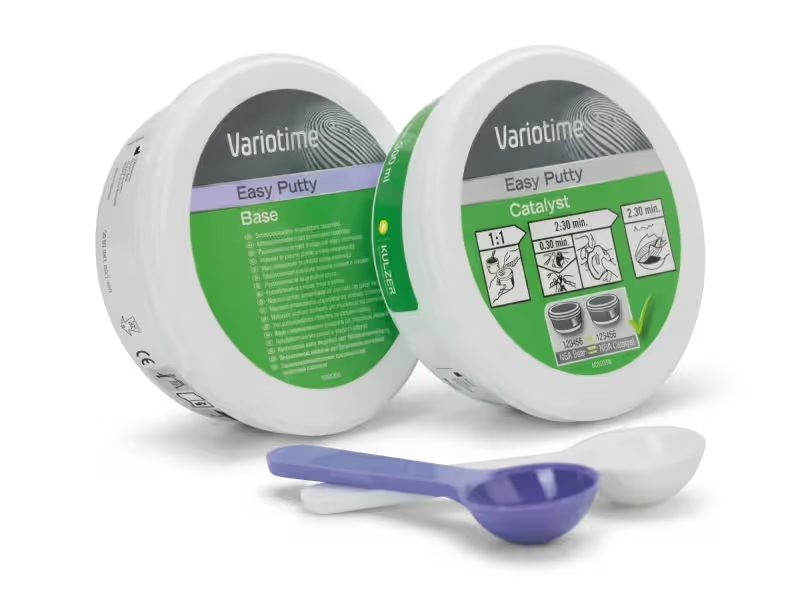
Kulzer Variotime A-Silicone Kit Elastomeric Impression Material
Your Advantages
Kulzer Variotime A-Silicone Kit Elastomeric Impression Material - One Easy Putty 600ml + 2 Light Flow Cartridges 50ml
5/5
(32 reviews)
₹3,891.64
Inclusive of 18% GST
Pack Type
Variant unavailable, Please select another variant
Brand: Kulzer
Country of Origin: Germany
What's in the Box
1 x 300 ml Base 1 x 300 ml Catalyst 2 x 50 ml Light Flow
Kulzer Variotime is an innovative A-silicone (vinylpolysiloxane) elastomeric impression material engineered for precision dental impressions. It is indicated for a wide range of dental applications, including crown and bridge, implants, and complex prosthetic restorations.
The Variotime system features a variable working time, ranging from 1:00 to 2:30 minutes, which allows for adaptable handling during the impression-taking process. This flexibility is combined with a consistently short intraoral setting time of 2:30 minutes, designed to enhance patient comfort and streamline clinical workflows.
This impression material offers excellent precision and accuracy, exhibiting permanent dimensional stability and low dimensional changes. Variotime also features strong hydrophilic properties, comparable to polyether materials, ensuring optimal performance in the wet sulcus and facilitating detailed reproduction. It is suitable for various impression techniques, including two-step, two-phase, single-step, two-phase, and single-step, one-phase impressions.
Key Features :
Material Type: Addition-cured silicone (A-silicone/VPS)
Indication: Precision dental impressions for crowns, bridges, implants, and complex prosthetic restorations
Working Time: Variable, ranging from 1:00 to 2:30 minutes
Setting Time: Consistent intraoral setting time of 2:30 minutes
Hydrophilicity: Polyether-level hydrophilic properties for optimal performance in the wet sulcus
Compatible Impression Techniques: Supports two-step, two-phase, single-step, two-phase, and single-step, one-phase impression techniques

